Can Shield Laws Protect Journalists Reporting on Reproductive Health?
Analysis reveals 8 key thematic connections.
Key Findings
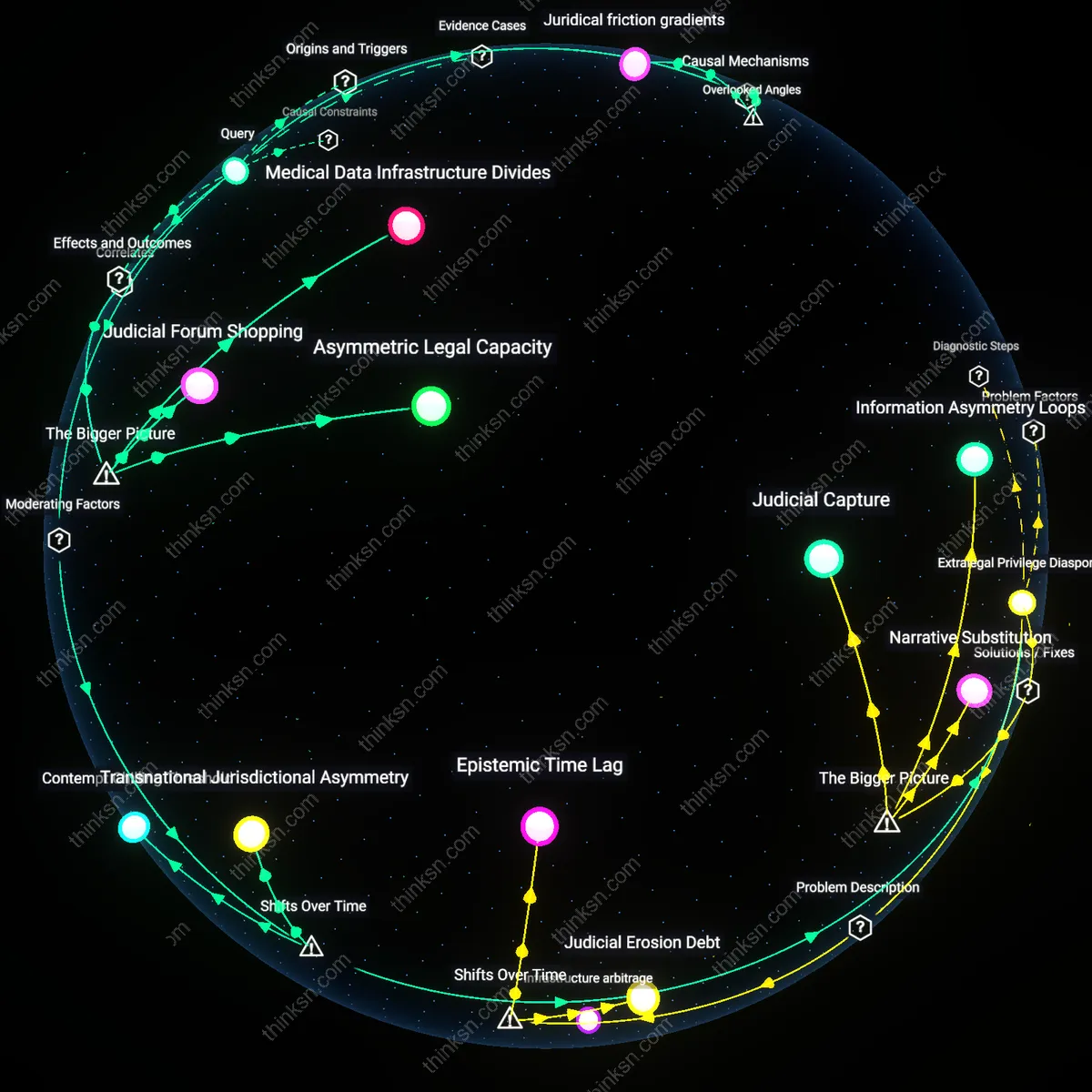
Juridical friction gradients
Cross-border shield laws enable journalists to store reproductive health source materials in jurisdictions with stronger press protections, making federal subpoena enforcement logistically constrained by conflicting state sovereignty norms. This works through federal courts’ hesitancy to override state-level evidentiary privileges when data resides outside the issuing district, particularly in states like California or Oregon where shield statutes explicitly cover digital journalistic records. The overlooked dynamic is that legal jurisdictional mismatches—often dismissed as procedural noise—actually create operational sanctuaries for sensitive data, altering the risk calculus for investigative reporting on abortion access. Most analyses focus on content legality, not the procedural drag of inter-jurisdictional enforcement.
Adversarial comity networks
Cross-border shield laws foster informal cooperation between foreign press entities and U.S. journalists by enabling the redaction and transfer of reproductive health documentation through third countries with reciprocity in media protections, such as Canada or Mexico, where U.S. subpoenas lack immediate reach. This depends on under-documented coordination between border-region news bureaus and transnational legal liaisons who exploit gaps in mutual legal assistance treaties. The overlooked reality is that these networks operate not as escapes, but as structured bypass corridors—where the jurisdictional pluralism of North American legal systems becomes a tactical substrate, rather than a barrier, for reporting on post-Roe healthcare suppression.
Transnational Jurisdictional Asymmetry
Cross-border shield laws have weakened journalists' ability to avoid contempt when reporting on reproductive health services since the mid-2010s, as legal protections in media-friendly jurisdictions like Canada or the EU do not bind U.S. federal or state courts demanding data held by multinational news organizations. U.S. subpoena powers, particularly under the Stored Communications Act, have increasingly targeted reporting materials stored or routed through domestic servers, even when journalists operate from countries with robust shield laws, creating a material vulnerability rooted in data territoriality rather than press freedom statutes. This shift—driven by the post-Snowden expansion of extraterritorial surveillance norms—reveals how digital infrastructure now overrides legal domicile in determining journalistic exposure, an asymmetry underappreciated in press freedom advocacy focused solely on legislative shields.
Contempt Chilling Threshold
Journalists' capacity to report on abortion access diminished after the 2022 Dobbs decision, not because shield laws changed, but because state-level prosecutors in restrictive U.S. states began weaponizing contempt powers against out-of-state reporters citing non-compliance with subpoenas as grounds for financial penalties or travel bans. Prior to Dobbs, such penalties were rare and geographically contained; afterward, they became a coordinated deterrent, especially in Southern and Midwest states, where grand jury investigations were used to compel disclosure of sources related to telehealth abortion referrals or cross-border clinic networks. This escalation represents a temporal pivot from passive non-cooperation to active legal retaliation, exposing a threshold at which contempt shifts from procedural tool to instrument of press suppression—a phenomenon that only emerged when domestic legal fragmentation intersected with transnational reporting flows.
Extralegal Privilege Diaspora
Since the early 2020s, journalists have increasingly circumvented subpoena risks in reproductive health reporting by relocating to, or aligning with, news entities in nations without formal shield laws but where de facto non-enforcement of foreign legal demands—such as in Mexico or certain Balkan states—creates safe havens for investigative archives. Unlike prior reliance on legal privilege, this strategy depends on weak inter-state judicial cooperation and understaffed legal enforcement systems, turning jurisdictional inefficiency into a protective resource. This shift from law-based to dysfunction-based safety—accelerated by the offshoring of data and byline domicile—reveals an unacknowledged dependency on state incapacity, where the collapse of legal harmonization paradoxically enables press autonomy, inverting earlier assumptions that stronger cross-border legal coordination would benefit journalism.
Judicial Forum Shopping
Cross-border shield laws enable journalists in restrictive states to store sensitive reproductive health reporting in jurisdictions with stronger legal protections, which reduces the likelihood of successful subpoenas by encouraging courts to defer to out-of-state legal venues where materials are held. This dynamic is driven by discrepancies in state-level shield law strength—such as between New York and Texas—and exploits the U.S. federalist structure where jurisdictional boundaries complicate enforcement of subpoenas across state lines. The practice is non-obvious because it shifts legal risk from content creation to data custody, turning geography into a strategic asset in press freedom.
Medical Data Infrastructure Divides
Journalists’ ability to report on reproductive health services without legal penalty correlates with access to cross-border digital health platforms—such as Canadian telehealth providers or Mexican abortion pill distributors—whose data flows bypass U.S. state surveillance systems, making evidence harder to subpoena. This occurs because fragmented regional regulatory regimes create 'data shadows' where health information is generated and stored beyond the reach of hostile state actors. The underappreciated consequence is that reporting capacity now depends not only on journalistic intent but on integration with foreign clinical infrastructures.
Asymmetric Legal Capacity
Cross-border shield laws disproportionately protect reporters affiliated with national or international media organizations—like ProPublica or BBC—because they can legally anchor operations in countries with robust press protections, while local journalists in abortion-restrictive states remain vulnerable due to lack of institutional mobility and legal resources. This imbalance is sustained by systemic disparities in legal infrastructure access, where networked media entities can exploit jurisdictional arbitrage whereas independent journalists cannot. The significance lies in how transnational legal tools deepen structural inequities within the press itself.