Selective Enforcement and Justifying Civil Disobedience?
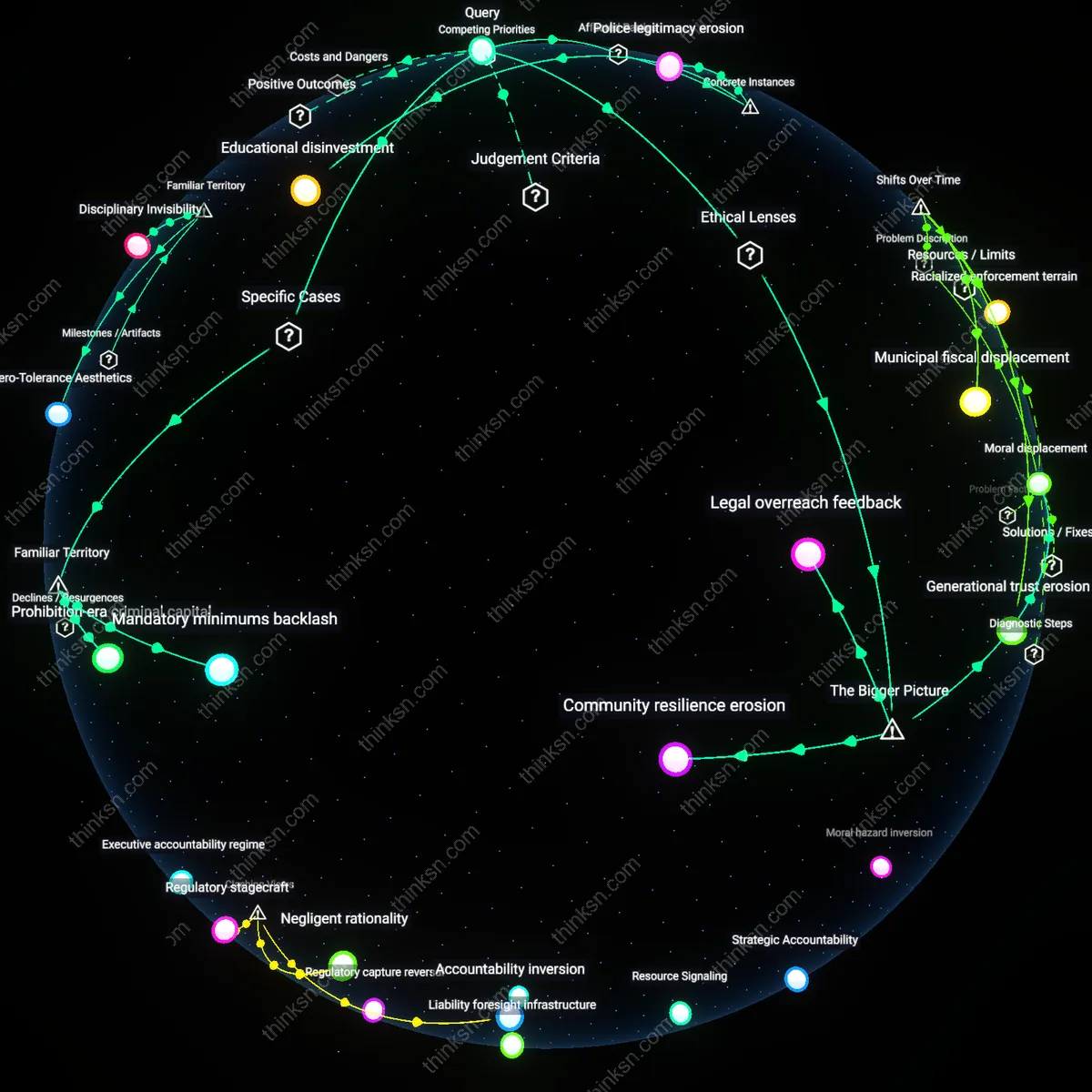
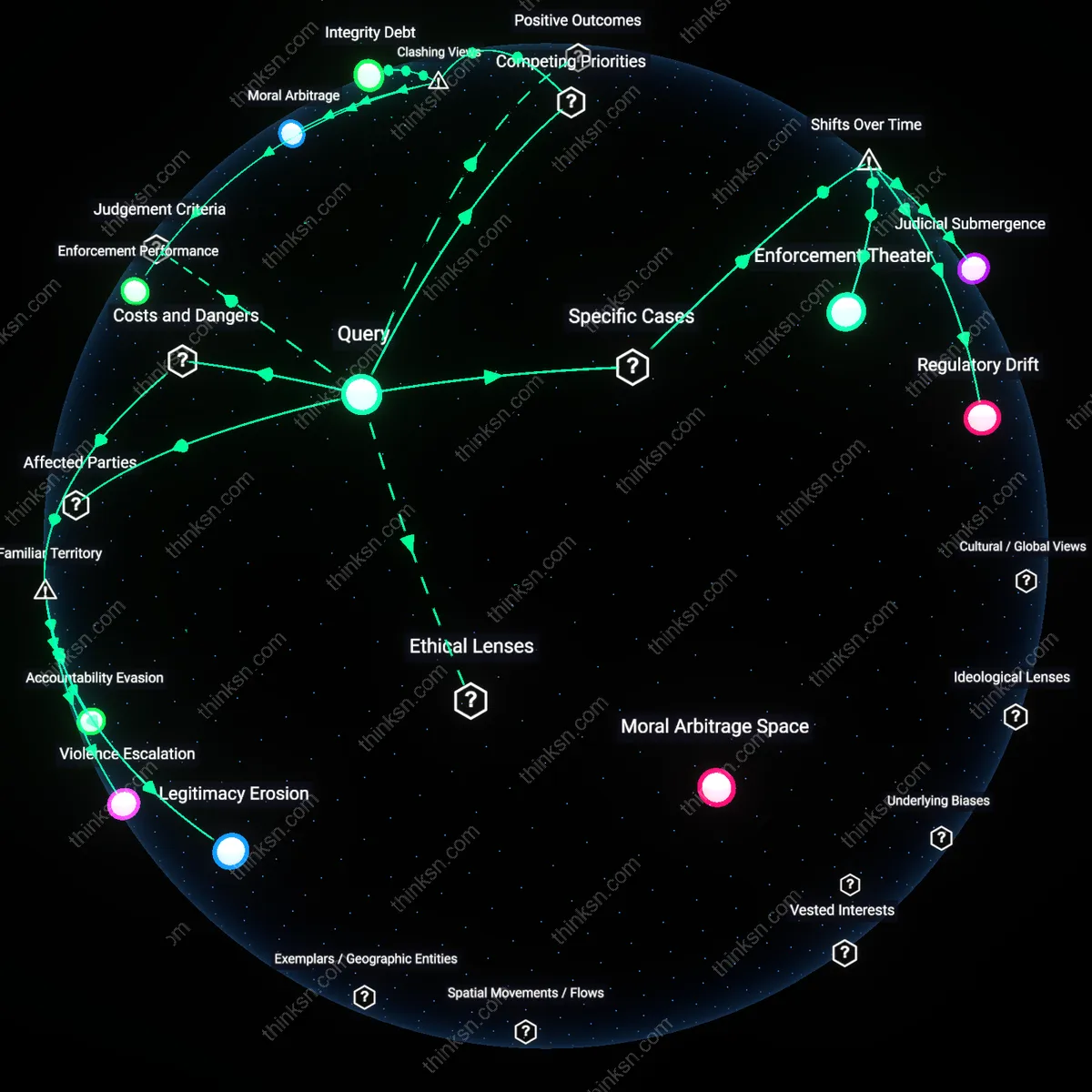
Analysis reveals 12 key thematic connections.
Key Findings
Enforcement Feedback Loop
Yes, because marginalized communities experiencing selective enforcement are structurally incentivized to mobilize civil disobedience as a corrective signal, which in turn pressures oversight institutions to recalibrate enforcement priorities through public accountability channels. When elites manipulate prosecutorial discretion or regulatory enforcement to shield favored actors—such as corporate entities in environmental or labor law—aggrieved populations, particularly low-income or racialized groups bearing disproportionate harm, resort to visible law-breaking to expose systemic bias; this activates media scrutiny and judicial attention, creating a feedback mechanism that can reroute institutional enforcement capacity. What is non-obvious is that civil disobedience does not just challenge authority but functions as an epistemic intervention—revealing otherwise opaque enforcement distortions within systems like the U.S. Environmental Protection Agency’s regional enforcement offices, where political patronage often determines inspection rates.
Elite Accountability Deficit
Yes, because when judicial and legislative bodies fail to investigate or sanction elite abuse of enforcement discretion, civil disobedience emerges as a de facto institutional check, redistributing political salience to otherwise deprioritized violations. In contexts like municipal policing or financial regulation—such as the U.S. Department of Justice’s deferred prosecution agreements with major banks—repeated non-enforcement for well-connected actors erodes legal legitimacy, prompting civic actors to bypass formal channels and generate crisis visibility through deliberate law-breaking. This shift occurs not out of disdain for law but as a systemic adaptation to institutional capture, where courts and inspectors general are underfunded or staffed by politically affiliated appointees unable or unwilling to investigate powerful networks.
Moral Arbitrage Space
Yes, because civil disobedience exploits a moral arbitrage space created when elites selectively enforce rules to maintain a façade of legal order while privately exempting themselves, thereby inviting public actors to reclaim normative legitimacy through symbolic defiance. In settings like zoning violations among political donors or tax evasion among offshore beneficiaries, the state’s failure to enforce widely known breaches undermines its moral monopoly on coercion, enabling activists—such as climate blockaders or housing rights squatters—to position themselves as upholding the rule of law more faithfully than the state. The non-obvious insight is that the permissibility of disobedience arises not from lawlessness but from surplus legality, where selective enforcement generates a surplus of unenforced obligations that civic actors can selectively activate to reanchor legal norms.
Legitimacy Erosion
Yes, evidence of elite capture justifying civil disobedience risks normalizing lawlessness because when citizens take enforcement into their own hands, even with moral intent, they undermine the perceived universality of legal authority; this occurs through public acts—like traffic blockades or property defacement—that, despite targeting selective enforcement, are interpreted by broader populations as disregard for rule-bound order, especially when amplified by media narratives linking protest to chaos; what's underappreciated in familiar discourse is that legitimacy isn't solely tied to fairness but to predictability—people accept imperfect systems if they appear consistent, and civil disobedience disrupts that baseline expectation.
Violence Escalation
Yes, such civil disobedience risks triggering disproportionate state retaliation because visible challenges to enforcement—especially those invoking moral superiority over law—provoke security institutions to reassert control through force, as seen in responses to environmental or racial justice protests where initial nonviolence gives way to confrontational policing; this dynamic operates through institutional self-preservation, where police and political elites frame disobedience as existential threats rather than corrective feedback; the non-obvious aspect, despite widespread awareness of police brutality, is how even disciplined civil actions can catalyze violence not through immediate provocation but through institutional scripts that equate disruption with rebellion.
Accountability Evasion
Yes, civil disobedience in response to elite capture often enables authorities to deflect scrutiny by recasting systemic failures as individual lawbreaking, allowing politicians and agencies to portray protesters—not the institutions they critique—as the destabilizing force; this operates through media and judicial systems that focus on visible violations (e.g., trespassing, obstruction) while deprioritizing investigations into covert manipulation like regulatory lobbying or prosecutorial discretion; what goes unnoticed in mainstream discussion is that civil disobedience, despite aiming to spotlight injustice, frequently shifts public debate from structural corruption to personal responsibility, reinforcing the very opacity it seeks to dismantle.
Enforcement Performance
Civil disobedience undermines institutional legitimacy and thereby reduces compliance across the board, making elite capture worse by weakening the very systems that could correct selective enforcement through procedural accountability. When activists disrupt traffic, occupy public spaces, or break minor laws to protest enforcement bias, they inadvertently signal that law itself is negotiable, which emboldens powerful actors to further manipulate rules in their favor under the guise of restoring order—this dynamic is observable in cities like Rio de Janeiro, where anti-corruption protests eroded trust in judicial institutions and preceded intensified police violence in favelas under broadened 'security' mandates. The non-obvious consequence is that demands for equitable enforcement, when met with lawbreaking, trigger a systemic shift toward control over fairness, elevating enforcement performance as the dominant operational metric at the expense of distributive justice.
Moral Arbitrage
Civil disobedience does not correct elite capture but instead becomes a theater for middle-class moral signaling that displaces material risk onto marginalized populations who bear the brunt of state retaliation, revealing that the practice functions less as resistance and more as ethical substitution within hierarchies of political risk. In the United States, white environmental activists engaging in pipeline blockades often receive media acclaim and lighter legal consequences, while Indigenous land defenders face criminalization, demonstrating how selective enforcement persists even within dissent—this creates a moral economy where privilege leverages disobedience for reputational gain without altering power structures. The clashing view is that civil disobedience, rather than restoring enforcement integrity, becomes a mechanism of moral arbitrage, allowing dominant groups to profit ethically from resistance while subordinates absorb its costs.
Integrity Debt
Appeals to civil disobedience as a corrective for selective enforcement ignore how legal transgression accumulates integrity debt within institutional cultures, where each tolerated exception erodes normative constraints on state power and enables future elite manipulation under emergency or reformist pretexts. For example, India’s 2012 Nirbhaya protests successfully mobilized national outrage over gender-based violence but led to fast-track courts and expanded police powers that were later repurposed for political arrests and surveillance of dissenters, showing that ruptures in legal order—no matter how justified—are structurally fungible to authoritarian drift. The underappreciated reality is that restoring enforcement integrity cannot be achieved through lawbreaking, because the resulting institutional compromises embed long-term vulnerabilities that elites eventually exploit, treating momentary moral clarity as convertible currency for systemic corruption.
Judicial Submergence
Elite capture of appellate judicial appointments in the United States after the 1980s enabled selective non-enforcement of campaign finance and anti-corruption laws, transforming courts from oversight bodies into institutional legitimators of politically insulated misconduct; this shift—evident in the erosion of Federal Election Commission enforcement power post-*Buckley v. Valeo* and reinforced by the *Citizens United* trajectory—reveals how incremental politicization of judicial confirmation processes converted legal neutrality into a temporally embedded shield for elite legal impunity. The transformation was not immediate but emerged through sustained partisan conditioning of judicial ideology, making the court system’s structural deference to executive and legislative elites a normal, invisible mechanism rather than an exceptional failure. What is non-obvious is that civil disobedience targeting campaign finance laws does not react to overt repression but to the slow procedural erasure of enforcement capacity within supposedly independent institutions.
Regulatory Drift
In post-1990 deregulated utility markets in the United Kingdom, privatized water companies increasingly exploited ambiguous enforcement mandates under Ofwat to delay or avoid environmental compliance, with regulatory penalties systematically set below cost-saving benefits of noncompliance—this enforcement asymmetry grew not through overt corruption but through the gradual integration of industry executives into regulatory advisory panels after the 1997 shift to ‘performance-based regulation’; the consequence was a redefinition of regulatory ‘compliance’ as negotiated compromise rather than legal obligation. This trajectory reveals how civil disobedience by environmental activists post-2015 (e.g., Extinction Rebellion’s targeting of Thames Water discharge sites) responded not to absent rules but to their managed decay under collaborative governance frameworks. The underappreciated shift is that enforcement integrity was not captured outright but was incrementally deflected into risk-assessment bureaucracies where delay and cost-benefit analysis function as institutionalized non-enforcement.
Enforcement Theater
In post-2008 New York City, the erosion of housing code enforcement integrity—despite robust tenant protection laws—was achieved not through law repeal but through the selective prioritization of nuisance abatement actions against low-income tenants while deprioritizing landlord violations, a shift institutionalized after the 2002 Bloomberg-era reorganization of HPD and NYPD coordination under ‘quality-of-life’ policing; this created a visible spectacle of enforcement that punished victims of code violations (e.g., tenants in unsafe buildings cited for minor infractions) while shielding politically connected real estate owners. The turn toward tenant-led civil disobedience after 2014 (e.g., Crown Heights Tenant Union rent strikes) emerged not in reaction to static neglect but to the performative reallocation of enforcement capacity that made selective compliance a public ritual. What is non-obvious is that civil disobedience here aims not to demand new laws but to collapse the symbolic legitimacy of enforcement institutions that maintain credibility through visible action—just not the right kind.