Do Employer Health Plans Really Protect Gig Workers from Catastrophe?
Analysis reveals 6 key thematic connections.
Key Findings
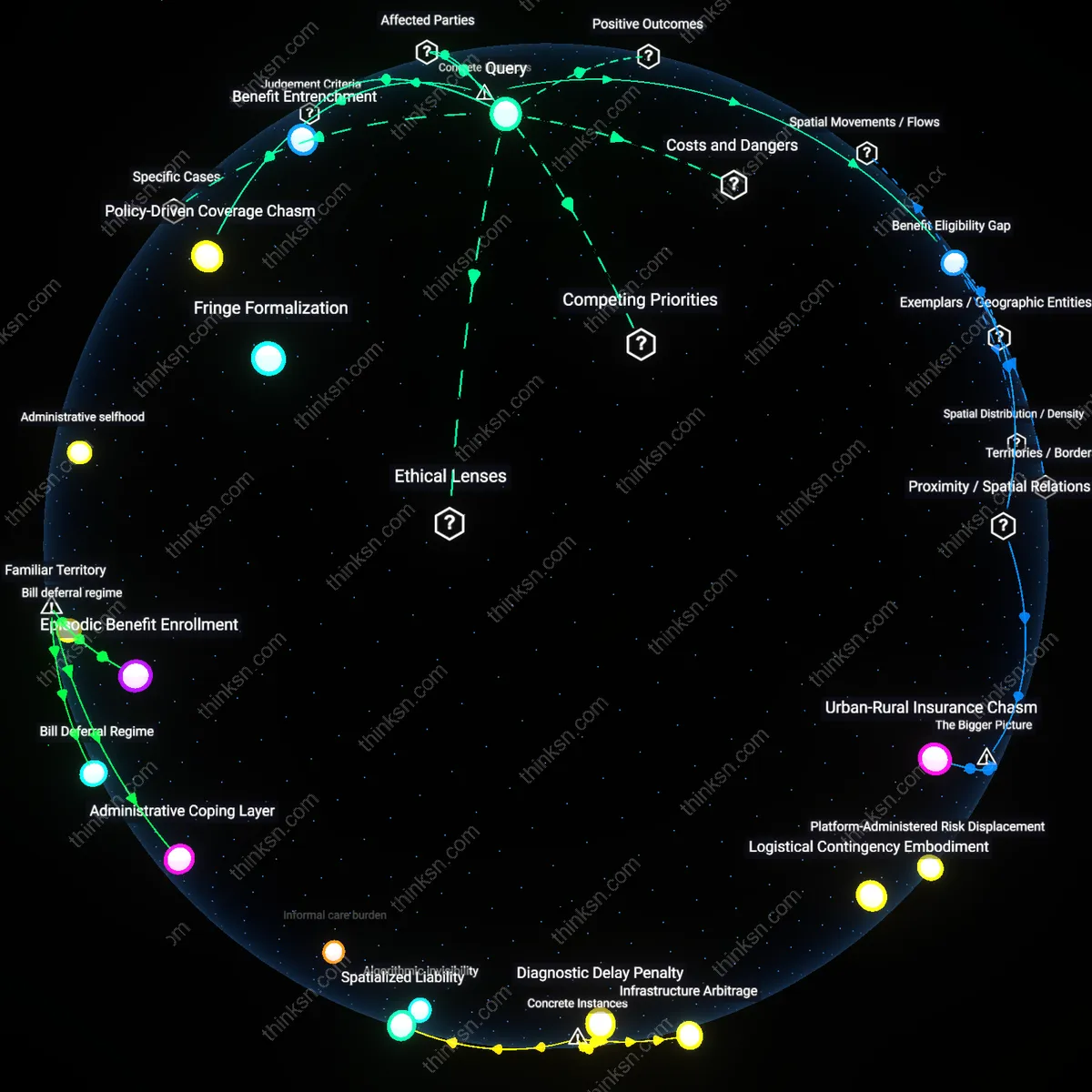
Benefit Eligibility Gap
Employer-sponsored health plans do not protect gig-economy workers because platform companies like Uber and Lyft classify drivers as independent contractors, excluding them from benefit systems—evident in California’s 2020 Proposition 22, which explicitly exempted app-based drivers from employee status and its accompanying protections. This classification severs access to employer-sponsored insurance, leaving drivers exposed to catastrophic costs despite platform-dependent livelihoods, exposing a structural loophole where economic reliance does not trigger benefit entitlement. The non-obvious insight is that legal categorization, not economic reality, determines access, making vulnerability systemic rather than incidental.
Market-Based Risk Transfer
Gig workers in Texas who purchased health coverage through the freelance-focused startup Stride reveal that market-mediated alternatives to employer plans shift financial risk onto individuals—demonstrating that the absence of traditional benefits results in adoption of private, often high-deductible plans that fail to prevent catastrophic outlays. Stride’s model, which aggregates gig workers into pooled purchasing groups, still operates within a high-cost individual market where cost-sharing obligations remain prohibitive during major medical events. This illustrates that even organized collective action cannot replicate the risk absorption of employer-based pooling, exposing how the safety net is restructured as a transactional burden rather than institutional protection.
Policy-Driven Coverage Chasm
Domestic workers in New York City, organized through the Domestic Workers Alliance, secured a 'Health Benefits Bill' in 2022 that mandates clients to contribute to a fund for portable benefits, revealing that gig-like labor without traditional employers requires state intervention to simulate employer-sponsored protection. Unlike platform workers excluded by classification, domestic workers leveraged policy advocacy to create a hybrid public-private funding mechanism for health coverage, demonstrating that protection against catastrophe does not emerge organically but must be legislatively manufactured where employer ties are absent. The underappreciated insight is that the safety net’s reach depends not on labor form but on political recognition of economic vulnerability.
Benefit Entrenchment
Employer-sponsored health plans fail gig workers because the postwar bargain linking employment to insurance excluded nonstandard labor, and this exclusion has hardened into systemic bias as platform work rises. The mid-20th-century expansion of tax-subsidized employer plans rewarded full-time, continuous employment—a model that treated benefits as earned through job stability, not portable entitlements. As gig work expanded after 2010, especially in urban service economies, the infrastructure of risk protection remained tethered to traditional jobs, making catastrophe protection inaccessible precisely to those most exposed to income volatility. This reveals that the yardstick of economic efficiency—maximizing coverage through workplace leverage—has become a tool of inequity when labor structures shift.
Risk Individualization
The belief does not hold because the shift from defined-benefit to high-deductible health plans after the 2000s transferred cost volatility onto individuals, undermining catastrophe protection even for those nominally covered. As employers adopted consumer-driven health plans to curb premiums, gig workers—who lack employer pooling—face full exposure to deductibles and surprise billing, rendering nominal coverage ineffective during crises. The moral yardstick of autonomy, which justified high-deductible plans as promoting 'informed consumerism,' ignores that gig workers lack both financial buffers and pricing power in medical markets. This transition marked a broader move from collective risk-sharing to personal financial resilience, which collapses under acute shocks for non-benefited labor.
Fringe Formalization
Gig workers are structurally disembedded from employer-sponsored plans not by accident but due to deliberate reclassification of roles after the 1990s contractor boom, which redefined 'employee' to exclude benefit eligibility for platform-mediated labor. When federal labor interpretations relaxed in the late 1980s, firms increasingly used 1099 contracts to access flexible labor while avoiding ERISA obligations; this legal shift converted what was once marginal practice into central business logic. The practical yardstick of administrative feasibility—once ensuring manageable benefit enrollment—now legitimizes exclusion by classifying the growing gig workforce as ineligible by design. This trajectory reveals how a temporary workaround became a permanent underclass of risk exposure.