Do Skill Badges Undermine the Value of Traditional Degrees in Hiring?
Analysis reveals 5 key thematic connections.
Key Findings
Credential Legibility
Skill badges fail to replace degrees in hiring algorithms because standardized degrees produce structurally legible signals for automated systems, whereas badges generate fragmented, platform-specific metadata that resist aggregation. Hiring algorithms in firms like IBM or LinkedIn depend on consistent, comparably normalized data points—such as four-year degree attainment from regionally accredited institutions—that map cleanly onto compliance, promotion, and internal mobility pipelines. Badges, even when verified, lack cross-platform ontologies and academic accreditation anchors, making them noise in high-volume screening systems. This exposes the non-obvious reality that algorithmic hiring does not prioritize skill transparency but institutional legibility, privileging data that fit pre-existing bureaucratic taxonomies over granular competence evidence.
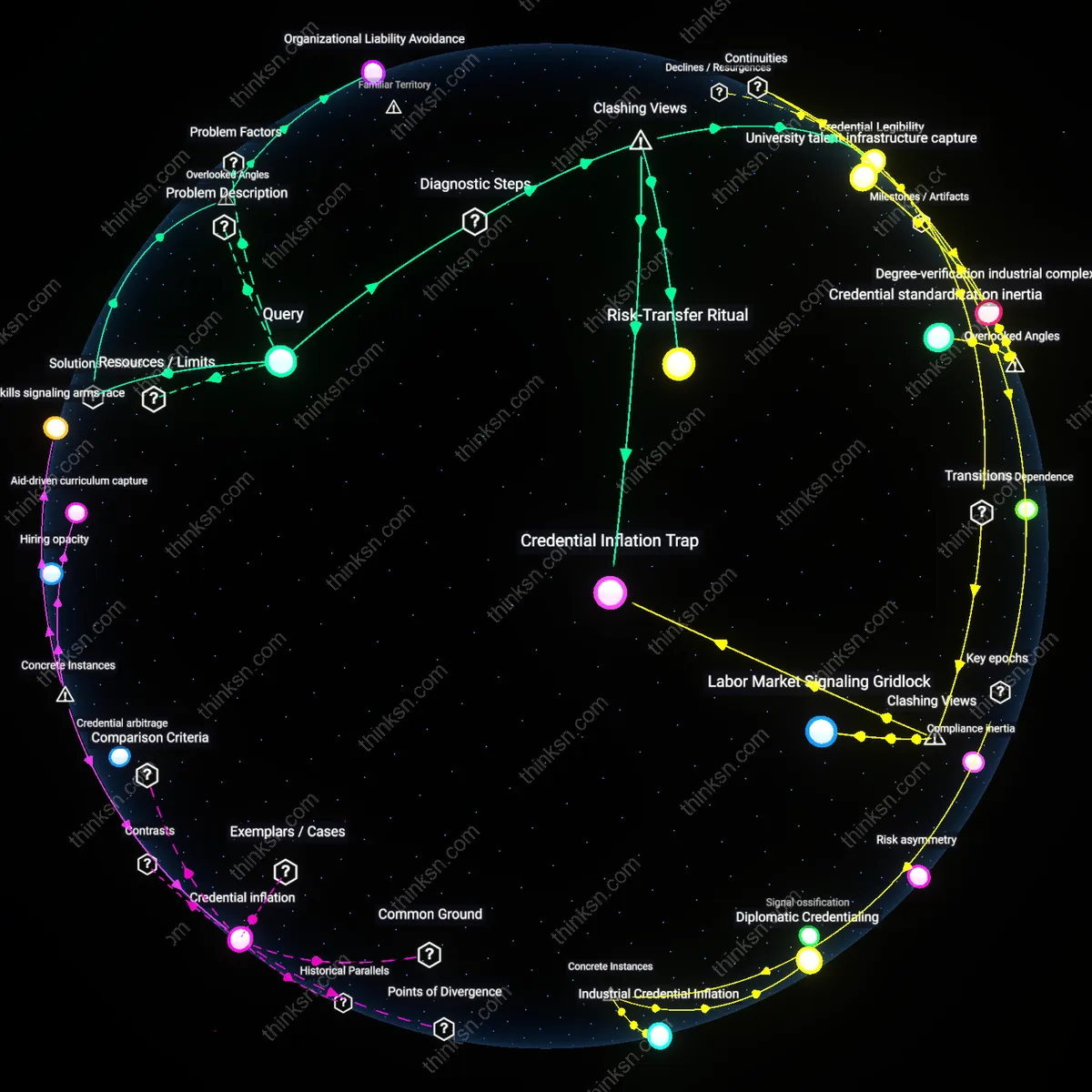
Risk-Transfer Ritual
Traditional degrees persist in hiring algorithms not because they better predict performance, but because they serve as legally defensible proxies that transfer liability away from employers in regulated labor markets. In industries overseen by bodies like the EEOC or OFCCP, using degree requirements insulates companies from claims of discriminatory hiring, as degrees are seen as neutral, meritocratic filters—unlike skill badges, which imply subjective or non-uniform evaluation standards. Even if badges correlate more strongly with job performance, their absence from legal precedent and HR policy frameworks makes them high-risk substitutes. This reveals that hiring algorithms are less optimizing for productivity than for ritualized compliance, preserving degrees as risk-mitigating artifacts in algorithmic decision-making.
Credential Inflation Trap
Hiring algorithms retain traditional degrees because their design is locked into historical labor market hierarchies where degrees function as threshold filters, not skill indicators, and removing them would destabilize nested assumptions about career progression in enterprise systems like SAP SuccessFactors or Workday. HR departments at Fortune 500 companies rely on degree-based branching logic—e.g., assigning managerial tracks only to bachelor’s holders—so replacing degrees with badges would require overhauling downstream processes in compensation, promotion, and reporting structures. The growing visibility of badges on LinkedIn does not alter this because platform-level signaling cannot override embedded institutional logic. This exposes that algorithmic hiring isn’t driven by signal accuracy but by path-dependent infrastructure, where credentialing systems persist not due to efficacy but structural entrenchment.
Hiring Signal Dilution
Skill badges introduce noise into hiring algorithms because their proliferation across platforms with varying issuer credibility—such as a LinkedIn 'Python' badge earned in 10 minutes versus a year-long certified nanodegree—erodes their reliability as consistent signals. Recruiters and algorithmic models depend on predictability in credential value, but badge inflation from low-bar platforms forces risk-averse employers to revert to degrees as a stable baseline. This dynamic is overlooked because most analyses assume badges are fungible, ignoring how platform-specific incentive structures and badge-granting policies create a fragmented signal ecosystem where meaning is unstable. The residual concept emerges from the lack of cross-platform credential calibration.
Organizational Liability Avoidance
HR departments resist replacing degrees with skill badges in hiring algorithms not due to skepticism about skills, but because degrees provide legal defensibility in employment disputes by aligning with established educational standards recognized in labor law. In regulated industries like finance or healthcare, managers using algorithmic tools must justify hiring decisions under compliance scrutiny, and degrees serve as traceable, court-accepted proxies for competence, whereas skill badges lack jurisprudential standing. This legal conservatism, rooted in risk mitigation rather than merit assessment, is rarely accounted for in tech-forward discussions of credential innovation. The residual concept arises from the hidden alignment between academic credentials and institutional liability frameworks.