Is BECCS Cleaner than Electrification? Lifecycle Emissions Debate
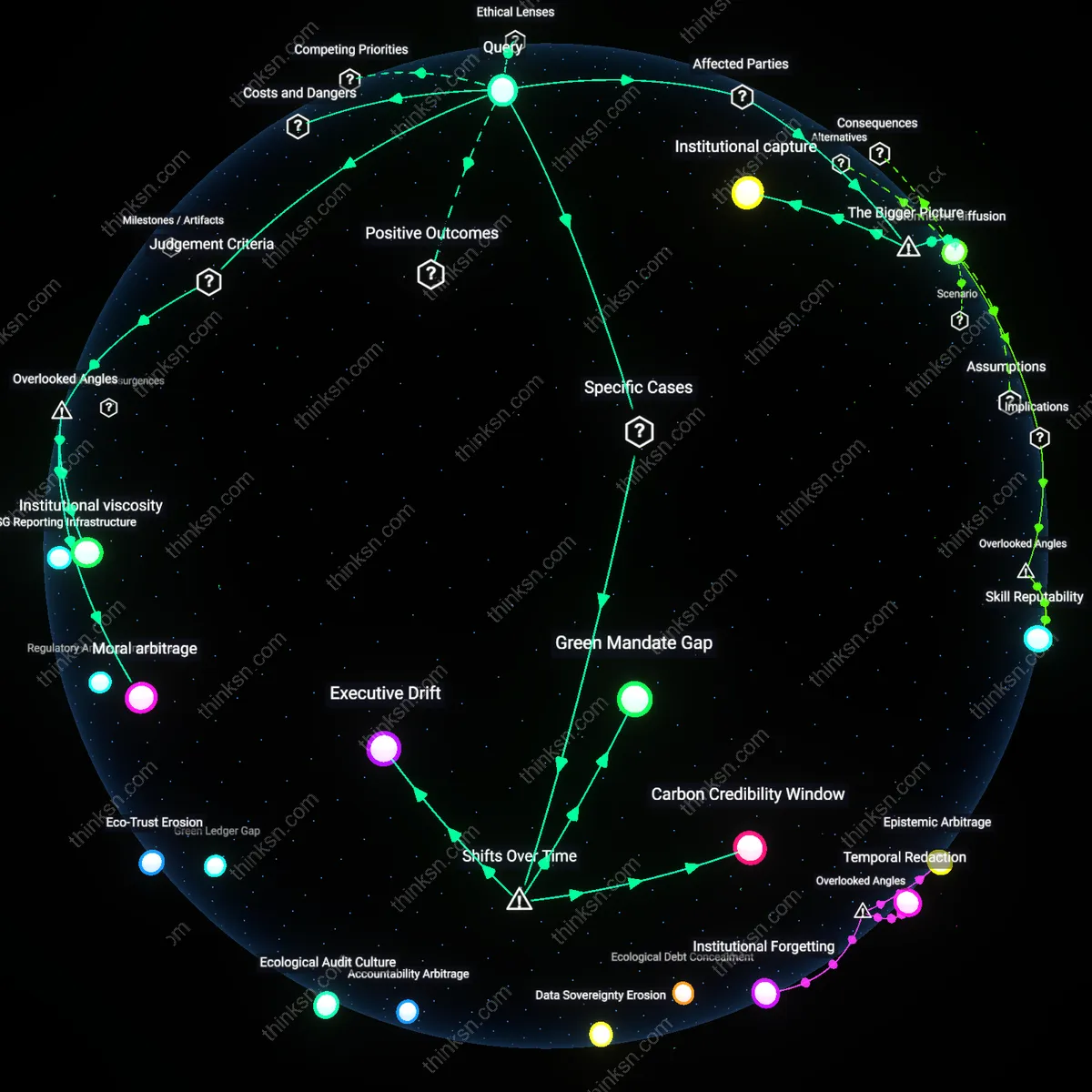
Analysis reveals 10 key thematic connections.
Key Findings
Soil carbon debt
BECCS systems often trigger decades-long carbon deficits in agricultural soils due to intensified biomass harvests, a dynamic overlooked in lifecycle models that assume rapid carbon payback; unlike direct electrification, which leaves soil carbon stocks intact, BECCS can initiate a biogeochemical lag where soil organic matter depletion from repeated cropping offsets aboveground carbon sequestration gains, particularly in temperate zones like the U.S. Midwest where corn-based feedstocks dominate proposed deployments — this delayed payback period, often exceeding 50 years, reframes BECCS not as a clean carbon drawdown tool but as a carbon debt instrument with intergenerational ecological liabilities.
Infrastructure entrenchment
Large-scale BECCS deployment historically reinforces fossil-compatible energy infrastructures by retrofitting coal plants, as seen in the Drax power station conversion in the UK, where carbon capture retrofits functionally extend the operational lifespan and political viability of centralized thermal generation; this creates a lock-in effect that systematically undercuts investment and regulatory momentum for distributed renewable electrification, meaning BECCS’s lifecycle emissions advantage is negated not by its own operations but by its role in delaying systemic decarbonization — a political economy effect absent from technical lifecycle assessments.
Feedstock water footprint
The water intensity of BECCS feedstock cultivation — particularly irrigated biomass like miscanthus or eucalyptus in water-stressed regions such as the Murray-Darling Basin in Australia or the Ogallala Aquifer region in the U.S. — generates indirect emissions through energy-intensive groundwater pumping and aquifer depletion, a feedback loop rarely included in lifecycle analyses; as aquifers lower, pumping requires more energy per unit of water, increasing upstream electricity demand and associated emissions, which can erode or reverse BECCS’s net carbon benefit relative to direct electrification that avoids such hydrological dependencies.
Infrastructure Lock-in
BECCS exhibits lower lifecycle emissions than direct electrification only when existing fossil infrastructure is retained and incrementally adapted, because retrofitting coal plants with biomass carbon capture leverages sunk capital and avoids stranded assets, a dynamic driven by utility companies and regulators prioritizing grid stability and cost recovery over optimal decarbonization pathways; this reveals how legacy energy systems shape the apparent superiority of BECCS by embedding inertia into emissions accounting, rendering infrastructure durability the hidden variable in lifecycle comparisons.
Carbon Valuation Asymmetry
BECCS appears to have lower net lifecycle emissions than direct electrification in policy models because carbon removal is credited at full face value while upstream biogenic emissions and land-use change are systematically underpriced, a gap maintained by international climate accounting rules that treat biomass as carbon neutral upon combustion; this distortion, institutionalized by IPCC guidelines and EU renewable directives, enables governments to meet short-term targets without confronting the full carbon opportunity cost of large-scale biomass sourcing, making regulatory arbitrage the structural reason for BECCS's apparent advantage.
Electrification Timing Delay
BECCS is credited with lower effective lifecycle emissions than direct electrification in near-term scenarios because mass electrification of heat and transport requires synchronized grid decarbonization, demand-side adaptation, and manufacturing scale-up—delays exploited by BECCS to dominate carbon removal portfolios in integrated assessment models; this time-lag advantage, reinforced by slow permitting for renewable deployment and storage infrastructure in countries like the UK and Norway, positions BECCS not as inherently cleaner but as a temporally convenient proxy for delayed systemic transformation, exposing how scheduling bottlenecks elevate transitional technologies.
Carbon accounting fracture
BECCS was presumed to have lower lifecycle emissions than direct electrification only after 2010, when IPCC carbon accounting frameworks began treating biogenic carbon as inherently carbon-neutral, privileging flux over stock changes; this shift allowed BECCS to appear carbon-negative despite rising upstream emissions from biomass cultivation and transport, whereas direct electrification’s emissions remained tied to real-time grid carbon intensity, exposing a methodological divergence in how time-delayed emissions are valued. The fracture emerged as climate models prioritized end-of-pipe carbon removal over the thermodynamic efficiency of energy use, making BECCS appear superior in long-term stabilization scenarios even as its supply chain emissions grew. What is underappreciated is that this presumed advantage is not empirical but a byproduct of when emissions are counted—not whether.
Infrastructural lock-in pivot
The belief that BECCS has lower lifecycle emissions than direct electrification solidified between 2015 and 2020 as energy systems in the EU and U.S. Midwest retrofitted coal plants for biomass co-firing, reframing BECCS as a transitional technology rather than a last-resort option; this pivot embedded BECCS into long-term infrastructure planning, locking in supply chains and carbon capture investments that redefined its lifecycle emissions downward through anticipatory accounting, whereas direct electrification faced higher effective emissions due to reliance on fossil-backed grids during early rollout. The shift matters because BECCS ceased to be evaluated on current performance and instead gained credit for projected future sequestration, altering the temporal basis of lifecycle assessment. The non-obvious consequence is that BECCS’s lower emissions are not measured but promised—its accounting rests on a future that is being built now.
Energy hierarchy inversion
Prior to 2008, direct electrification was assumed to have superior lifecycle emissions due to end-use efficiency, but the post-2015 scaling of BECCS pilot projects in Scandinavia and Canada redefined 'decarbonization hierarchy' by positioning carbon removal as more valuable than carbon avoidance, thus inverting the priority from reducing energy demand to expanding energy throughput for carbon sequestration; this reordering treated BECCS’s high energy losses as justified by negative emissions, while electrification’s efficiency gains were discounted in policy models that valued gigatonne-scale drawdown over immediate emissions reduction. The shift reveals that lifecycle emissions are no longer a technical metric but a political proxy for what kind of future energy system is imagined—centralized and removal-dependent versus distributed and restraint-based. Underappreciated is that BECCS’s apparent advantage emerges not from cleaner technology but from a new doctrine of energy sufficiency.
Model Dependency
BECCS appears lower-emission than direct electrification only under idealized assumptions in integrated assessment models like those used by IPCC. These models, such as GCAM or IAMC frameworks, treat BECCS as a uniform, scalable carbon sink with fixed efficiency, ignoring real-world biomass supply chain losses and land-use conflicts. The dominance of these models in climate policymaking makes their embedded assumptions appear as empirical truth, even though BECCS has not been deployed at meaningful scale. What’s underappreciated is that the perceived advantage of BECCS stems not from physical measurement but from modeling conventions that prioritize theoretical neutrality over lifecycle accountability.