Fast-Track Energy Storage: Safety vs. Speed?
Analysis reveals 12 key thematic connections.
Key Findings
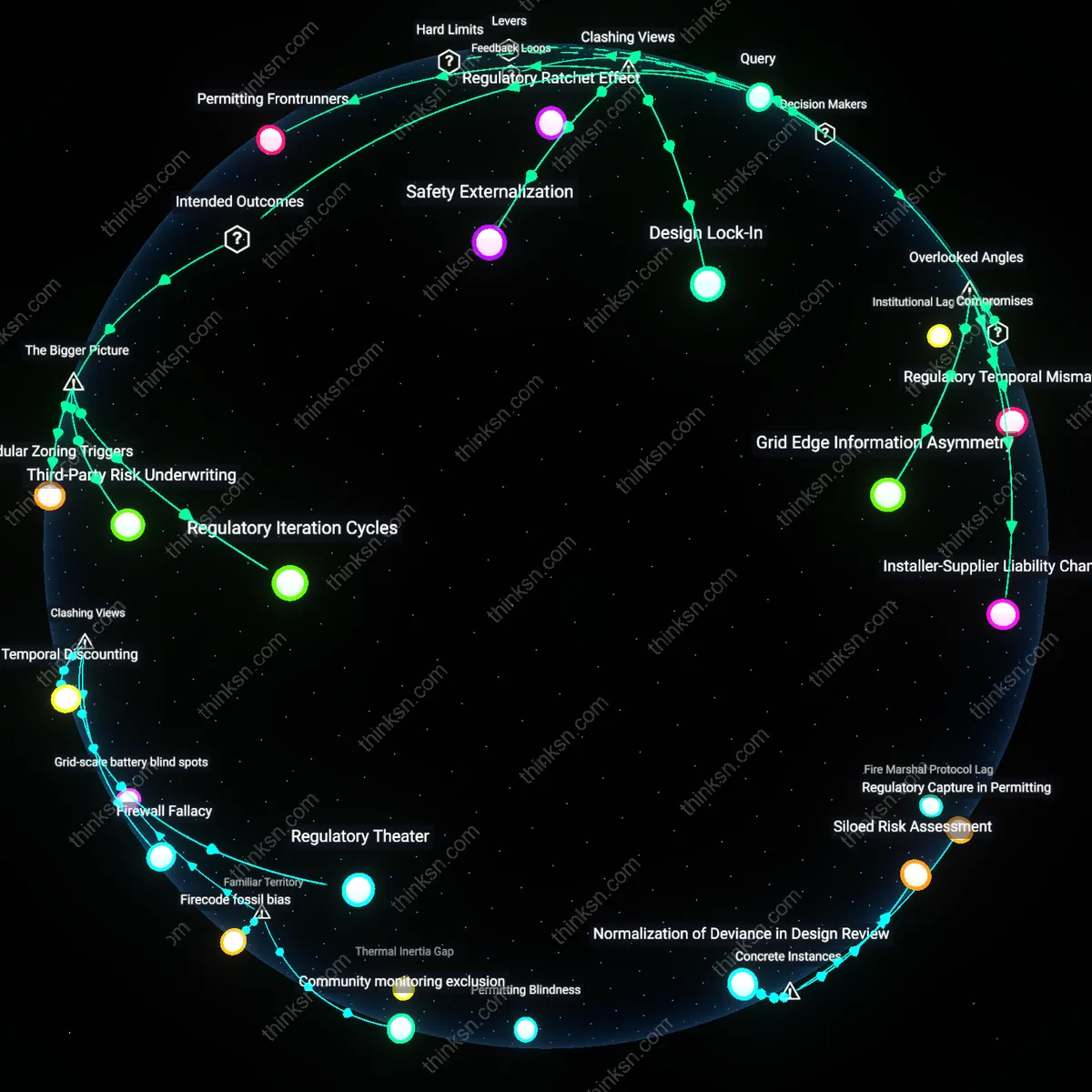
Regulatory Ratchet Effect
Policymakers can stabilize the feedback loop between rapid deployment and safety by institutionalizing post-incident review panels that retroactively adjust permitting thresholds—this mechanism emerged prominently after the 2019 Arizona battery fire, where utility-scale lithium-ion storage malfunction exposed gaps between accelerated siting approvals and operational risk assessment; unlike ad hoc safety upgrades, these panels create a balancing loop by feeding real-world failure data into permit automation systems, thereby making past accidents a non-linear input into future speed, a shift from the pre-2015 era when environmental reviews treated energy storage as functionally identical to generation infrastructure.
Temporal Compression Trap
By aligning modular safety certifications with rolling technology disclosure timelines, policymakers can convert what was once a sequential gating process into a parallel development pathway—this shift became feasible only after the Department of Energy’s 2021 Standardized Testing Program for BESS (Battery Energy Storage Systems) decoupled cell chemistry validation from project siting, reversing a decades-old linear model where safety compliance delayed permitting until technical design finalization; the underappreciated consequence is that temporal overlap between certification and review now creates a reinforcing loop where early safety data accelerates permitting, but compresses oversight windows, increasing latent risk accumulation.
Institutional Lag Gradient
States like California have mitigated system instability by delegating tiered permitting authority to regional air districts, which update safety protocols based on localized incident density rather than uniform national schedules—this devolution gained traction after 2020, marking a break from the federally dominated regulatory paradigm of the 2000s, where static NFPA (National Fire Protection Association) codes could not adapt to the spatial clustering of storage projects near urban load centers; the non-obvious dynamic is that regional heterogeneity in enforcement now generates a balancing feedback loop, where high-deployment zones experience tighter reinvestment in safety capacity, slowing further buildout until compliance infrastructure catches up.
Permitting Frontrunners
Policymakers should delegate expedited permitting authority for energy storage projects to state-level utility commissions that already enforce rigorous safety codes through existing inspection regimes. These commissions—such as the California Public Utilities Commission or New York State Public Service Commission—possess both technical expertise and enforcement infrastructure, allowing them to fast-track approvals without compromising safety by leveraging pre-audited equipment lists and certified installers. This approach contradicts the dominant assumption that speed and safety trade off against each other, revealing that regulatory specialization enables simultaneity—where acceleration emerges not from cutting corners but from institutional path dependency and accumulated compliance data.
Safety Externalization
Mandating private liability insurance as a condition for permit approval forces project developers to internalize safety risks through market mechanisms, thereby allowing public agencies to reduce review timelines while maintaining stringent outcomes. Under this model, insurers—acting as de facto regulators—conduct their own technical due diligence because they bear financial risk, creating a parallel oversight layer that governmental bodies can rely on without duplication. This inverts the conventional view that faster permitting requires stronger public oversight, exposing how the state can outsource risk discipline to capital markets, where actuarial logic enforces safety more consistently than bureaucratic checklists.
Design Lock-In
Adopting nationally standardized, pre-engineered energy storage system designs—such as those developed by the DOE in partnership with NFPA—enables automatic permitting approval for any project using approved configurations, thus eliminating redundant safety reviews while preserving high safety thresholds. Jurisdictions like Austin and Salt Lake City have piloted such libraries, demonstrating that standardization shifts the regulatory burden upstream to design certification rather than site-by-site evaluation. This challenges the intuitive belief that localized review ensures better safety, revealing instead that modular, closed-domain designs create ‘safety by construction,’ where failure modes are eliminated at the prototype level, making field inspections largely ceremonial.
Regulatory Temporal Mismatch
Policymakers can accelerate permitting for energy storage by aligning approval timelines with battery chemistry degradation schedules, not arbitrary administrative benchmarks, because manufacturers already monitor electrochemical decay through embedded sensors and reporting protocols that could feed real-time safety validation into regulatory oversight. This shift from static pre-construction review to dynamic operational compliance reframes safety as a time-conditioned variable, allowing faster site approval while maintaining risk control through continuous monitoring—yet this linkage between permitting speed and chemical lifecycle dynamics is systematically ignored in current regulatory frameworks, which treat safety as a one-time design specification rather than an evolving technical trajectory.
Installer-Supplier Liability Channel
Expedited permitting can be safely enabled by legally transferring residual safety liability from permitting agencies to certified installer-supplier coalitions that bundle equipment sales with installation warranties, because these private actors have greater exposure to long-term performance risks and thus stronger incentives to self-enforce standards beyond minimum code requirements. This re-channeling of accountability leverages market-based enforcement through extended corporate risk retention—a mechanism overlooked in public regulatory debates that prematurely assume the state must bear full oversight burden, when distributed liability in supply chains can function as a stealth compliance accelerator without downgrading safety.
Grid Edge Information Asymmetry
Policymakers can safely compress permitting review cycles by mandating third-party data escrow services that collect and verify safety-critical design inputs from project developers before submission, because distribution utilities—despite being key safety stakeholders—currently lack standardized access to pre-application technical data, creating redundant verification delays. By institutionalizing neutral data intermediaries that pre-validate thermal management and fault response models, the information asymmetry between fast-moving developers and risk-averse utilities is reduced, enabling faster approval without sacrificing rigor—an infrastructure-level coordination fix that remains invisible in policy discussions fixated on regulatory 'streamlining' rather than epistemic friction at the grid edge.
Regulatory Iteration Cycles
Policymakers should establish feedback-embedded permitting pathways that automatically tighten or relax safety review intensity based on aggregated project failure data. This mechanism involves energy regulators like the U.S. Department of Energy and state-level public utility commissions dynamically adjusting checklist requirements and inspection frequency in response to real-time incident reporting from grid operators and first responders, using standardized NERC/FERC data streams. The system leverages the fact that risk profiles for storage technologies are not static—lithium-ion risks differ across geographies and deployment scales—so permitting elasticity improves both speed and safety outcomes. What’s underappreciated is that permitting acceleration need not precede safety oversight but can be co-constituted through learning loops that treat approvals as provisional experiments.
Third-Party Risk Underwriting
Policymakers can outsource safety validation to accredited private certification bodies whose liability exposure aligns with long-term performance of the storage systems they approve. Entities like UL Solutions or DNV GL would conduct pre-permit technical audits and retain partial financial responsibility for failures occurring within a project’s first five years, creating endogenous incentives to balance speed with thoroughness. This shifts the enforcement burden from public agencies—often understaffed and reactive—to market-embedded actors with technical capacity and reputational capital at stake. The critical dynamic is that private underwriters internalize systemic grid reliability risks, transforming safety from a compliance checkbox into an insurable commodity with priced risk gradients.
Modular Zoning Triggers
Adopting technology-tiered zoning codes that pre-approve certain storage types in designated infrastructure corridors based on fire suppression capacity, population density, and interconnection proximity reduces case-by-case review without sacrificing safety. Municipal planners and regional transmission organizations (RTOs) can classify projects into risk bands—such as Category 1 for <10 MWh installations using non-flammable electrolytes—automatically qualifying them for fast-tracked permitting if located beyond 500 meters from residential zones. The overlooked insight is that location and technology standardization create de facto safety buffers more reliably than individualized engineering reviews, enabling speed gains not through reduced scrutiny but through systemic preemption of risk scenarios.