Why Catastrophic Coverage Can Leave Some Policyholders Vulnerable?
Analysis reveals 10 key thematic connections.
Key Findings
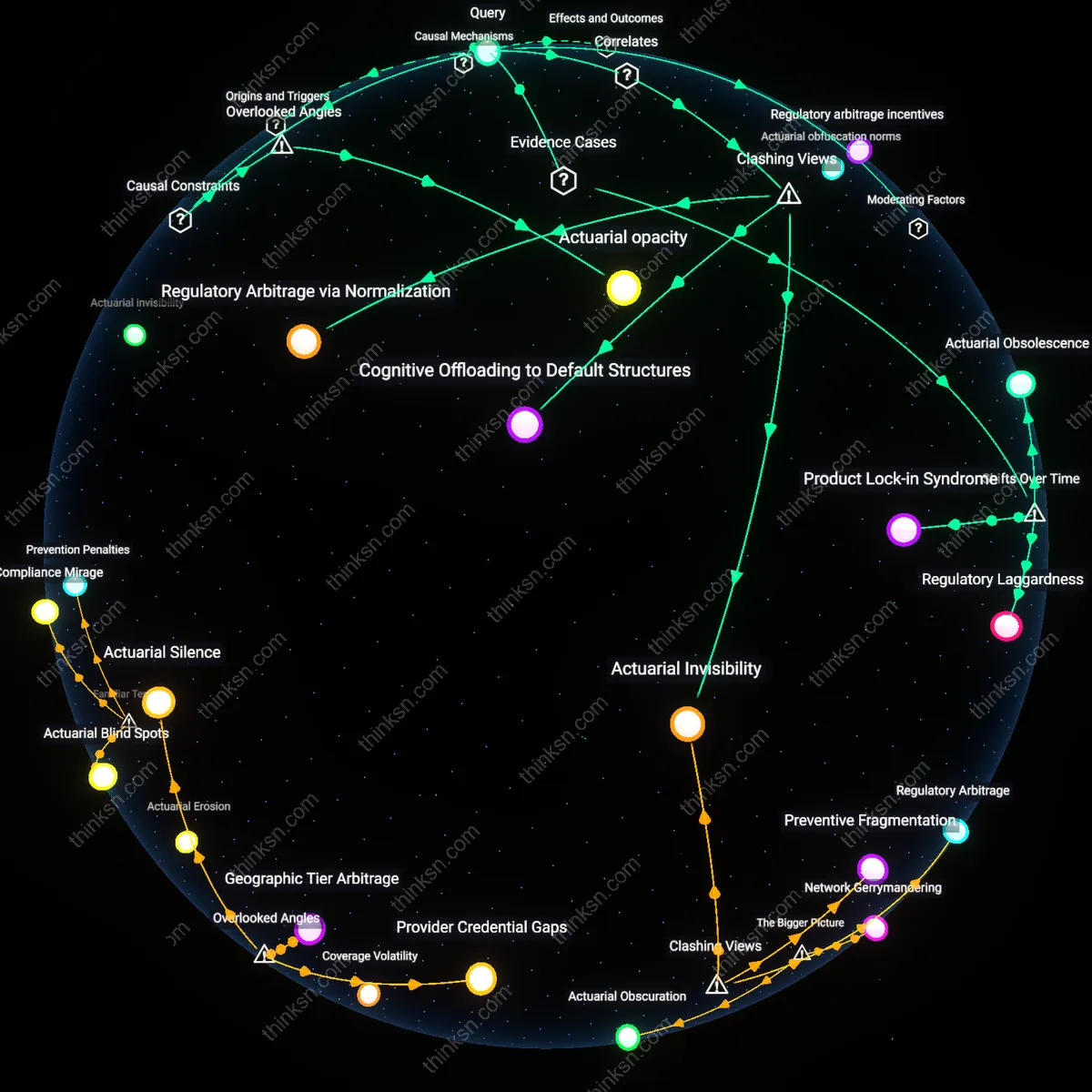
Regulatory arbitrage incentives
Bundling catastrophic coverage with standard insurance policies creates hidden coverage gaps when state-level insurance mandates allow insurers to minimize benefit generosity under federal preemption loopholes. Insurers exploit variability in state definitions of essential benefits to design policies that technically comply with regulations while excising high-cost services relevant to chronically ill populations, particularly in Medicaid expansion gap states. This misalignment between federal floor requirements and state implementation enables cost-shifting to consumers who unknowingly forgo supplemental coverage, revealing how jurisdictional fragmentation in U.S. health policy incentivizes strategic underdesign in bundled products.
Actuarial obfuscation norms
Bundling catastrophic coverage with standard insurance policies creates hidden coverage gaps because industry-standard actuarial models prioritize aggregate risk pooling over individual risk transparency, making it impossible for consumers to assess personal exposure to low-probability, high-severity events. Insurers deploy standardized risk-scoring algorithms that collapse heterogeneous risk profiles into broad demographic tranches, effectively masking differential vulnerability to coverage shortfalls in events like rare disease outbreaks or environmental disasters. This systemic preference for statistical simplification over personalized risk signaling entrenches information asymmetry, particularly disadvantaging geographically concentrated populations with elevated exposure to climate-related health catastrophes.
Employer-sponsored insurance feedback loop
Bundling catastrophic coverage with standard insurance policies creates hidden coverage gaps when large employers, as dominant purchasers of group health plans, pressure insurers to suppress premium visibility by embedding catastrophic risk in opaque composite packages. Human resources departments prioritize short-term budget predictability over long-term coverage adequacy, enabling insurers to dilute catastrophic benefits while maintaining a veneer of comprehensiveness. This dynamic reinforces a feedback loop in which employee underutilization of catastrophic provisions is misinterpreted as low demand, leading to further benefit erosion—a systemic distortion driven by organizational procurement incentives that disproportionately affects younger workers with delayed-onset genetic conditions.
Actuarial Invisibility
Bundling catastrophic coverage with standard insurance policies obscures coverage shortfalls for high-risk individuals because insurers rely on population-level models that statistically neutralize outlier risk profiles, thereby rendering extreme vulnerabilities invisible in plan design; this occurs not from malicious omission but from the actuarial prioritization of aggregate predictability over individual exposure, a mechanism structurally embedded in how U.S. private health and property markets price risk—what is non-obvious is that apparent comprehensiveness emerges precisely by disregarding the edges of risk distribution, not by addressing them.
Regulatory Arbitrage via Normalization
Bundling creates hidden coverage gaps not because of insufficient benefits but because compliance-driven standardization allows insurers to meet regulatory thresholds while tailoring exclusions that subtly undermine protection for geographically concentrated or demographically distinct populations, such as coastal homeowners or elderly urban renters; this happens through state-level insurance regulations that measure adequacy by nominal coverage categories rather than functional resilience, enabling carriers to exploit misalignment between regulatory checklists and real-world risk complexity—a dissonance that reveals how adherence to rules can mask systemic evasion of protection mandates.
Cognitive Offloading to Default Structures
Consumers with specific risk profiles experience unacknowledged coverage deficiencies because bundling leverages behavioral inertia, leading individuals to equate inclusion of catastrophic tiers with complete protection, even when trigger thresholds exceed likely loss magnitudes—this mechanism operates through cognitive reliance on insurer-framed 'completeness,' prevalent in employer-sponsored health plans and federally backed flood insurance, where decision architecture discourages scrutiny; the non-obvious reality is that perceived safety from bundling actively inhibits risk reassessment, turning policy integration into a psychological subsidy for under-preparedness.
Actuarial opacity
Bundling catastrophic coverage with standard insurance policies creates hidden coverage gaps by obscuring the differential risk loading of catastrophic riders in actuarial models available to consumers. Most policyholders, brokers, and even small-risk employers lack access to the segmented loss distributions insurers use internally to price composite policies—where standard claims are modeled on frequency and catastrophic claims on severity—causing misestimation of true exposure at the point of purchase. This opacity becomes a bottleneck because the causal chain from bundled product design to coverage gap requires invisibility in how risk transfer is calibrated across layers; if transparent, consumers could adjust selections or demand modular pricing. The overlooked dynamic is not moral hazard or adverse selection, but the absence of granularity in risk disclosure, which shifts decision power permanently toward underwriters.
Actuarial Obsolescence
Bundling catastrophic coverage with standard policies since the early 2000s has silently eroded protection for elderly homeowners in wildfire-prone California counties because standardized actuarial models failed to update risk curves after climate-driven fire patterns shifted post-2017, exposing policyholders to coverage insufficiency during the 2018 Camp Fire despite apparent full coverage. Insurers like State Farm and Allstate maintained bundled packages with static risk triggers, assuming historical fire frequency would persist, but the post-2017 acceleration in high-intensity blazes ruptured those assumptions—revealing that temporal misalignment between actuarial cycles and environmental change produces hidden gaps in bundled offerings, an effect obscured by the illusion of comprehensiveness. This mechanism is analytically significant because it shows how legacy actuarial timelines, once adequate, become structurally blind to emergent risks when bundled products resist modular recalibration.
Regulatory Laggardness
After the 2008 financial crisis, U.S. health insurers began embedding catastrophic riders within Affordable Care Act marketplace plans, which masked gaps for low-income diabetics in rural Texas who unknowingly forfeited continuous glucose monitor coverage due to post-2014 benefit design changes that prioritized actuarial balance over condition-specific needs. The shift from pre-2010 standalone catastrophic plans to post-2014 bundled essential health benefits created a regulatory illusion of uniform protection, yet formulary carveouts in plans from providers like Blue Cross Blue Shield of Texas systematically downgraded device access under cost-control mandates. This shift matters because it reveals how regulatory modernization, intended to expand access, inadvertently concealed condition-specific vulnerabilities when bundled designs assimilated disparate risks into averaged benchmarks, making specific deficits invisible within ostensibly universal coverage.
Product Lock-in Syndrome
Following the 2013 expansion of multi-peril crop insurance bundling by the USDA, Midwestern corn-soy farmers in Iowa experienced undetected exposure to sequential drought-pest events because post-2013 policy bundles merged yield protection with catastrophic risk, suppressing uptake of supplemental pest-specific riders once widely used in the 1990s and early 2000s. The transition from à la carte federal insurance modules to standardized bundled products after the 2012 Farm Bill reduced farmer flexibility, embedding a path dependency where historical adoption rates of ancillary coverage plummeted even as climate stressors diversified. This shift is significant because it demonstrates how product consolidation—framed as simplification—can suppress adaptive risk response in agricultural communities, freezing risk management practices in an earlier ecological era and generating latent vulnerabilities that only emerge under novel stress sequences.