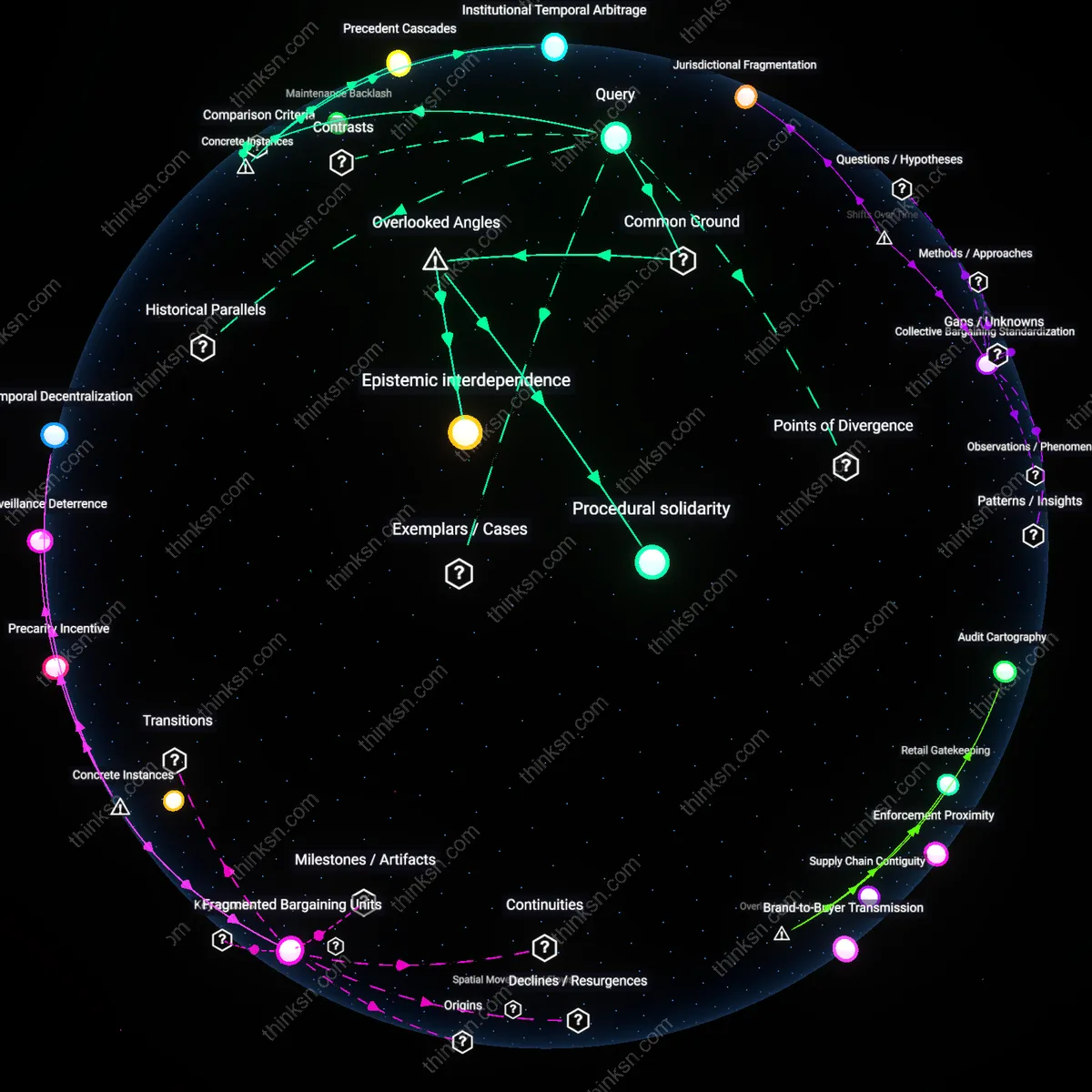
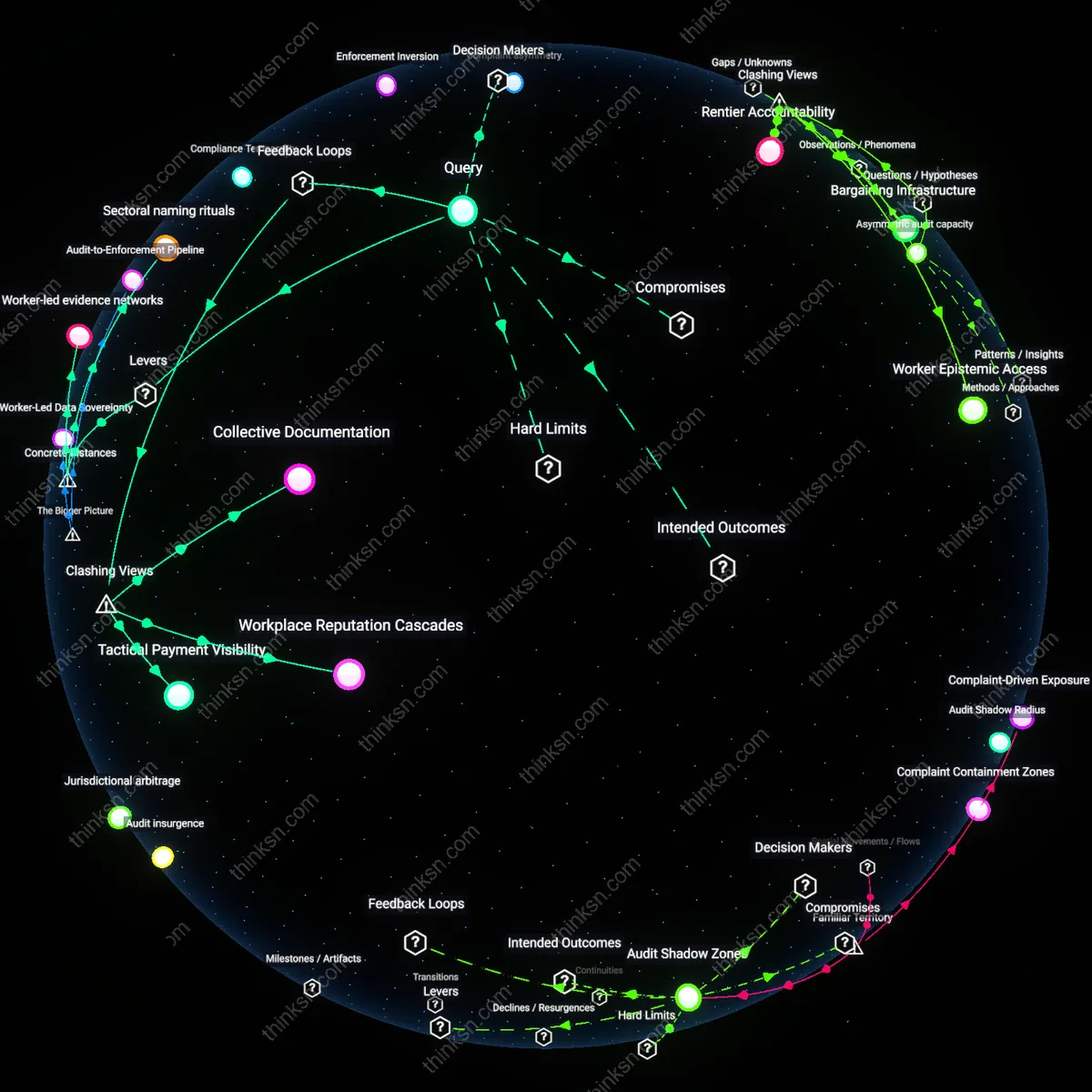
Jurisdictional Fragmentation
The union's ability to organize workers across multiple states initially weakened after the 1893 Pullman Strike because federal injunctions under the Sherman Antitrust Act criminalized multi-state strike coordination, binding union strategy to fragmented state labor laws and limiting cross-jurisdictional solidarity. Federal courts, particularly in the Northern District of Illinois, interpreted the Act to halt boycotts that disrupted interstate rail traffic, effectively isolating union locals in Ohio, Missouri, and Michigan from centralized direction. This legal segmentation created a patchwork of enforcement where state-level political climates dictated organizing capacity, making national cohesion structurally impossible despite shared industrial conditions. What is underappreciated is that the defeat wasn’t merely logistical—it embedded a legal geography into labor strategy that persisted long after the strike ended.
Collective Bargaining Standardization
The union’s multi-state organizing capacity transformed decisively during the New Deal era, specifically after the 1935 Wagner Act empowered the National Labor Relations Board to enforce collective bargaining across state lines, overriding corporate use of geographic decentralization to resist unionization. Companies like U.S. Steel had previously exploited jurisdictional variance by relocating operations to anti-union states, but the NLRB established uniform rules for representation elections and unfair labor practices, enabling unions such as the Steelworkers and Auto Workers to build regional bargaining units. This federal standardization neutralized corporate merger strategies that relied on regulatory arbitrage between states, turning labor relations into a national field. The non-obvious outcome was that mergers no longer diluted union power—they inadvertently created larger, more centralized workforces that became easier to organize under federal oversight.
Jurisdictional fragmentation
The union's capacity to coordinate cross-state organizing declined after 1980s corporate roll-ups because multi-state firms leveraged decentralized legal jurisdictions to isolate labor actions, pitting regional workforces against one another through venue-specific concessions; this strategy exploited the fact that U.S. labor law enforcement varies significantly by circuit court and state right-to-work statutes, enabling employers to dilute solidarity with localized threats of relocation or shutdown—what was underappreciated is that corporate structural integration did not require centralized HR policy but could instead weaponize legal disintegration, fracturing union leverage even as production became more consolidated.
Regulatory arbitrage
During the 1960s and 1970s, union cross-state coordination strengthened in response to early vertical mergers because national unions like the UAW and Teamsters used standardized collective bargaining templates and coordinated strike timing across multiple plants under new multi-divisional corporate hierarchies, turning corporate scale into an organizing advantage by threatening system-wide disruption; here, the critical dynamic was that merged firms required operational uniformity, which unintentionally created predictable patterns in labor relations that unions could exploit across state lines—this reveals that corporate integration can create institutional regularities that empower countervailing forces, a reverse feedback loop rarely seen in narratives of corporate dominance.
Inter-union competition
Following the 1990s wave of service-sector consolidation, such as in telecommunications and airlines, the ability of unions to organize across states eroded not due to employer pressure alone but because overlapping union jurisdictions—like between CWA and SEIU—were exacerbated by corporate mergers that blended workforces under different bargaining histories, leading to coordination failures and diluted mobilization; the systemic issue was that the AFL-CIO’s federated structure provided no binding mechanism to resolve turf conflicts, turning organizational pluralism into a structural weakness in the face of horizontally integrated firms—what remains underrecognized is that labor’s internal governance design became a liability precisely when corporate unity demanded unified opposition.
Jurisdictional entanglement
The AFL-CIO’s coordinated campaign across Texas, Illinois, and South Carolina during the 2015–2017 resistance to Amazon’s warehousing consolidation demonstrated that union organizing capacity eroded not due to lack of will but from conflicting state labor regimes actively exploited by merged corporate entities. Amazon, following internal restructuring into a single supply-chain network, leveraged disparities in state-level right-to-work laws and NLRB enforcement density, fragmenting union efforts into isolated legal battles despite centralized logistics operations; this revealed that multi-state organizers faced structural disempowerment not from internal decline but from the weaponization of federalism by capital. The non-obvious insight is that corporate mergers did not simply concentrate power—they reconfigured inter-state legal asymmetries into operational tools, constraining union strategy even where labor solidarity existed.
Bargaining jurisdiction
After the 1998 merger of Fiat and Chrysler, the United Auto Workers (UAW) failed to extend collective agreements across the newly unified firm’s plants in Michigan, Indiana, and Mexico, not because of employer resistance alone, but because NLRB certification boundaries prohibited transnational bargaining units and discouraged cross-border strike coordination. The UAW’s strategy remained bound to plant-specific recognition, even as capital operated through a single integrated production plan, exposing a legal-rigid adherence to geographic bargaining units despite economic centralization. This reveals how union structure preserved intact a nineteenth-century model of locality-based representation, making multi-state leverage obsolete even when worker interests were materially unified.
Strategic sequencing
The Coalition of Immokalee Workers (CIW) transformed multi-state agricultural organizing after Publix and other supermarket chains merged procurement networks in the early 2000s by shifting from workplace-based mobilization to supply-chain targeting, binding Florida tomato farms to corporate procurement contracts through time-bound audit regimes and brand-name accountability. Rather than confronting growers or retailers separately, the CIW exploited the very integration created by retail mergers—using the unified purchasing power of companies like Whole Foods and Trader Joe’s after their acquisition waves—as leverage to enforce a Worker-Driven Social Responsibility agreement across six states. This illustrates that union-like movements adapted to capital consolidation not by mirroring corporate scale, but by inserting worker rights into the temporal logic of procurement cycles, a mechanism overlooked in traditional labor strategy.
Jurisdictional Arbitrage
Union cross-state organizing weakened not due to overt anti-union campaigns but because corporate mergers reconfigured operational geography, enabling firms to shift work between jurisdictions with asymmetric labor enforcement. When national chains or manufacturing networks centralized procurement and HR decisions in states with restrictive labor climates—like Tennessee or the Carolinas—unions lost leverage even in union-friendly states such as New York or Illinois, because capital could credibly threaten decentralization without wage or contract parity. This dynamic undermined multi-state solidarity by exploiting regulatory asymmetry rather than outright confrontation—an administrative rather than ideological weaponization of federalism overlooked in mainstream narratives of union decline.
Pension Jurisdictionality
The erosion of multi-state union power intensified after corporate mergers consolidated retirement plans into centralized trust structures governed by ERISA, which preempted state-level pension regulation and weakened local union chapters’ influence over benefit design. As firms like RJR Nabisco or Pacific Bell merged across regions, unified pension funds diluted the political weight of localized worker cohorts, transforming benefits from a collective bargaining enticement into a portable financial instrument managed by fiduciary boards in cities like Dallas or Cleveland, not local union halls. This shift detached long-term worker loyalty from geographic organizing hubs, an underreported financial logic that recalibrated union incentive structures away from sustained cross-state mobilization.
Maintenance Backlash
Following railroad and telecommunications mergers in the 1990s, unions retained formal representation but saw their de facto coordination capacity erode as corporate restructuring redefined 'maintenance of way' responsibilities, dispersing technically specialized workers across state lines under contractor networks that bypassed traditional bargaining units. In systems like BNSF or AT&T’s legacy lines, work previously performed by unionized linemen and trackmen was outsourced to regional subcontractors whose employees were often classified as independent or multi-employer assignees, creating a patchwork of labor status that nullified strike leverage and obscured organizing geography. This technical reclassification of essential labor—hidden beneath neutral operations policies—degraded trans-state union cohesion without visible layoffs or plant closures.