Lump Sum or Annuity at 47: Pension Payouts in Low Rates?
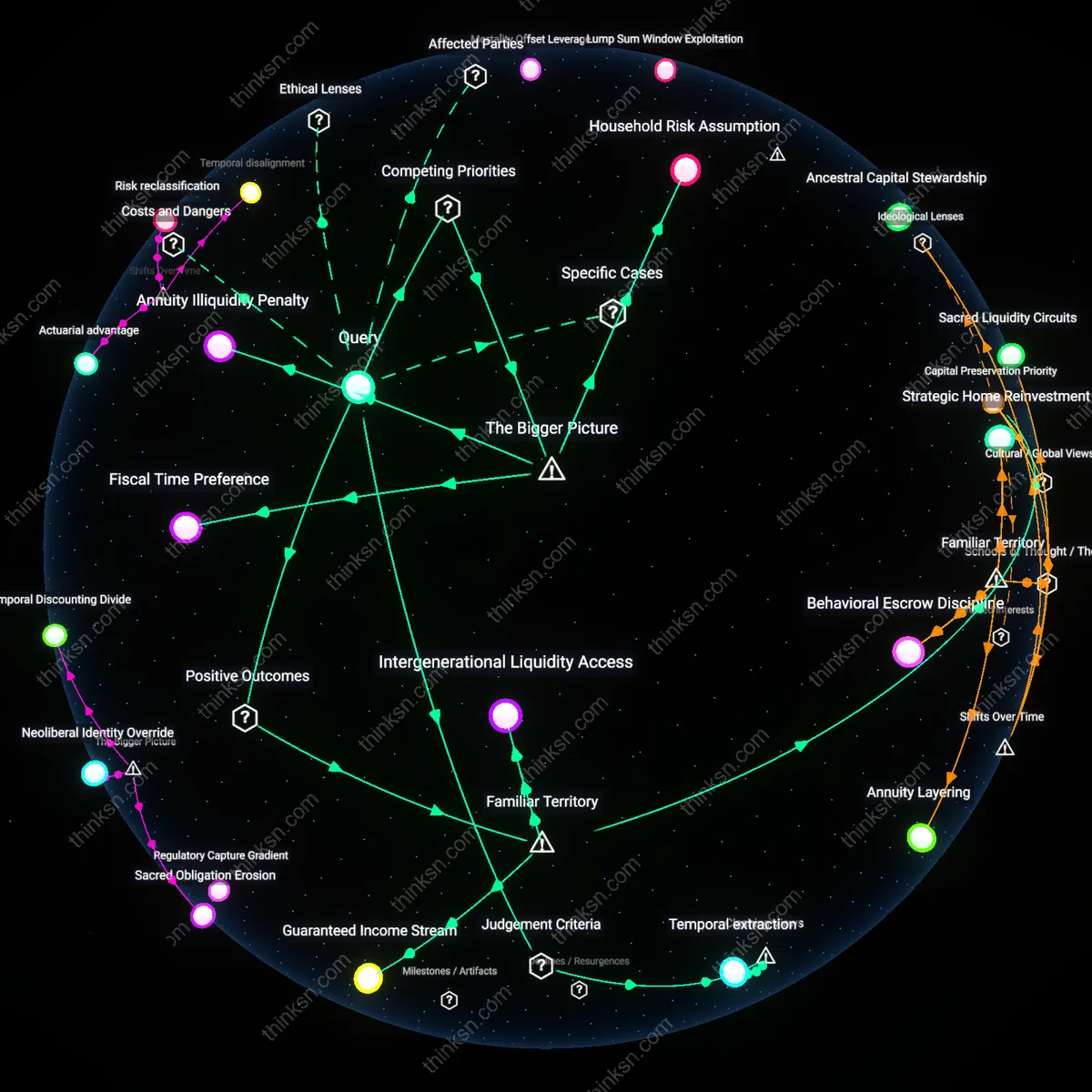
Analysis reveals 8 key thematic connections.
Key Findings
Temporal extraction
A lump-sum payout exploits the present bias of individuals by front-loading liquidity in a way that undermines long-term pension equity. Middle-aged workers, like a 47-year-old warehouse supervisor in Ohio with a $400 monthly pension, face immediate financial demands—student debt, childcare, medical costs—that make a $60,000 lump sum feel transformative, even when actuaries show it will erode under low interest rates and inflation. This mechanism, embedded in defined benefit plan withdrawal options, converts intergenerational solidarity—where pensions redistribute risk across time—into individualized financial hazard, privileging present autonomy over future security. The non-obvious consequence is not poor money management by individuals, but the systemic transfer of longevity risk from institutions to persons under the guise of choice.
Interest asymmetry
In a low-interest-rate environment, the true cost of a lump-sum payout is obscured by discount rates set by Treasury yields, which systematically undervalue future pension obligations and incentivize premature exits from annuitization. For a 47-year-old municipal employee in Minnesota, the offered $55,000 lump sum may appear generous, but it is calculated using a 2% discount rate tied to 10-year Treasuries—rates far below historical pension fund returns of 6–7%—effectively penalizing longevity and inflating the present value illusion. This regulatory mechanism, codified in IRC Section 417(e), enables employers and plan administrators to reduce future liabilities by pushing beneficiaries toward cash outs, shifting investment risk onto individuals despite stable long-term asset performance. The underappreciated reality is that the 'choice' is structurally distorted by state-sanctioned valuations that favor institutional balance sheets over individual financial resilience.
Guaranteed Income Stream
A lifetime annuity provides a 47-year-old with a predictable monthly income until death, which directly reduces longevity risk for individuals who may outlive their savings. This mechanism operates through pooled mortality risk in insurance structures, where the pension plan or insurer absorbs the uncertainty of lifespan, converting a finite balance into stable cash flows. What’s underappreciated in common discussions is that even in low interest rates, the actuarial value of survivorship pooling often outweighs the low yields, especially for those without investment expertise or self-discipline.
Capital Preservation Priority
Opting for a lump-sum payout allows a 47-year-old to retain control over pension assets, enabling strategic allocation across income-generating investments or protective buffers against future emergencies. This works through direct ownership and asset diversification, leveraging brokerage, real estate, or legacy accounts to potentially outpace inflation and generate higher cash flow than an annuity’s fixed payments. Despite widespread fear of poor market timing, the overlooked advantage is the ability to deploy capital during rare favorable windows—like equity dips or rising-rate cycles—something annuitants forfeit permanently.
Intergenerational Liquidity Access
A lump-sum payout creates immediate access to principal, allowing the pension holder to transfer wealth to descendants or caregivers before death, fulfilling familial obligations that annuities inherently block. This operates through estate planning mechanisms like trusts or direct gifting, where liquidity enables responsive support during critical life events—education, home purchases, or medical costs—within tight-knit household economies. The underappreciated reality is that for modest-income families, such transfers often represent their only opportunity for upward mobility, making the annuity’s irreversible nature a social constraint disguised as financial security.
Fiscal Time Preference
Choosing a lump-sum payout over a lifetime annuity prioritizes present control of capital against future income guarantees, a trade-off exacerbated by central bank rate-setting that suppresses discount rates and inflates asset valuations. In a low-interest-rate environment engineered by monetary authorities to stimulate investment, individuals face distorted intertemporal price signals that undervalue future cash flows, making lump sums appear more liquid and flexible than they safely are for long-term needs. This mechanism privileges near-term agency under the guise of financial rationality, embedding a hidden temporal bias in state-sponsored pension systems that shifts longevity risk onto households without adjusting for behavioral myopia.
Annuity Illiquidity Penalty
Opting for a lifetime annuity in a low-interest-rate climate effectively locks in below-market returns, a systemic consequence of insurance companies pricing annuity streams based on current bond yields, which are compressed by quantitative easing and centralized yield curve management. Because insurers must reinvest annuity premiums into low-yielding government debt to match liabilities, the resulting payments reflect artificially depressed yields over decades, not just the present. This creates a structural disadvantage for annuitants—especially those in midlife—who exchange a modest lump sum today for decades of inflation-vulnerable payments, sacrificing option value if rates later rise or personal needs change, a cost rarely priced into pension counseling.
Household Risk Assumption
The selection between lump sum and annuity forces retirement risk from pooled, professionally managed systems into individual households, a shift driven by the decades-long retreat from defined-benefit plans and enabled by regulatory frameworks that treat pension payouts as completion events rather than lifecycle supports. Fiduciary rules and product design norms in capital markets incentivize the transfer of responsibility to the individual under principles of 'choice architecture,' even though systemic factors like stagnant wage growth and unaffordable long-term care make self-insurance unrealistic for modest-income cohorts. This transforms a social risk-mitigation function into a privatized gamble, where one decision at age 47 determines decades of downstream resilience.