Is Your Stagnation Internal Laziness or External Forces?
Analysis reveals 11 key thematic connections.
Key Findings
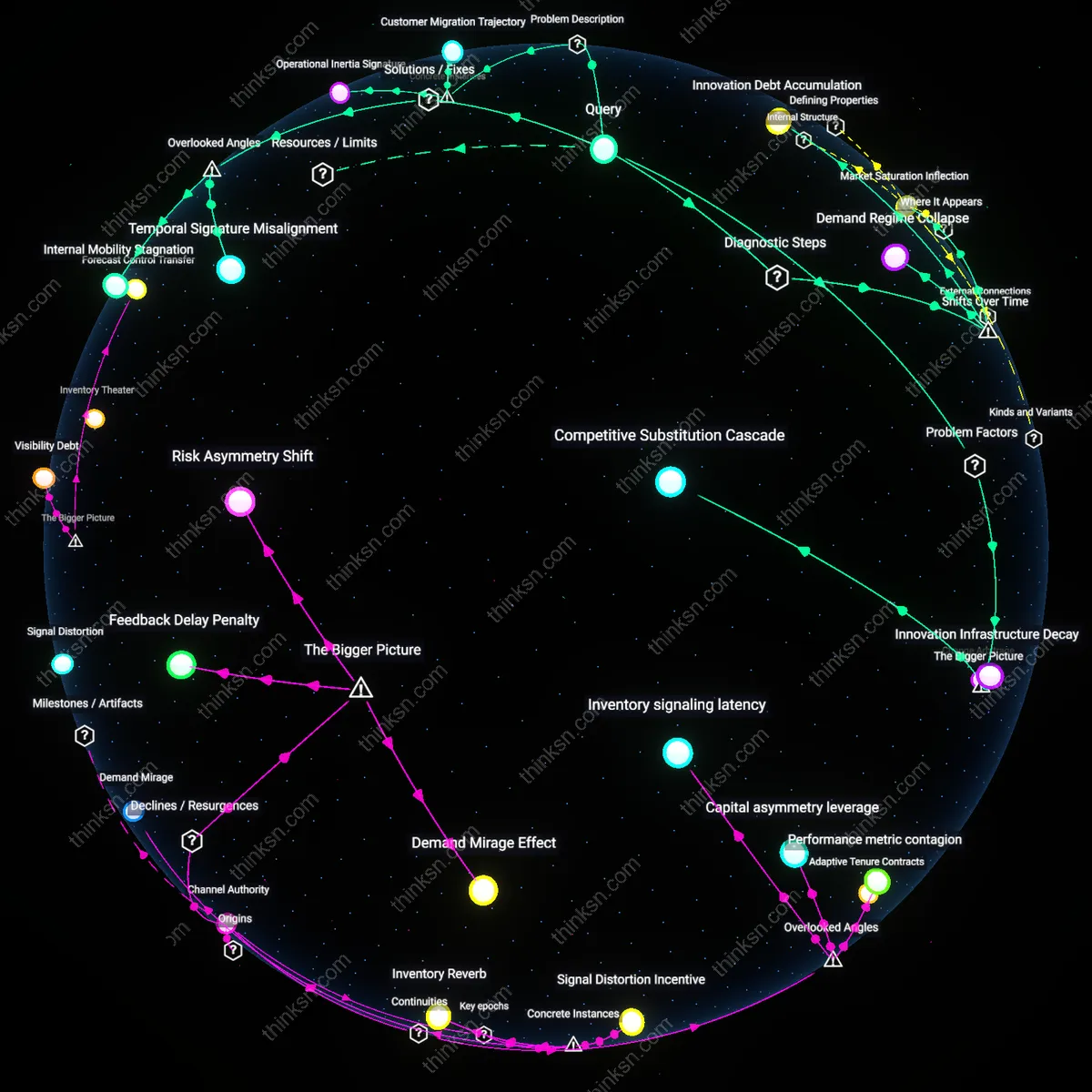
Operational Inertia Signature
A sustained decline in internal process innovation despite stable market conditions reveals stagnation driven by internal complacency, as demonstrated by Kodak’s failure to scale digital imaging capabilities even when patent data and R&D outputs showed early leadership; this inertial pattern—where organizational routines suppress the commercialization of disruptive ideas—exposes a system in which risk-averse middle management and legacy performance metrics actively downweight new opportunities, a dynamic often invisible in P&L statements but detectable in project pipeline attrition rates. The non-obvious insight is that stagnation can originate not from lack of ideas, but from a procedural immune response against them.
Customer Migration Trajectory
When core customer segments actively shift spending to alternative solutions within the same functional domain, stagnation reflects external market contraction rather than internal failure, as seen in IBM’s enterprise hardware division during the early 2010s when clients migrated from on-premise servers to cloud infrastructure; detailed account-level revenue and usage telemetry revealed not declining engagement but a systematic reallocation of IT budgets toward AWS and Azure, signaling a sector-wide capital reallocation rather than IBM’s operational deficiency. The critical insight is that market exit isn’t random—it follows predictable substitution pathways that can be mapped before aggregate industry data confirms decline.
Resource Allocation Rigidity
Persistent capital and talent deployment into underperforming business units despite clear signaling from market feedback indicates internal complacency, exemplified by General Motors’ continued investment in large internal-combustion SUV platforms between 2005–2008 while Toyota gained dominance via hybrid-electric innovation and fuel efficiency; GM’s budgeting cycles and executive incentive structures favored short-term margin preservation over strategic pivoting, embedding rigidity that masked as market adaptation. The underappreciated mechanism is that internal power structures often hijack resource allocation processes, making stagnation appear as continuity rather than active misjudgment.
Innovation Infrastructure Decay
Business stagnation stems from a breakdown in internal knowledge-sharing systems, where middle management hoards information to protect departmental autonomy, eroding the organization’s collective capacity to adapt—despite external demand remaining stable; this occurs because matrixed reporting structures create competing incentives that disable cross-functional learning, making the real bottleneck not market size but the firm’s own fragmented epistemic architecture, a mechanism often invisible in traditional performance metrics. The residual concept is the slow collapse of shared learning systems within technically complex firms under decentralized leadership models.
Demand Signal Distortion
Stagnation is driven by intermediaries—distributors and resellers—systematically misrepresenting market demand due to their own inventory overhangs or pricing strategies, causing firms to misinterpret legitimate external contraction as universal decline when in fact end-user interest remains steady; this distortion emerges from asymmetric information flows in long supply chains, especially in industries like industrial equipment or specialty chemicals, where downstream actors buffer volatility at the expense of upstream visibility, obscuring the true shape of demand. The non-obvious insight is that market contraction may be a reporting artifact, not a behavioral one, rooted in supply chain power asymmetries rather than consumer pullback.
Competitive Substitution Cascade
Apparent stagnation originates not from total market shrinkage but from a stealthy reconfiguration of value chains triggered by regulatory shifts in adjacent sectors—such as data privacy laws altering SaaS adoption—which redirect capital and attention toward alternative business models that fulfill similar functional needs without registering as direct competitors in conventional market definitions; this systemic displacement is masked in aggregate revenue data but evident in behavioral shifts among early-adopter customer segments. The overlooked dynamic is that market contraction signals may actually reflect competitive displacement via ecosystem-level regulatory arbitrage.
Market Saturation Inflection
Compare the trajectory of customer acquisition costs and unit economics against industry-wide demand indicators over the past decade to identify when growth stalled relative to market potential; if internal performance decayed while aggregate demand remained stable or expanded, internal complacency is indicated. This analysis requires isolating the firm’s conversion rates, retention, and innovation cycles from macroeconomic consumption trends, particularly around the shift from expansionary market entry (pre-2015) to mature competition (post-2018), when easy growth faded and operational discipline became decisive. The non-obvious insight is that stagnation during a period of rising market saturation often reflects a failure to adapt internally rather than market collapse—firms that maintained R&D reinvestment and sales agility post-2018 outperformed peers despite identical external conditions, revealing complacency as a lagged response to diminished organic growth.
Innovation Debt Accumulation
Trace the erosion of product development velocity and engineering investment relative to key competitive milestones over the last business cycle, particularly during the 2020–2022 digital acceleration phase, when market leaders pulled ahead by embedding AI and automation into core offerings. If the firm maintained profitability but systematically deferred technological upgrades under short-term margin pressure, the root cause is internal complacency manifesting as innovation debt. This dynamic is observable in budget allocations and talent retention patterns, where underinvestment in future capabilities created irreversible lag once external disruption crystallized. The critical transition—overlooking the strategic necessity of digital transformation during a broadly accessible technological inflection—reveals how internally rational decisions can produce externally visible stagnation independent of market conditions.
Demand Regime Collapse
Analyze regional sales decomposition and customer cohort attrition from 2019 to 2023 alongside macroeconomic indicators such as disposable income growth, sector-specific regulation, and competitor exit rates to determine if revenue plateaus align with structural demand destruction rather than operational failure. In markets like commercial real estate or legacy retail, where post-pandemic behavior shifts led to permanent reductions in B2B contracts and foot traffic, even agile firms with strong internal discipline experienced stagnation. The pivotal moment was 2021–2022, when remote work adoption and e-commerce normalization rewrote spatial consumption patterns; firms in affected sectors saw declining renewal rates irrespective of service quality, exposing a demand regime collapse that invalidated prior business models. The underappreciated reality is that internal rigor cannot offset a vanished value proposition in a newly unviable market configuration.
Temporal Signature Misalignment
Audit the timing patterns of customer exit against macroeconomic indicators to isolate internal complacency from external contraction—when customer churn precedes or diverges from market downturns, it signals internal decay. This works because firms embedded in contracting markets typically see demand erosion that correlates temporally with broad indicators like commodity prices or regional GDP; persistent lag between these signals and performance drop reveals operational inertia. The non-obvious insight is that most diagnostics prioritize magnitude over synchronization—yet the temporal signature of decline is a leading tracer of root cause, not just a byproduct.
Internal Mobility Stagnation
Measure lateral and upward movement of mid-level technical staff across product teams as a proxy for organizational vitality—flat internal mobility during stable market conditions indicates complacency. High-performing units in resilient companies redistribute talent dynamically in response to subtle performance gradients, even without layoffs or growth. The overlooked mechanism is that human capital arbitrage within the firm often precedes formal strategy shifts, making mobility flows a latent sensor of adaptive capacity missed by financial or customer metrics.