Do More Condos Mean Less Beach Access in Expensive Coastal Cities?
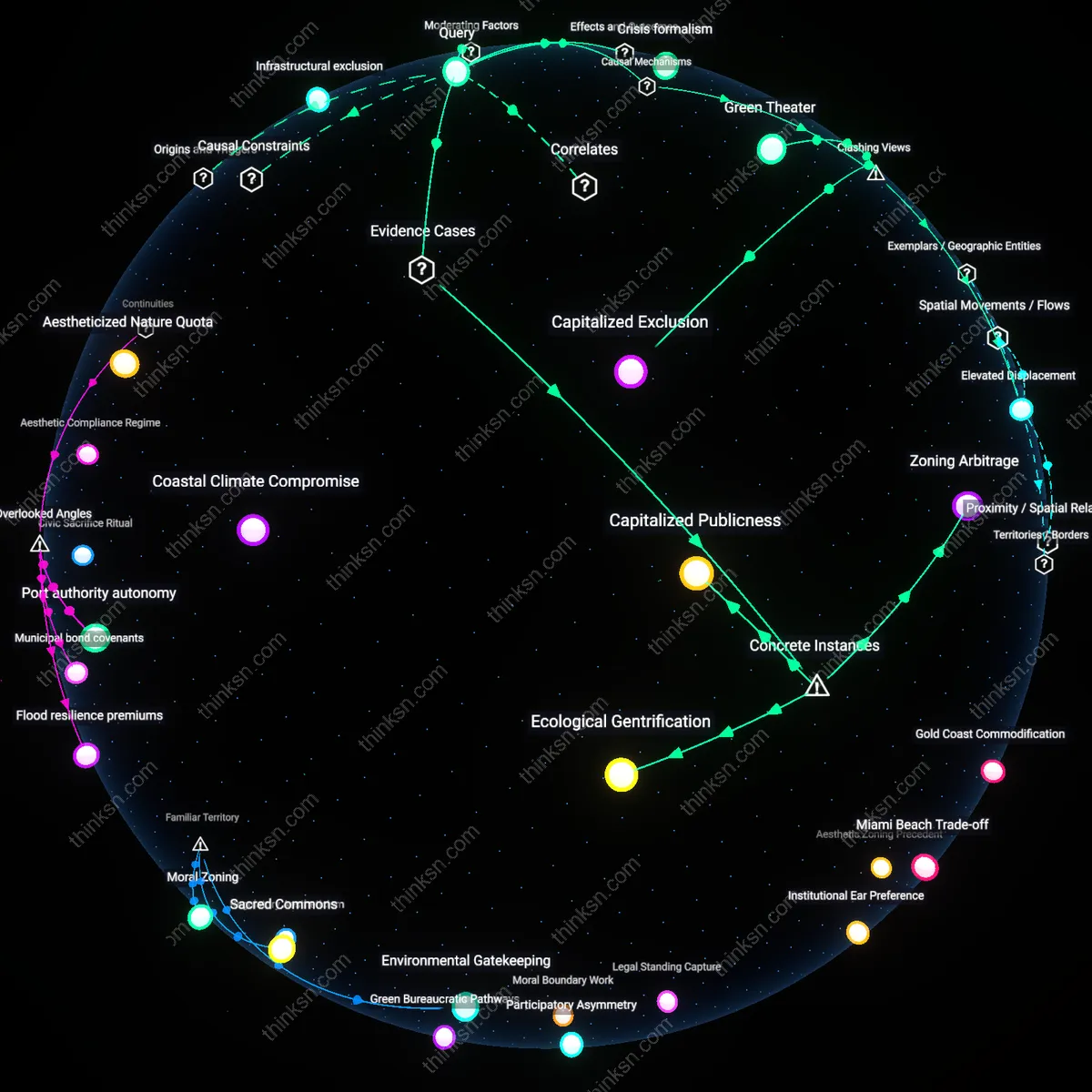
Analysis reveals 12 key thematic connections.
Key Findings
Capitalized Exclusion
Mid-rise waterfront developments in cities like Vancouver and Miami succeed not by accident but by systematically converting public shoreline access into private amenity value, where zoning reclassification—often lobbied for by real estate consortia—enables developers to profit from views that were previously communal, which reveals that increased housing supply in these zones does not resolve scarcity but redistributes it toward capital. This mechanism functions through municipal planning boards that prioritize development fees over equitable access covenants, making the non-obvious reality that density gains are less about solving housing crises and more about capturing appreciating land rents for private benefit, challenging the dominant narrative that supply-side development inherently serves the public good.
Green Theater
The inclusion of slivers of publicly accessible promenades or 'pocket parks' in waterfront projects—such as in Brooklyn Bridge Park’s surrounding developments—does not preserve public green access but performs it, where landscape architecture and access easements are calibrated to satisfy legal thresholds while funneling foot traffic away from prime riverfront plots, creating a mediated environment in which presence is permitted but lingering is discouraged. This works through spatial design codes that allow developers to meet open-space mandates without ceding control, exposing how green space is being instrumentalized as a compliance tool rather than a shared resource, directly undercutting the intuitive belief that visible park features equate to meaningful public access.
Elevated Displacement
The shift to mid-rise, rather than high-rise, structures along constrained coastlines like Seattle or Alexandria, Virginia, is not a concession to neighborhood scale but a deliberate strategy to maximize unit count while minimizing the political cost of vertical density, allowing developers to bypass historic height opposition and accelerate approval timelines, which accelerates the privatization of the shoreline under cover of modesty. This mechanism depends on local council members trading incremental density for infrastructure upgrades and targeted tax revenues, obscuring how even moderate infill entrenches exclusivity by pricing out non-market uses and adaptive reuse of piers or bulkheads, thereby challenging the progressive assumption that mid-scale development is inherently more inclusive or environmentally cautious.
Capital-rent alignment
Mid-rise waterfront developments in cities like Seattle and Miami prioritize housing supply not to meet broad affordability needs but to align real estate capital with municipal tax revenue goals, enabling city governments to accept private investment in exchange for reduced public access. This alignment functions through zoning concessions that mandate minimal open space while maximizing sellable floor area, a trade-off justified by framing new units as progress on housing crises—despite most units being luxury condos. The non-obvious outcome is that public green space is not simply lost but actively redefined as privatized, aestheticized 'pocket parks' that serve residents only, entrenching a system where capital gains and municipal fiscal health depend on constrained access rather than inclusive urban design.
Infrastructural exclusion
The construction of mid-rise waterfront housing in dense coastal cities such as San Francisco and Boston systematically redirects public infrastructure investment—like promenades, stormwater management, and transit links—toward serving new residential enclaves rather than expanding equitable shoreline access. This occurs through developer mitigation agreements that substitute broad public benefits with narrowly scoped improvements, often gated or spatially segregated. The consequence is that green space access becomes topographically fragmented, with legacy communities physically and institutionally distanced from the waterfront, revealing how ostensibly neutral housing solutions become vehicles for the spatial redistribution of environmental privilege.
Crisis formalism
The acceptance of diminished public green space in exchange for mid-rise housing is legitimized through a political performance of responding to housing shortages, where the mere act of building—regardless of unit affordability or spatial equity—counts as effective policy action. This formalism is sustained by regional planning bodies and media narratives that measure success in units constructed per square foot, not in social or ecological outcomes, allowing city councils to discharge their perceived obligations without confronting deeper structural constraints like land ownership concentration or tenant protections. The underappreciated effect is that the 'crisis' itself becomes a functional tool to fast-track developments that reconfigure public space as residual, not foundational, to urban life.
Market-Price Green Access
Mid-rise waterfront buildings in cities like Miami and Vancouver displace public esplanades because developers can capture higher revenues by converting waterfront land into private balconies and luxury amenities. Municipal zoning allows this shift when fees or donated spaces—such as a small retail plaza or ticketed rooftop garden—technically satisfy 'public access' requirements, even as physical connectivity and open sightlines erode. What’s underappreciated is that the public increasingly experiences green access not as a right, but as a benefit conditional on market-tier residency or consumption, turning ecological proximity into a tiered service.
Coastal Climate Compromise
Waterfront development rises in elevation not for views alone, but because building slightly higher improves survivability during storm surge and sea level rise, as seen in post-Hurricane Sandy projects in Brooklyn and Norfolk. This practical adaptation unintentionally concentrates housing on land most critical for natural flood absorption—wetlands, dunes, and floodplains—reducing both green space and long-term coastal resilience. The non-obvious trade-off is that climate-resilient design, meant to preserve urban livability, accelerates the loss of ecosystem services that could otherwise reduce climate risk without construction.
Aestheticized Nature Quota
City approvals in places like Seattle and Boston increasingly accept artificial green features—vertical gardens, synthetic lawns on terraces, or paid-entry pocket parks—as substitutes for contiguous waterfront parks, satisfying policy targets while maximizing buildable area. These features are valued not for ecological function but visual 'greenness,' making nature a design element rather than a public utility. The shift reveals that planning systems now measure access to nature symbolically, where the appearance of green space offsets its material absence, normalizing ornamental substitutes over usable land.
Capitalized Publicness
The Hudson Yards redevelopment in New York City demonstrates that private investment in mid-rise waterfront housing is contingent on public infrastructure subsidization, where the extension of the 7 subway line was funded by taxpayers to serve a luxury development zone. This mechanism reveals how green space and public access are selectively integrated as value-enhancing amenities rather than universal rights, with elevated parks like The Vessel and Hudson Yards Public Plaza serving as privately governed, semipublic spaces that exclude informal uses. The non-obvious insight is that public access is not lost but repurposed into a managed, spectacle-driven form that legitimizes exclusionary development.
Zoning Arbitrage
In Seattle’s South Lake Union neighborhood, Amazon’s collaboration with the city to rezone industrial waterfront land triggered a wave of mid-rise residential towers that replaced proposed public open spaces with podium-style plazas and pocket parks tied to private developments. The city accepted diminished public easements in exchange for density bonuses and tax revenues, using municipal codes to convert legal requirements for green space into transferable development rights. This case underscores how zoning becomes a negotiable instrument where green space is not eliminated but displaced, fragmented, and monetized within private governance schemes.
Ecological Gentrification
The transformation of Copenhagen’s Nordhavn district into a mid-rise sustainable housing hub illustrates how climate-resilient infrastructure—such as stormwater-absorbing green corridors and tidal buffers—is designed alongside premium housing to attract high-income residents. Public access to waterfront greenery is preserved in name, but embedded within high-security, surveilled eco-districts that prioritize aesthetic and environmental performance over communal use. The insight is that ecological functionality becomes a veneer for exclusion, where sustainability mandates are leveraged to displace informal publicness under the guise of environmental stewardship.