Is Rent Cheaper Than Buy in High-Maintenance Condo Cities?
Analysis reveals 11 key thematic connections.
Key Findings
Institutional rent capture
Couples assessing condo ownership versus renting are inadvertently evaluating extraction by developer-aligned strata corporations rather than market efficiency. Maintenance fees in high-end Canadian condominiums are often set and escalated by developer-appointed property management firms that maintain influence post-sale, prioritizing reserve fund contributions and premium services that benefit new buyers and investors over long-term resident affordability, which transforms what appears to be a personal financial trade-off into a structural liability shaped by corporate governance favorable to capital over occupancy. This reframes the decision not as a neutral housing choice but as a confrontation with institutionalized rent extraction masked as stewardship, revealing a non-obvious power asymmetry between resident-owners and the legal entities governing their assets.
Aesthetic coercion
Couples choosing between high-maintenance condos and rentals are actually negotiating entry into class-specific regimes of civic visibility enforced by municipal zoning and architectural review boards that codify upkeep as a proxy for social worth. In downtown cores like Vancouver's West End or Toronto's Waterfront, rental buildings are subject to density-diluting 'design guidelines' that limit tenant anonymity and suppress operational economies, whereas comparable condos justify exorbitant fees through globally marketed prestige aesthetics—polished lobby staff, curated green spaces, smart-home systems—not to enhance livability but to sustain capital flight from emerging markets; the lifestyle difference is thus not about space or comfort, but state-sanctioned class performance where fees act as tuition for socially acceptable urban belonging. This exposes an unacknowledged moral surveillance embedded in maintenance expectations, where financial outlays enforce a publicly legible form of respectability.
Temporal Autonomy
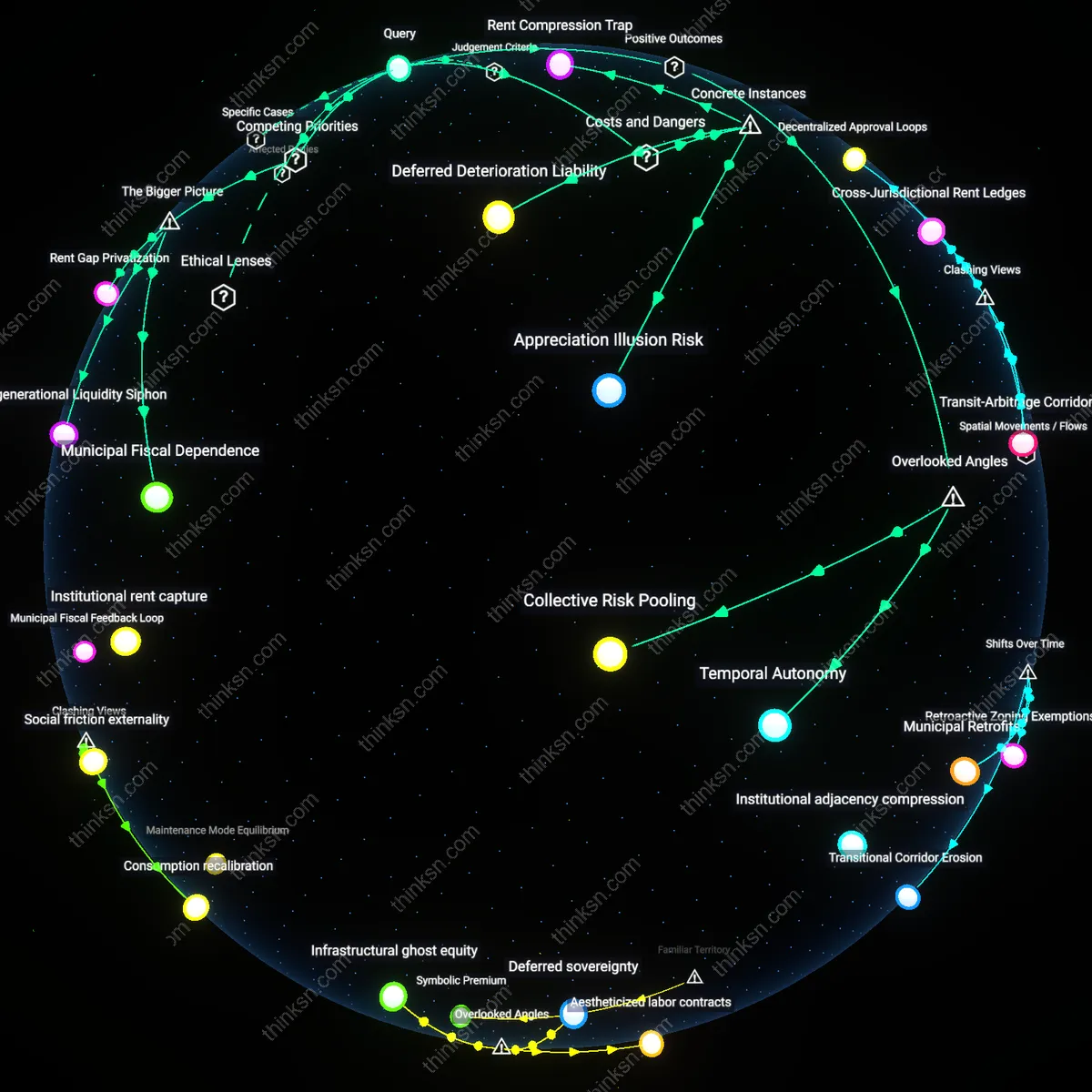
Purchasing a condo with high maintenance fees increases temporal autonomy by delegating cyclical home stewardship tasks to professional management, freeing household members to allocate cognitive bandwidth and discretionary time toward career advancement or caregiving. This benefit is most pronounced in cities like Toronto or Vancouver, where strata corporations enforce standardized repair schedules and reserve fund planning, effectively offloading long-term maintenance foresight from residents. Most financial trade-off analyses focus on cash flow but overlook the hidden utility of time and mental accounting preservation, which disproportionately benefits dual-career couples or aging homeowners facing declining physical capacity to manage repairs.
Collective Risk Pooling
High maintenance fees in urban condos enable implicit collective risk pooling against extreme capital repairs, such as balcony remediation or envelope failure, which municipalities like Vancouver are increasingly mandating due to aging mid-rise concrete buildings. Because fees are spread across units and funded progressively, individual owners avoid lumpy, ruinous special assessments that can exceed $50,000 per unit. This form of risk absorption is rarely priced into rental comparisons, yet it mimics the stabilizing function of insurance markets within a privately governed community—transforming a cost into a resilience mechanism that protects middle-wealth households from forced displacement.
Regulatory Arbitrage Access
Condo ownership grants access to municipal regulatory arbitrage by locking in density privileges and service entitlements—such as elevator access, sewage capacity, or proximity to transit—that new renters cannot obtain due to changing zoning or building codes. In cities like Montreal or Ottawa, where new rental developments face height restrictions or parking minimums, older high-maintenance condos occupy a privileged regulatory tier that ensures continued access to urban cores under outdated but grandfathered frameworks. This embedded regulatory advantage inflates long-term location utility beyond what market rent comparisons suggest, especially as cities tighten development rules in response to infrastructure strain.
Deferred Deterioration Liability
Owning a condo in Vancouver’s 2010s high-maintenance boom exposed couples to unexpected structural repair liabilities when the Wood [WE-1] building at 99 West 5th Avenue faced a $7-million special assessment in 2018 due to underfunded reserves for rain-screen failures, a risk invisible at purchase; the mechanism was strata councils legally empowered to distribute costs proportionally, turning monthly savings into overwhelming one-time bills, revealing that high fees don’t eliminate deferred maintenance — they mask it until systemic failure crystallizes, which most buyers fail to model because maintenance records and reserve fund studies are rarely audited personally.
Rent Compression Trap
In Toronto’s 2021 rental freeze under pandemic emergency measures, couples who rented comparably priced units to condos — like those in the The Rent Dupont building — found themselves locked into stable payments while neighboring owners absorbed rising fees, but the city’s sudden 2023 rent hike of 2.5% was preceded by landlords accelerating capital cost recoveries through RT units, a practice enabled by Ontario’s Landlord and Tenant Board loopholes, demonstrating how perceived rental flexibility masks a feedback loop where public policy distorts cost trajectories, trapping tenants in rising-payment cycles they cannot anticipate because cost pass-throughs are decoupled from income growth.
Appreciation Illusion Risk
Couples betting on condo ownership in Calgary’s 2014–2017 oil slump faced negative equity when downtown projects like the Icon Society Hill tower depreciated 30% while maintenance fees rose to offset low occupancy, exposing a miscalculation that assumed urban property must appreciate; the dynamic was a supply glut among newer high-rises attempting to command premium fees without corresponding demand, causing owners to pay more annually to lose value, a danger obscured by real estate marketing equating ownership with wealth-building even when market fundamentals invert.
Municipal Fiscal Dependence
Choosing to buy a condo over renting prioritizes long-term asset accumulation but forces reliance on municipal fiscal structures that externalize infrastructure costs onto fee-based governance models, where city governments offload service provision to strata corporations. This occurs because Canadian cities like Vancouver and Toronto have constrained land-based tax expansion due to political resistance to property tax increases, prompting a shift toward privatized service delivery in condos—such as maintenance, utilities, and security—funded through high monthly fees. As a result, buyers unknowingly trade public accountability for private convenience, subsidizing urban livability through strata fees rather than equitable taxation, which reveals how municipal revenue constraints reshape household financial exposure behind the scenes.
Intergenerational Liquidity Siphon
Purchasing a high-maintenance-fee condo instead of renting redirects capital from immediate lifestyle flexibility to an illiquid asset that primarily benefits future market participants, particularly younger buyers priced out of ownership. In Toronto and Montreal, low housing supply and investor-heavy markets make condos a speculative vehicle, where current owners absorb rising fees to maintain building valuations that mostly advantage future sellers, not occupants. This intergenerational transfer is amplified by provincial land transfer taxes and federal mortgage stress tests, which compress affordability and shift cost burdens toward ongoing fee payers rather than transactional ones, making ownership a form of deferred financial citizenship rather than present security.
Rent Gap Privatization
Opting to rent instead of buying a high-cost, high-fee condo exposes tenants to landlord capture of the rent gap—the difference between current rental income and potential redevelopment value—particularly in transit-oriented neighborhoods like Vancouver’s Cambie corridor, where zoning changes incentivize landlords to delay turnover and underinvest in improvements. Because municipal redevelopment policies reward holding over housing, renting becomes a de facto subsidy to eventual condo conversion or rezoning, where tenants unknowingly finance the appreciation they are excluded from. This dynamic reveals how local planning regimes convert residential stability into speculative equity, rendering rental short-termism not a personal choice but a structurally engineered outcome.