Do Large Corporate Landlords Retaliate Quicker with More Resources?
Analysis reveals 9 key thematic connections.
Key Findings
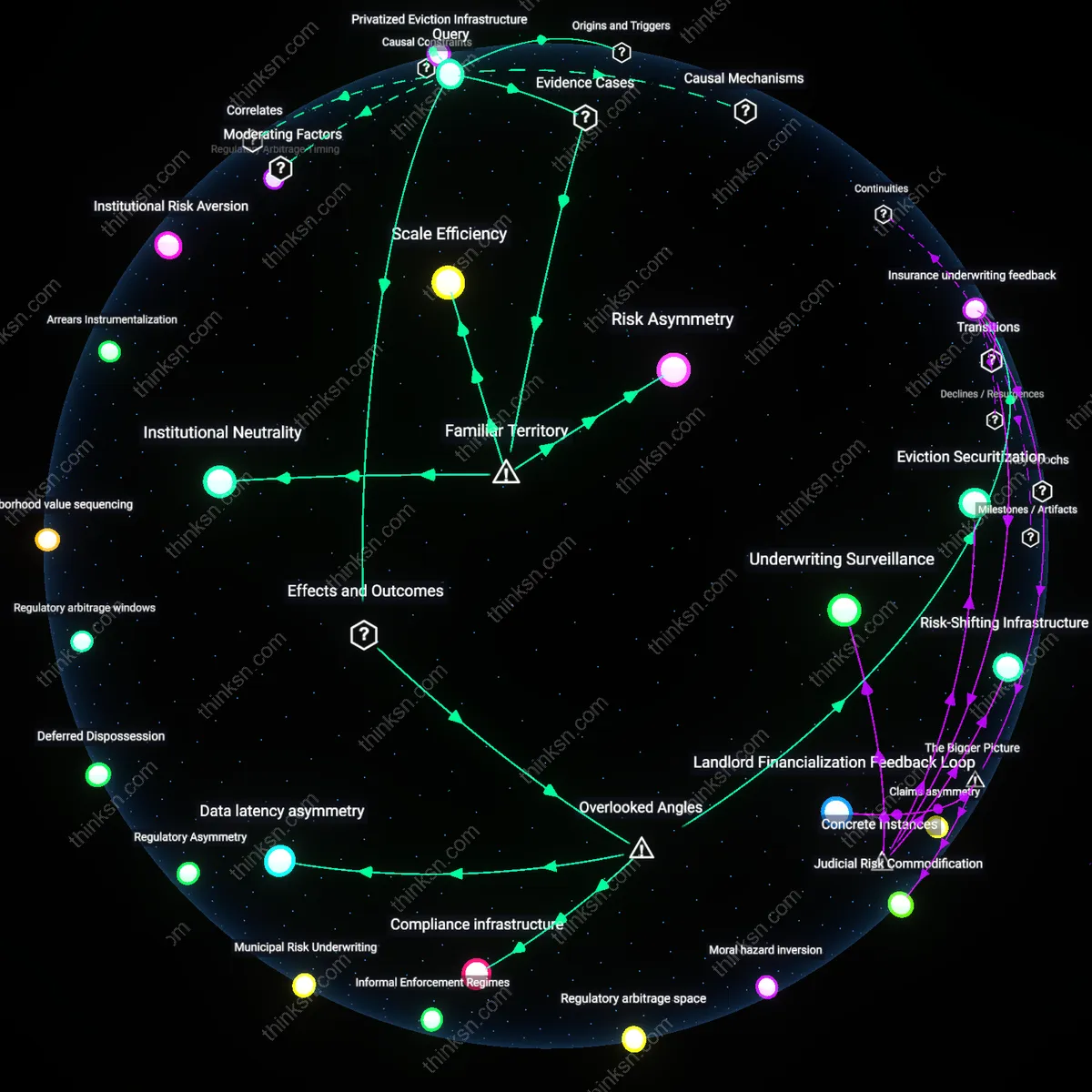
Institutional Risk Aversion
Large corporate landlords are less likely to retaliate through eviction because their decision-making is constrained by regulatory scrutiny and public relations exposure that emerged after the 2008 foreclosure crisis and the subsequent rise of tenant advocacy under the Obama-era CFPB and FHFA oversight. Corporate entities like Equity Residential or Aimco operate within heavily regulated, investor-transparent frameworks where aggressive eviction tactics trigger reputational and regulatory penalties—unlike smaller landlords who face fewer reporting requirements and less media attention. This systemic caution, institutionalized between 2010 and 2015, reveals that corporate scale now functions as a buffer against retaliation, not an enabler, reversing earlier assumptions about power and control. The non-obvious insight is that corporate self-restraint arose not from ethics but from the strategic necessity of maintaining access to capital markets and government-backed financing.
Privatized Eviction Infrastructure
Large corporate landlords use their capital and legal capacity to outsource and systematize evictions through third-party property managers and algorithmic screening tools, a shift that crystallized during the rapid financialization of housing between 2012 and 2016. Firms like Invitation Homes and Blackstone’s property divisions deploy standardized lease enforcement protocols, pre-emptive rent-collection algorithms, and automated notice systems that disperse accountability across legal subcontractors, enabling faster, more frequent evictions without direct corporate exposure. This mechanized efficiency, distinct from individual landlord vengeance, emerged from the integration of real estate into securitized debt markets where cash flow predictability demands proceduralized displacement—a move from reactive retaliation to preemptive administration. The underappreciated consequence is that eviction becomes not an act of conflict but a managed operational metric, detached from personal animus.
Tenant Portfolio Rationalization
Corporate landlords prioritize portfolio-wide rent extraction over individual tenant relationships, a strategic shift that intensified in urban markets like Atlanta and Phoenix after 2013 when private equity firms began treating rental units as algorithmically managed assets rather than homes. This transition from localized landlord-tenant dynamics to macroeconomic asset optimization means that eviction decisions are made not in response to specific behaviors but as part of broader risk-adjusted yield models, where retaining a non-paying tenant distorts actuarial targets. Unlike historical patterns where retaliation implied personal grievance, today’s evictions are side effects of statistical governance—revealing a new mode of absentee control defined by indifference rather than animosity. The non-obvious insight is that efficiency does not imply greater aggression; it implies depersonalized disengagement, where eviction is not retaliation but recalibration.
Compliance infrastructure
Large corporate landlords are less likely to retaliate through informal coercion because their public brand and institutional financing depend on maintaining a veneer of regulatory compliance, which suppresses overt acts of retaliation even when eviction is economically rational. These firms route enforcement through third-party property management platforms and automated lease compliance systems—especially in REIT-owned units in Sun Belt metro areas—that standardize tenant interactions and filter out discretionary, retaliatory actions by individual agents. The non-obvious outcome is that formalization doesn’t just enable evictions; it also constrains them, replacing personalized landlord vengeance with a depersonalized, rule-bound enforcement regime whose rigidity inadvertently protects some tenants. This infrastructure of compliance, mandated by FHA reporting, GSE underwriting standards, and ESG audits, functions as a hidden safeguard embedded in financialized rental systems.
Data latency asymmetry
Large corporate landlords use predictive maintenance algorithms and real-time rent-payment monitoring to time evictions with maximum operational stealth, reducing visible retaliation by preempting tenant resistance before it organizes. By integrating building access logs, utility usage, and payment data across portfolios—such as those managed by Invitation Homes or Equity Residential—these firms detect occupancy vulnerabilities weeks in advance, scheduling evictions during judicial lulls or municipal court backlogs to minimize publicity and opposition. The overlooked mechanism is not raw enforcement power but the strategic exploitation of time differentials between tenant awareness and corporate action, where data velocity replaces overt hostility. This latency asymmetry transforms eviction from a reactive confrontation into a quietly synchronized logistics operation, obscuring corporate agency and fragmenting community resistance.
Insurance underwriting feedback
Corporate landlords face higher insurance premiums and liability exclusions if their properties accumulate patterns of tenant complaints or fair housing litigation, creating a financial disincentive to retaliate even when operational scale makes eviction easier. In counties like Maricopa or Harris, where third-party risk assessors audit multifamily portfolios for carriers like FM Global or Zurich, clusters of tenant grievances are coded as underwriting risks, triggering site inspections or rate adjustments that affect the entire asset class. This creates a feedback loop in which the actuarial logic of property insurance—not legal oversight or public relations alone—shapes landlord behavior by penalizing not just illegal retaliation but even the statistical appearance of tenant conflict. The hidden dependency is that risk pooling mechanisms, designed to protect capital, inadvertently regulate landlord conduct at a granular, preemptive level.
Institutional Neutrality
Large corporate landlords are less likely to retaliate because their standardized lease enforcement protocols reduce personal discretion in eviction decisions. Property management firms like Equity Residential use centralized legal teams and automated compliance systems that treat lease violations as administrative rather than personal conflicts, decoupling eviction from landlord-tenant emotional friction. This creates a perception of impartiality, but the real effect is procedural inertia—decisions are slower to initiate but more systematic once triggered. The non-obvious insight is that perceived restraint is not restraint at all, but delayed, scaled enforcement masked by bureaucratic delay.
Scale Efficiency
Large corporate landlords evict more efficiently by leveraging specialized legal infrastructure and data-driven tenant screening used by firms like Invitation Homes across Texas and Florida markets. These entities maintain standing relationships with eviction mill law firms and use predictive analytics to prioritize non-paying tenants, compressing the timeline from default to filing. The mechanism operates through asset-backed securitization pipelines that require high turnover reliability, turning eviction into a routine operational metric rather than a discretionary act. The surprise is that public discourse assumes corporate size breeds caution, when in practice it enables faster, broader enforcement cycles.
Risk Asymmetry
Large corporate landlords face negligible reputational or legal consequences for eviction compared to individual landlords, making retaliation a structurally viable tool rather than a risky proposition. Entities such as GRE Alpha and other Blackstone-affiliated REITs operate behind layers of shell entities and third-party managers, insulating ownership from public scrutiny in cities like Atlanta and Phoenix. This creates a one-sided risk environment where tenants bear full legal exposure while corporations externalize ethical or community accountability. The underappreciated reality is that corporate size doesn’t temper retaliation—it codifies it into processes so distributed that no single actor is responsible, rendering pushback ineffective.