Is Homeownership Still a Safe Bet for Renters in Sun Belt Cities?
Analysis reveals 5 key thematic connections.
Key Findings
Equity Illusion
Homeownership does not provide a meaningful financial safety net for renters in Sun Belt cities because the perceived stability of home equity is inaccessible to those excluded from property markets. Renters in cities like Phoenix or Austin face rising lease costs amid surging home prices, which amplify wealth gaps but offer no direct benefit to non-owners, even during downturns when homeowners draw on equity. The dominant public narrative equates home equity with resilience, yet this mechanism operates invisibly to renters, who experience the same macroeconomic shocks without asset buffers. What’s underappreciated is how this illusion reinforces policy inertia—renters’ vulnerability is normalized because the system’s stabilizers are designed around ownership.
Tenure Mirage
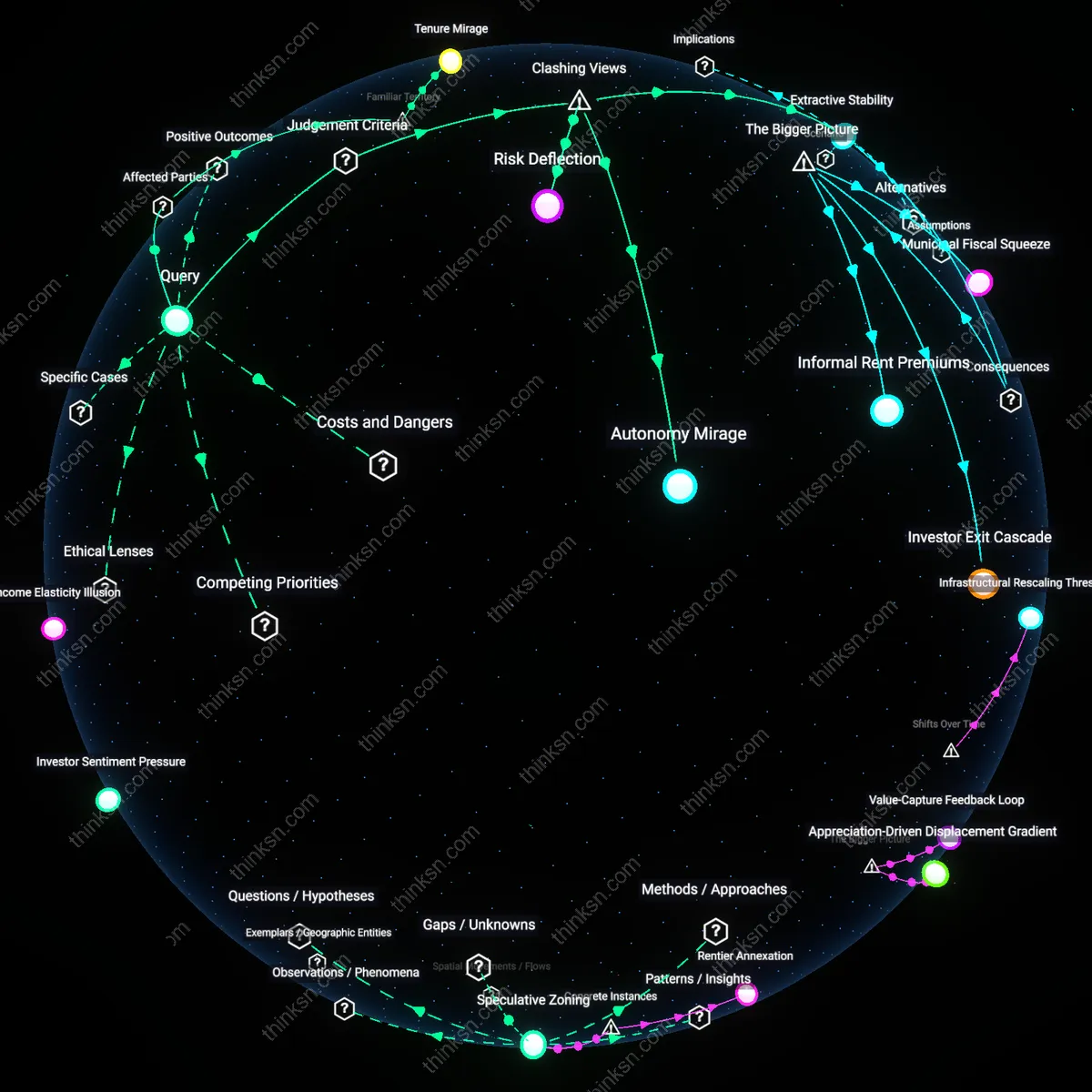
The cultural association of homeownership with economic dignity distorts renter agency by framing leasing as a failure to achieve stability, even in cities where renting is the market norm. In booming Sun Belt metros like Charlotte or Denver, renters internalize the idea that they lack a 'real' safety net, despite contributing to neighborhood value through long-term leases and community investment. This psychological burden persists because public discourse equates asset ownership with adulthood and preparedness, rendering tenant resilience invisible. What’s rarely acknowledged is that the emotional weight of this narrative reduces collective tenant advocacy—renters don’t organize as stakeholders because they’re conditioned to see themselves as temporary, not legitimate community holders.
Extractive Stability
Renters in Sun Belt cities like Austin or Tampa experience a false sense of financial resilience because rent growth outpaces income gains, transforming rental markets into engines of extraction rather than refuge during downturns. Landlords backed by institutional capital rapidly adjust rates in response to migration flows and low vacancy, effectively socializing housing risk while privatizing gains, leaving renters exposed to sudden cost shocks even as the broader economy falters. This contradicts the assumption that strong rental markets protect tenants by absorbing economic volatility — instead, they amplify it through pricing power concentrated in fragmented but highly responsive private ownership networks. The non-obvious insight is that market strength, when unregulated, undermines stability for those without asset leverage.
Autonomy Mirage
The perceived safety of homeownership during downturns is irrelevant to renters not because housing markets fail, but because renter decision-making is structurally constrained by time-limited leases and speculative landlords, making long-term financial planning a form of exposed vulnerability rather than practical agency. In Phoenix or Dallas, where single-family rentals are managed by corporate portfolios using algorithmic pricing, renters lack the autonomy to lock in terms or negotiate security, rendering their occupancy fundamentally insecure regardless of regional market metrics. This challenges the dominant narrative that a 'strong' rental market benefits renters equally — instead, it reveals that market efficiency often serves to erode tenant sovereignty under the guise of flexibility. The real cost is not just financial but agential.
Risk Deflection
Renters in high-demand Sun Belt markets bear the hidden costs of homeownership's financial insulation by absorbing systemic risk through premium pricing and security deposits that function as informal capital reserves for property owners facing mortgage volatility. When home values dip or interest rates spike, landlords in cities like Orlando or Raleigh pass stress downstream by hiking rents or reducing maintenance, converting renters into de facto risk cushions for asset-holding classes. This dynamic contradicts the idea that robust rental markets reflect balanced supply-demand — instead, they reveal a redistribution mechanism where tenant precarity subsidizes owner stability. The overlooked truth is that renter exposure isn't a market failure; it's a feature of financialized housing ecosystems.