Is The Cost Of Work-Life Balance Worth Career Spontaneity?
Analysis reveals 12 key thematic connections.
Key Findings
Spatial inertia of management norms
Organizations should prioritize dismantling the spatial inertia of management norms because middle managers in legacy industries—such as manufacturing or regional banking—still equate visibility with accountability due to evaluation systems built in the 1980s, which persist even after remote tools are adopted; this creates a structural drag where flexible work policies are technically permitted but socially penalized, distorting individual career calculations toward physical presence not for productivity but for ritual compliance. This dynamic is rarely acknowledged because most analyses focus on executive policy or employee preference, ignoring how mid-level evaluation routines fossilize outdated spatial assumptions, thereby locking in presence-based advancement despite official flexibility. The overlooked mechanism is that career progression depends less on face time itself than on the unmodified performance rituals that reward it.
Domestic time sovereignty
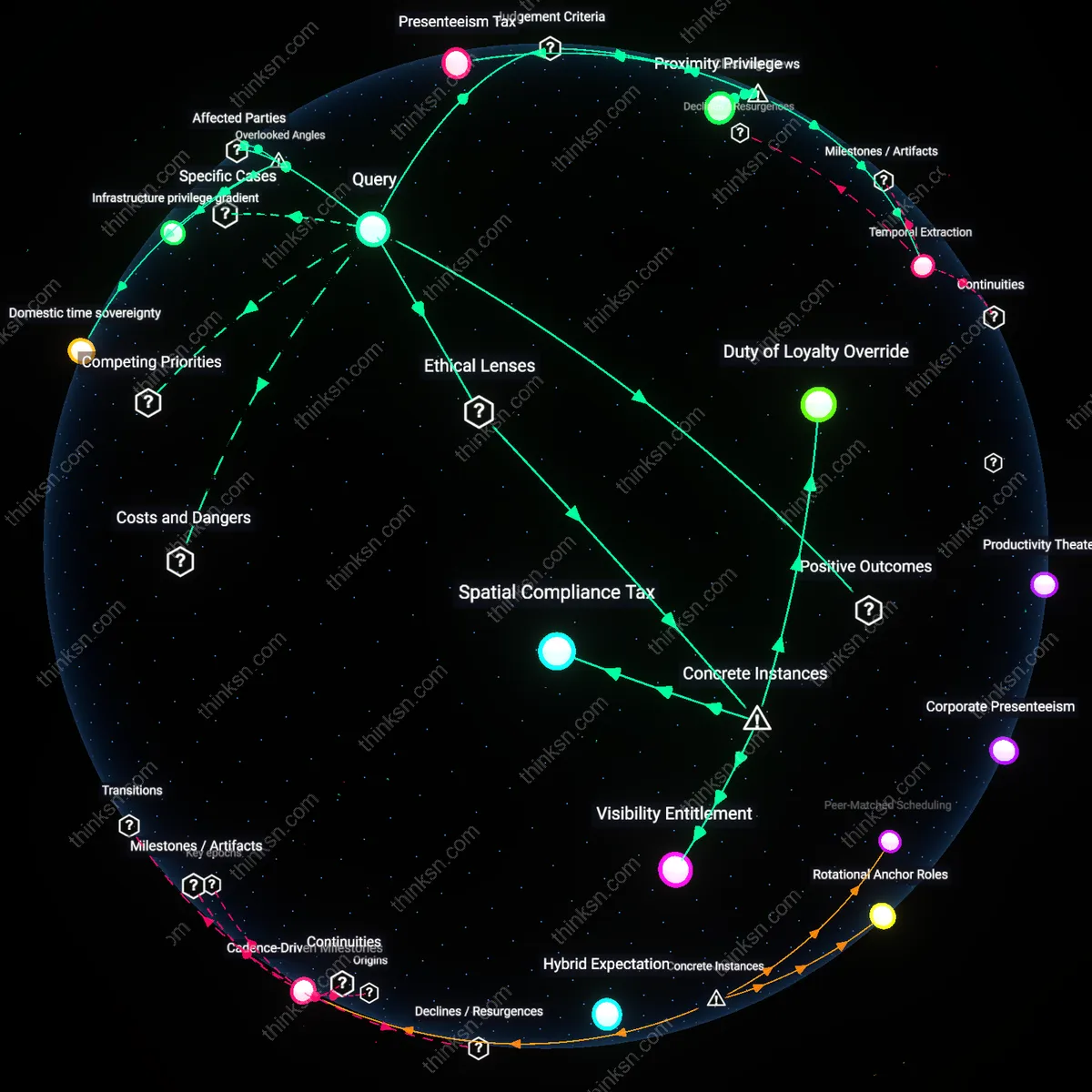
Employees in dual-career households with young children must actively defend domestic time sovereignty because the erosion of clear boundaries between office and home—fueled by hybrid work’s ‘availability creep’—shifts unpaid household coordination labor onto individuals who then face compounding career penalties when they resist workplace encroachment, especially in cultures like Japan or France where overtime is implicit in promotion. Unlike typical work-life balance discussions that treat time as a personal scheduling issue, this reframes the conflict as a territorial struggle over who controls decision rights to household temporal rhythm, revealing that physical office withdrawal can inadvertently cede domestic time to employer demands when digital presence substitutes for physical but not cultural presence. The hidden variable is that career advancement now depends on surrendering time sovereignty at home, not just office attendance.
Infrastructure privilege gradient
Professionals in secondary cities with unreliable broadband or limited co-working infrastructure face an invisible career tax that forces suboptimal physical presence in central offices, as their inability to guarantee seamless remote participation—due to local underinvestment in digital commons—makes them appear less dependable, even when policy allows flexibility. This creates a geographic class bifurcation where career mobility depends not on performance but on municipal infrastructure quality, a factor absent from mainstream discussions that assume digital connectivity as a universal baseline. The overlooked reality is that work-life balance inequities are increasingly mediated by local public goods, transforming personal choice into a function of civic underdevelopment.
Presenteeism Tax
One should refuse to treat physical presence as a career currency because it functions as an informal levy on personal time that rewards visibility over value, disproportionately taxing caregivers and those with long commutes. This tax operates through managerial reliance on proximity as a proxy for productivity, a heuristic embedded in promotion systems at firms like traditional law or consulting practices where face time correlates more strongly with advancement than documented output. The non-obvious implication is that the career benefits of presence are not rewards for performance but rather redistribution mechanisms transferring life capacity from less powerful employees to organizational norms.
Proximity Privilege
One should recognize that physical presence confers unearned career advantages tied to stable geography and bodily availability, privileging those who can afford urban housing near corporate hubs—such as junior bankers in Manhattan or tech employees in San Francisco—while excluding remote-capable workers in lower-cost or rural areas. This dynamic functions through informal networking loops (e.g., after-work drinks, hallway pitches) that embed decision-making within geographically concentrated social capital, making presence less about effort and more about spatial access. The clash lies in reframing 'work-life balance' not as a personal trade-off but as a structurally segregated distribution of career leverage based on bodily proximity.
Temporal Extraction
One should treat the expectation of physical attendance as a form of temporal extraction, where organizations capture hours beyond formal working time—commute durations, wardrobe maintenance, social grooming—that are invisible in productivity metrics but exact real personal cost. This extraction operates through corporate cultures like investment banking or agency creative work, where late stays are normed not because tasks require them, but because extended presence signals commitment, thus binding career trajectory to performative endurance. The underrecognized mechanism is that work-life imbalance is not a byproduct but a calculated feature that converts personal sovereignty into organizational loyalty metrics.
Hybrid Expectation
One should prioritize scheduled in-office engagement only during critical collaboration phases of a project, thereby gaining visibility and team coherence while preserving remote autonomy the rest of the week. This approach emerged after the 2020–2023 normalization of remote work, when tech firms like Google and Salesforce shifted from mandatory returns to ‘flex-week’ models, revealing that sporadic physical presence optimized relationship-building without requiring daily commutes; the underappreciated insight is that career advancement no longer depends on constant proximity but on strategically timed co-location during decision-forming moments.
Proximity Capital
One should treat office attendance as an investment in informal influence, attending in person during organizational transitions such as leadership changes or restructuring, when spatial access to decision-makers accelerates career mobility. From the 1980s to the early 2000s, corporate hierarchies rewarded physical endurance—long hours in headquarters—but the post-2008 era, marked by mobile tech and initial remote experimentation, redefined presence not as obligation but as tactical positioning; the overlooked dynamic is that proximity became scarce, thus more valuable, during moments of institutional flux.
Temporal Flexibility
One should align physical presence with generational shifts in labor values, particularly after 2020, when Gen Z entered the workforce expecting location independence as a default, forcing firms like Accenture and Spotify to institutionalize results-only work environments. The shift from equating office hours with dedication to measuring output performance revealed that career progression could be decoupled from bodily presence, making staggered in-person engagement a negotiated credential rather than a fixed norm; the unexamined consequence is that work-life balance is no longer sacrificed at scale but re-negotiated individually, altering workplace power dynamics.
Duty of Loyalty Override
One should prioritize work-life balance when physical presence becomes a coercive proxy for commitment, as seen in the 2015 Amazon warehouse uprisings where managers penalized remote-capable employees who refused onsite labor despite equivalent productivity, invoking corporate loyalty norms to justify spatial control. This mechanism reveals how ethical frameworks based on fiduciary duty—rooted in principal-agent theory—can be weaponized to erode personal autonomy, normalizing overwork under the guise of organizational trust. The non-obvious insight is that physical presence, when detached from functional necessity, functions as a ritual of subordination rather than a measure of contribution.
Spatial Compliance Tax
One should treat mandatory physical presence as a regressive labor tax when it disproportionately burdens lower-wage workers, exemplified by the 2023 Los Angeles Metro bus operators who, though deemed essential, were denied hybrid scheduling while higher-tier transit managers worked remotely—exposing how spatial compliance embeds class stratification within labor ethics. Grounded in Rawlsian fairness, this arrangement violates the difference principle by imposing avoidable burdens on the least advantaged, revealing that attendance mandates often reflect power asymmetry rather than operational need.
Visibility Entitlement
One should resist equating physical presence with professional value when proximity is exploited for hierarchical surveillance, as occurred at IBM's 2017 forced return-to-office policy that specifically targeted mid-tier engineering roles while shielding executive teams from the same mandate, illustrating how utilitarian arguments for 'collaboration gains' legitimize visibility-based privilege within meritocratic ideology. The overlooked mechanism is that presence requirements are often calibrated not to maximize collective outcomes, but to satisfy managerial desire for perceptual control—turning office attendance into a visible performance of allegiance.