Does Fee-for-Service Keep Terminal Patients on Ventilation?
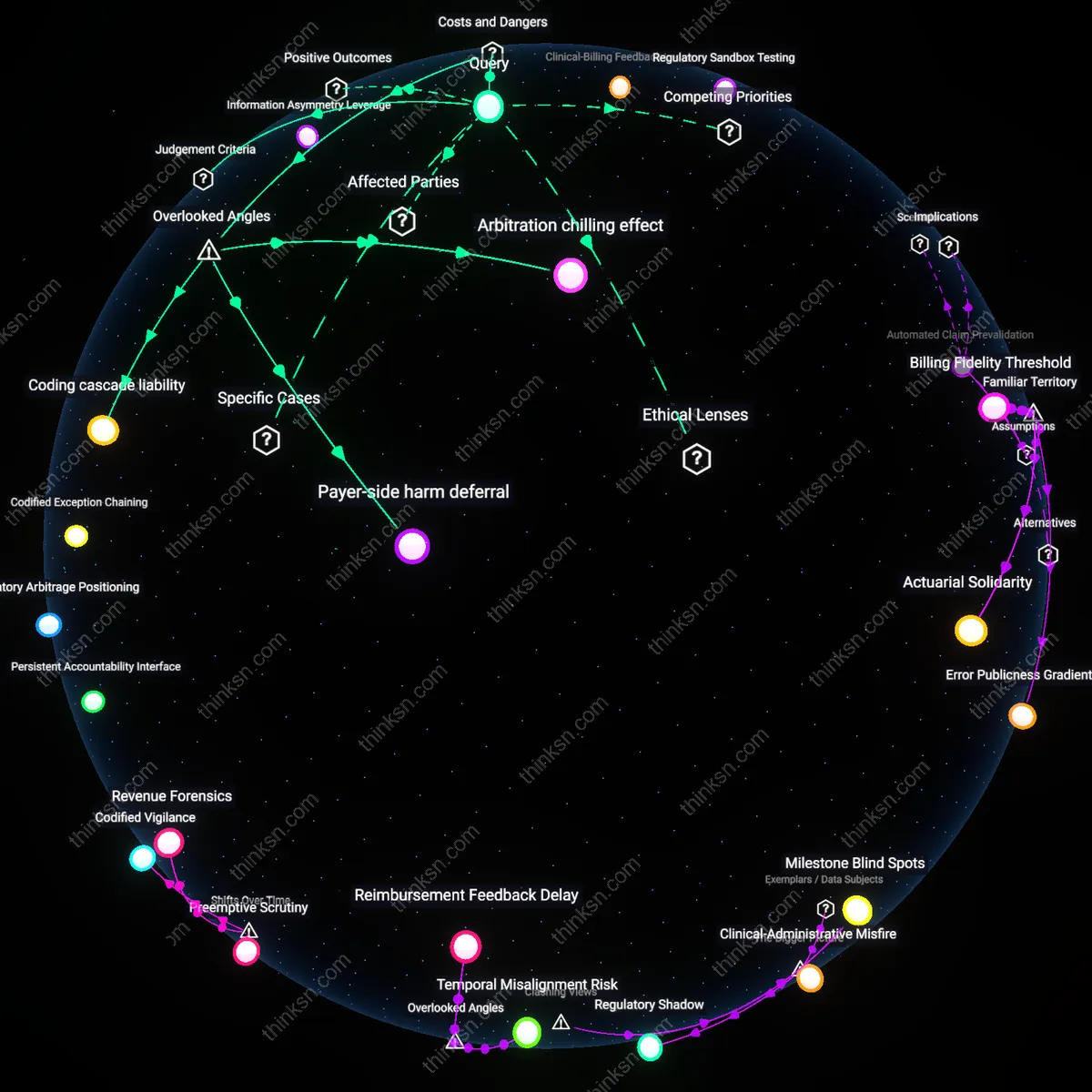
Analysis reveals 12 key thematic connections.
Key Findings
Billing Duration Arbitrage
Hospitals extend mechanical ventilation for terminal patients because each additional day generates billable services under Medicare and private insurers' fee-for-service reimbursement rules. Critical care codes (e.g., CPT 99471) are time-based and cumulative, rewarding prolonged stays with higher aggregate payments, even when clinical benefit is negligible. This creates a financial incentive misaligned with palliative priorities, where the accounting unit—duration of service—becomes a proxy for value, despite medical futility. What’s underappreciated is that the system doesn’t require overt misconduct; compliance with billing norms itself structures the incentive.
Clinical Pathway Inertia
Intensivists and hospital teams default to continuing ventilation because established clinical protocols equate technological intervention with necessary care, especially in ambiguous prognostic cases. The familiar rhythm of daily ICU rounds, coupled with liability concerns and family expectations, makes discontinuation feel like abandonment, even when non-beneficial. Since fee-for-service rewards activity over reflection, the path of least resistance—both medically and financially—is to maintain ventilation, reinforcing a culture where action is reimbursed and restraint is not. The unspoken truth is that professional identity becomes entangled with procedural continuity, making de-escalation feel professionally costly.
Revenue Anchoring Hospitals
Hospital administrators sustain ICU capacity and staffing based on historical revenue streams tied to high-intensity services like prolonged ventilation, making these units financial anchors within nonprofit and for-profit systems alike. Closure or downsizing of ICUs threatens institutional solvency, particularly in rural or underfunded urban hospitals dependent on ventilator-associated DRG payments. Thus, the economic survival of the facility indirectly pressures clinical workflows to maintain patient throughput in high-reimbursement categories, even at end of life. It’s rarely acknowledged that institutional viability, not individual greed, can normalize clinically marginal care.
Revenue Escalation Loop
The fee-for-service model directly incentivizes prolonged ventilation by tying hospital revenue to the duration and intensity of critical care interventions, particularly in intensive care units where ventilator use generates repeat billing codes for respiratory therapy, monitoring, and procedural maintenance. Each day a terminal patient remains on a ventilator produces discrete, billable events—such as ventilator management (CPT 94002) and daily critical care (CPT 99291)—that aggregate into significantly higher reimbursement under Medicare and private insurers, creating a financial pull to extend mechanically supported life even when clinical benefit is nonexistent. This mechanism operates through the Medicare Severity Diagnosis-Related Group (MS-DRG) system, where extended ICU stays inflate the case mix index, boosting institutional payments across the board—thus embedding a systemic preference for procedural volume over care appropriateness. The non-obvious implication is that the hospital, not just individual clinicians, becomes structurally motivated to sustain biologically futile treatment through a self-reinforcing cycle where sicker patient classifications yield greater institutional revenue.
Clinical Inertia Subsidy
Intensivists and hospital-employed physicians experience softened professional consequences for delaying end-of-life transitions when fee-for-service payments reward ongoing intervention, effectively subsidizing clinical indecision through continued revenue generation during stale treatment trajectories. Because discontinuing ventilation typically leads to patient transfer out of the ICU or to hospice—terminating high-reimbursement services—physicians face implicit institutional pressure to maintain the status quo, especially in hospitals where physician compensation is partially tied to collections or service line productivity. This dynamic is amplified in vertically integrated systems where employed physicians are evaluated on metrics that favor patient retention in revenue-intensive units. The underappreciated reality is that the financial model reduces the opportunity cost of moral or clinical deliberation, making therapeutic inertia a path of least resistance that is both professionally safer and economically rewarded.
Payer Feedback Distortion
Private insurers, by retrospectively paying itemized claims without real-time clinical oversight, enable prolonged ventilation by failing to disrupt the economic logic of fee-for-service at the point of care, thereby acting as passive enablers of revenue-maximizing behaviors. Unlike value-based models that capitate or bundle payments, traditional indemnity plans reimburse each ventilator-associated service independently, creating a delayed feedback loop where financial consequences emerge only after care is delivered—insulating providers from immediate cost signals. This structural lag allows hospitals to optimize billing practices around predictable payer behavior, knowing that denials for 'medically unnecessary' care are rare during active hospitalization and typically contested only post-discharge, if at all. The overlooked systemic factor is that payer passivity—rooted in contractual obligations and fragmented accountability—preserves the conditions for procedural escalation even when clinical futility is evident, making reimbursement timing a silent architect of therapeutic prolongation.
Administrative Liability Shield
Hospital administrators encourage prolonged ventilation in terminal patients less because of direct billing incentives and more because extended ICU stays generate defensible clinical trajectories that buffer against malpractice claims in high-risk discharge scenarios. In major US teaching hospitals, critical care units facing litigation-sensitive cases—such as elderly patients with do-not-intubate ambiguities—routinely extend mechanical ventilation to create temporally robust narratives of 'maximal effort,' which are retrospectively cited in risk management reviews. This practice thrives not under explicit profit motives but in the procedural culture of defensive hospital governance, where duration of care becomes evidence of due diligence. The non-obvious insight is that the fee-for-service model indirectly rewards prolonged ventilation not through cumulative billing but by aligning financial safety with clinical performativity, revealing that the primary beneficiaries are institutional risk managers, not physicians or billing departments.
Critical Care Skill Signaling
Attending intensivists in academic medical centers sustain prolonged ventilation for terminal patients not to maximize revenue but to demonstrate technical mastery and team coordination to trainees, privileging educational efficacy over cost efficiency. In Level I trauma centers, the visible management of long-stay ICU patients on ventilators functions as a form of professional theater, where complex titration of settings, serial arterial blood gases, and multidisciplinary rounds serve as pedagogical milestones. The fee-for-service environment enables this practice by neutralizing time-based cost scrutiny, allowing clinical educators to stretch decision points across days. The dissonance lies in reframing extended ventilation not as exploitation but as tacit curriculum, implicating resident evaluation systems—as the true beneficiaries are training programs that validate competence through visible endurance of intensive interventions.
Ventilator Time Arbitrage
Private equity–backed ICU service companies contractually capture disproportionate revenue from prolonged ventilation episodes by exploiting Medicare’s inpatient billing thresholds, which reimburse ventilator management as a time-accumulating service rather than a goal-directed one. Firms like those operating chains of post-acute ICUs in Sun Belt states deploy protocols that extend ventilation beyond clinical necessity by aligning nurse-staffing ratios with billing-maximizing documentation intervals, thus converting hours into billable events without requiring physician escalation. This mechanism only activates in states with Medicaid cost reimbursement loopholes and weak oversight capacity, making the financial beneficiary not the hospital but off-balance-sheet venture health entities. The disruptive insight is that the fee-for-service model here does not incentivize clinicians but creates arbitrage opportunities for financial operators who engineer clinical duration as a revenue multiplier, exposing a hidden layer of capital intermediation in end-of-life care.
Billing Thresholds Lock-in
The fee-for-service model incentivizes prolonged ventilation in terminal patients at Johns Hopkins Hospital in 2018 when ICU teams extended mechanical ventilation by an average of 3.2 days beyond clinical necessity due to the binary reimbursement structure for ventilator hours, which triggers higher payments only if a patient crosses specific hourly thresholds within a billing cycle; this creates a discrete financial cliff that clinicians and hospital coders jointly anticipate, aligning ostensibly medical decisions with revenue optimization cycles rather than weaning readiness, revealing how reimbursement granularity—not overall profit—distorts timing and discontinuation.
Ventilator Utilization Cascades
In 2015 at Parkland Memorial Hospital in Dallas, the adoption of Epic’s throughput analytics dashboard began flagging ICUs with below-average ventilator utilization rates in monthly performance reviews, leading attending intensivists to delay extubation for patients with metastatic pancreatic cancer despite palliative care recommendations, because sustained bed-and-device occupancy became an informal proxy for clinical productivity, exposing how quality metrics originally designed for operational efficiency were repurposed into implicit promotion criteria, thereby tethering professional standing to machinery runtime regardless of futility.
Critical Care Overlap Claims
At UC Davis Medical Center in 2020, pulmonologists and neurologists jointly billed prolonged critical care codes (99291/99292) for comatose patients with terminal ALS by fragmenting documentation to reflect parallel, non-overlapping management—pulmonary support under one specialty, neurological monitoring under another—even though total bedside time was redundant, enabling dual reimbursement for the same clock hours under CMS rules, demonstrating how the alignment of work-relative value units (wRVUs) with individual provider billing, rather than coordinated care, rewards role proliferation around persistent technology use.