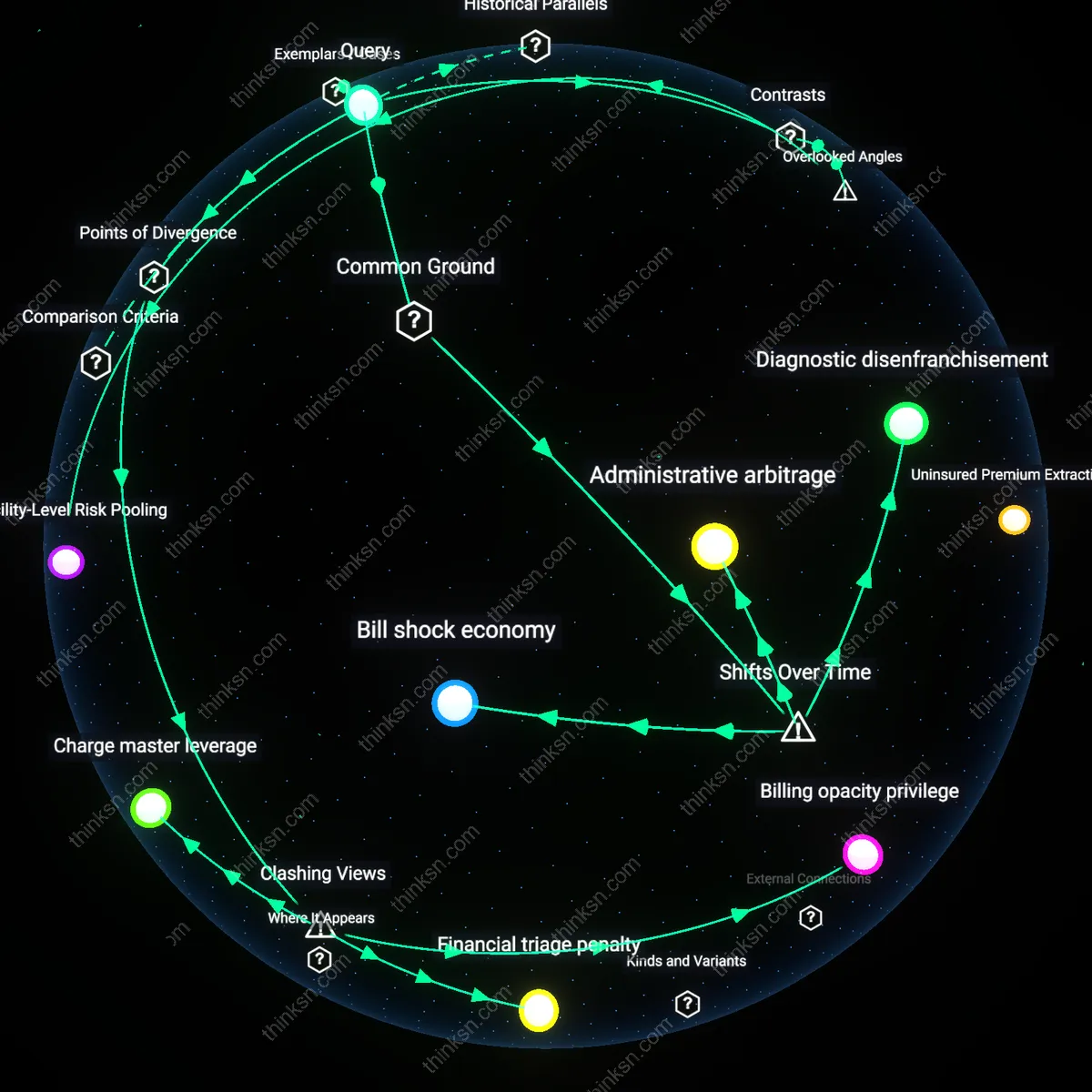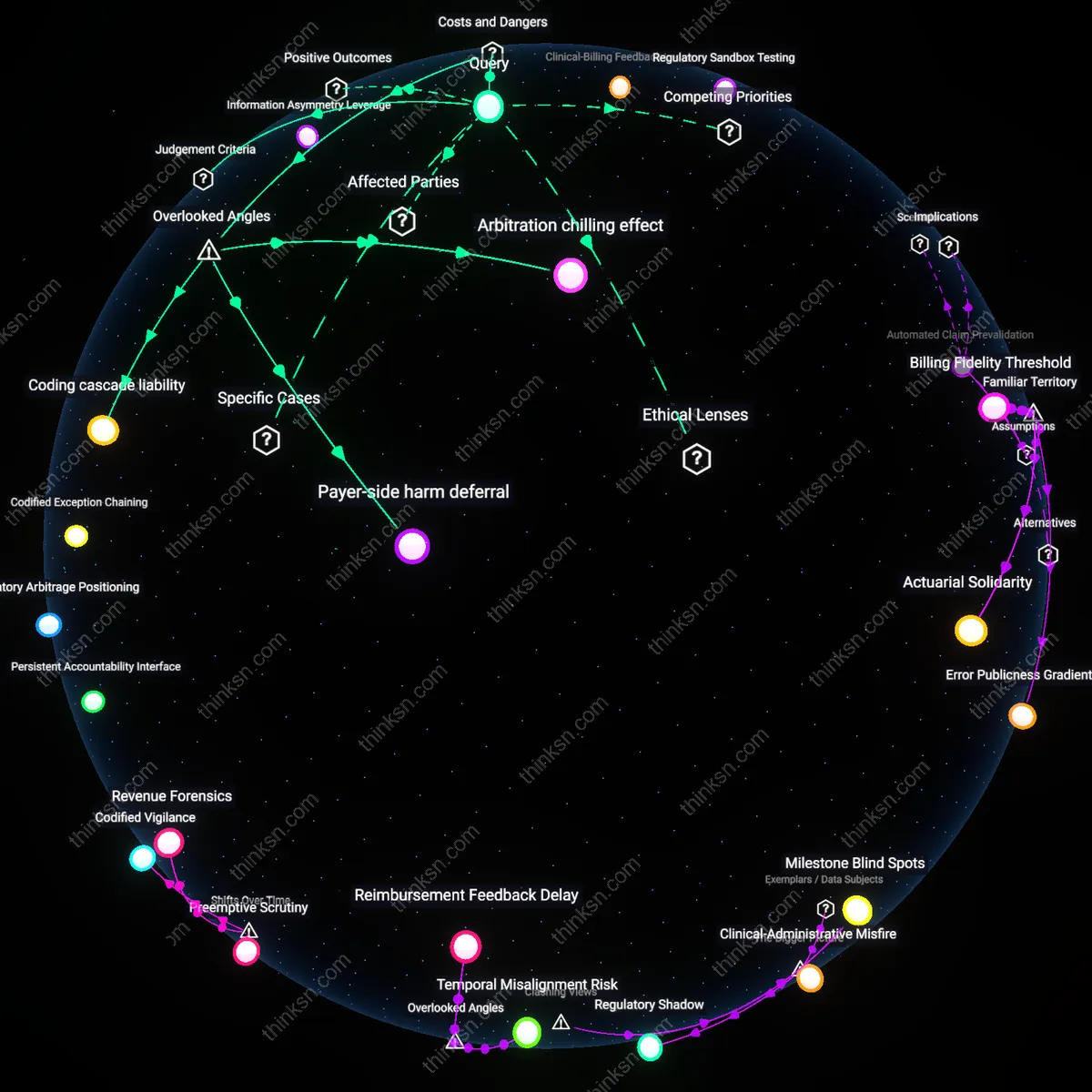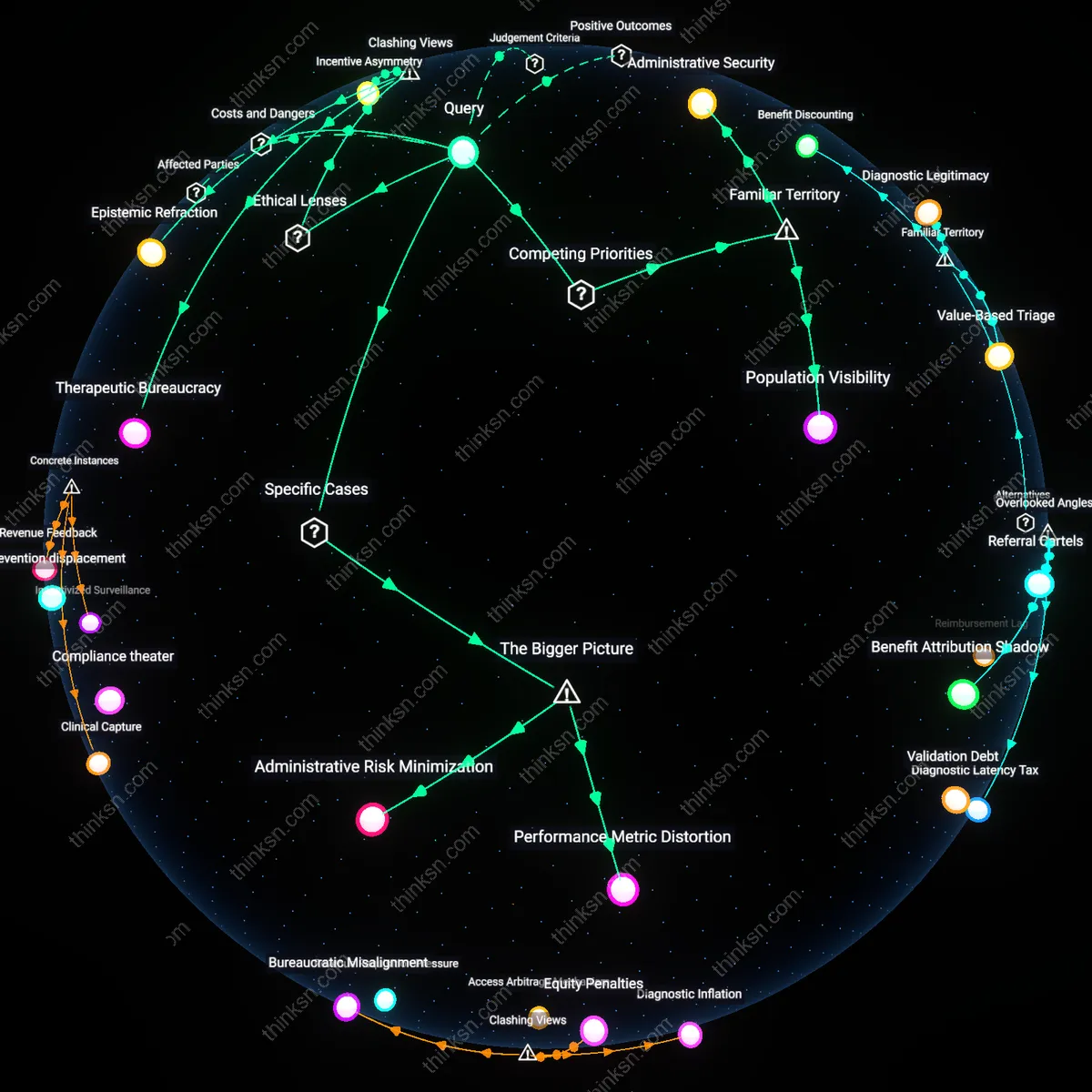
Who Profits from Surprise Billing and Its Impact on Patient Finances?
Analysis reveals 10 key thematic connections.
Key Findings
Revenue Lock-in
Surprise billing benefits hospital systems by triggering non-negotiable payment obligations through emergency care defaults. When patients receive unscheduled treatment at out-of-network facilities, insurers cannot deny coverage due to emergency care mandates—this creates a guaranteed revenue stream that bypasses cost-containment protocols. The mechanism operates through EMTALA’s (Emergency Medical Treatment and Labor Act) federal requirement to stabilize patients before transfer, which insurers must reimburse even without prior network agreements. This undermines long-term financial planning not because patients miscalculate, but because the legal-medical cascade invalidates insurance predictability at the point of crisis, rendering coverage illusions of control.
Temporal Arbitrage
Insurance administrators benefit from surprise billing by deferring financial responsibility into legal gray zones where accountability dissipates across time and jurisdiction. When unexpected charges emerge post-service, insurers often delay or partially pay claims, betting that patient exhaustion or litigation costs will prevent resolution. The mechanism exploits procedural latency—patients face immediate medical decisions but only discover financial consequences weeks later, when dispute windows have narrowed. This undermines long-term planning not via upfront cost, but by stretching the decision-payment interval beyond human cognitive bandwidth, transforming uncertainty into systemic inertia that advantages administrative delay as a profit strategy.
Provider Revenue Protection
Hospitals and physician groups benefit directly from surprise billing by capturing revenue otherwise lost due to insurance gaps or narrow networks. This occurs primarily in emergency care settings where patients cannot shop for in-network providers, allowing out-of-network practitioners to charge significantly above negotiated rates. The mechanism is sustained by legal permissibility in many states and patient inability to contest charges post-service, making it a structurally reinforced financial backstop for providers—what feels like patient exploitation in the moment is, from the provider side, a hedge against systemic underpayment. The non-obvious insight within this familiar narrative of billing abuse is that surprise billing functions not just as opportunistic profiteering but as a calculated response to unstable reimbursement models in fragmented insurance markets.
Insurance Design Arbitrage
Private insurers benefit indirectly from surprise billing by shifting cost uncertainty onto patients while preserving their own network fee schedules and premium structures. When patients enroll in plans with narrow networks or high deductibles—often marketed as lower-cost options—they unknowingly expose themselves to out-of-network charges that insurers have no obligation to cover. This arbitrage hinges on regulatory tolerance for network opacity and patient misprediction of care pathways, especially in urgent scenarios. The underappreciated reality, despite widespread blame placed on doctors and hospitals, is that surprise billing exposes how insurance product design itself creates financial vulnerabilities insurers are structurally indifferent to.
Predictability Erosion
Patients with unstable or ambiguous insurance coverage suffer compounded decision paralysis in health crises because surprise billing destroys the reliability of cost forecasting, even when care is medically necessary. In emergency rooms or during unplanned surgeries, individuals cannot exercise consumer-like control over provider selection, rendering pre-care financial planning meaningless. This systemic unpredictability discourages proactive engagement with insurance benefits and amplifies avoidance of needed care, particularly among underinsured populations. The overlooked consequence within common outrage over 'junk bills' is that surprise billing doesn't merely extract one-time payments—it systematically degrades trust in financial agency over health decisions.
Specialty Service Capture
Surprise billing financially benefits specialty physicians working in hospital emergency departments by enabling them to charge above-network rates when patients cannot pre-select in-network providers, a mechanism made possible by fragmented provider-hospital contracting and inconsistent insurance network disclosures; this dynamic disproportionately affects uninsured or high-deductible plan holders who only discover cost exposure after care, revealing how structural misalignment between provider employment and billing autonomy disrupts patient cost forecasting despite insurance enrollment.
Backloaded Financial Exposure
Patients with intermittent insurance coverage face long-term financial planning instability because surprise billing introduces unpredictable six- to seven-month lagged medical debt obligations that co-occur with employment volatility, particularly among gig economy workers in states without continuous coverage mandates; this temporal disconnection between care delivery and cost realization undermines credit-based planning mechanisms, exposing how asynchronous financial consequences exploit gaps in safety-net eligibility timing and amplify economic precarity.
Private Equity Capture
Private equity firms such as Welsh, Carson, Anderson & Stowe profit from surprise billing by acquiring emergency medicine groups and incentivizing aggressive out-of-network billing at hospitals in states without robust balance-billing protections, as seen in their ownership of TeamHealth—where physician compensation structures prioritize revenue extraction over patient affordability. This mechanism depends on fragmented insurance regulation and hospital reliance on outsourced emergency staffing, enabling financial investors rather than clinicians to control billing practices. What is underappreciated is that surprise billing functions not merely as a pricing failure but as a deliberate asset-stripping strategy within healthcare consolidation, where patient financial vulnerability is monetized systematically.
Regulatory Arbitrage Space
In Texas, prior to 2021, physicians at outpatient surgical centers like those operated by Specialty Surgical Center of Dallas exploited gaps between federal protections and state-level enforcement by remaining out-of-network while performing elective procedures, thereby exposing insured but cost-averse patients to surprise bills despite apparent in-network facility status. This dynamic persisted because federal 'prudent layperson' rules only covered emergency care, leaving ambulatory settings unregulated and creating a legal gray zone where providers could legally bill beyond patient expectations. The overlooked reality is that surprise billing thrives not in outright lawlessness but in jurisdictional seams—where overlapping but incomplete regulations enable calculated exploitation.
Actuarial Obscurity
Patients enrolled in self-funded employer plans governed by ERISA—such as those administered by Walmart for its hourly workforce—are disproportionately exposed to surprise bills because these plans are federally exempt from state balance-billing laws and often lack transparent claims adjudication, allowing third-party administrators like UnitedHealth Group to shift cost uncertainty onto workers during critical care episodes. This occurs because ERISA preempts state consumer protections while enabling opaque reimbursement protocols that neither patients nor providers can appeal effectively. The non-obvious consequence is that financial unpredictability becomes structurally embedded in employment-based coverage, undermining long-term planning not through malice but through regulatory invisibility.