Insurance Codification Gaps
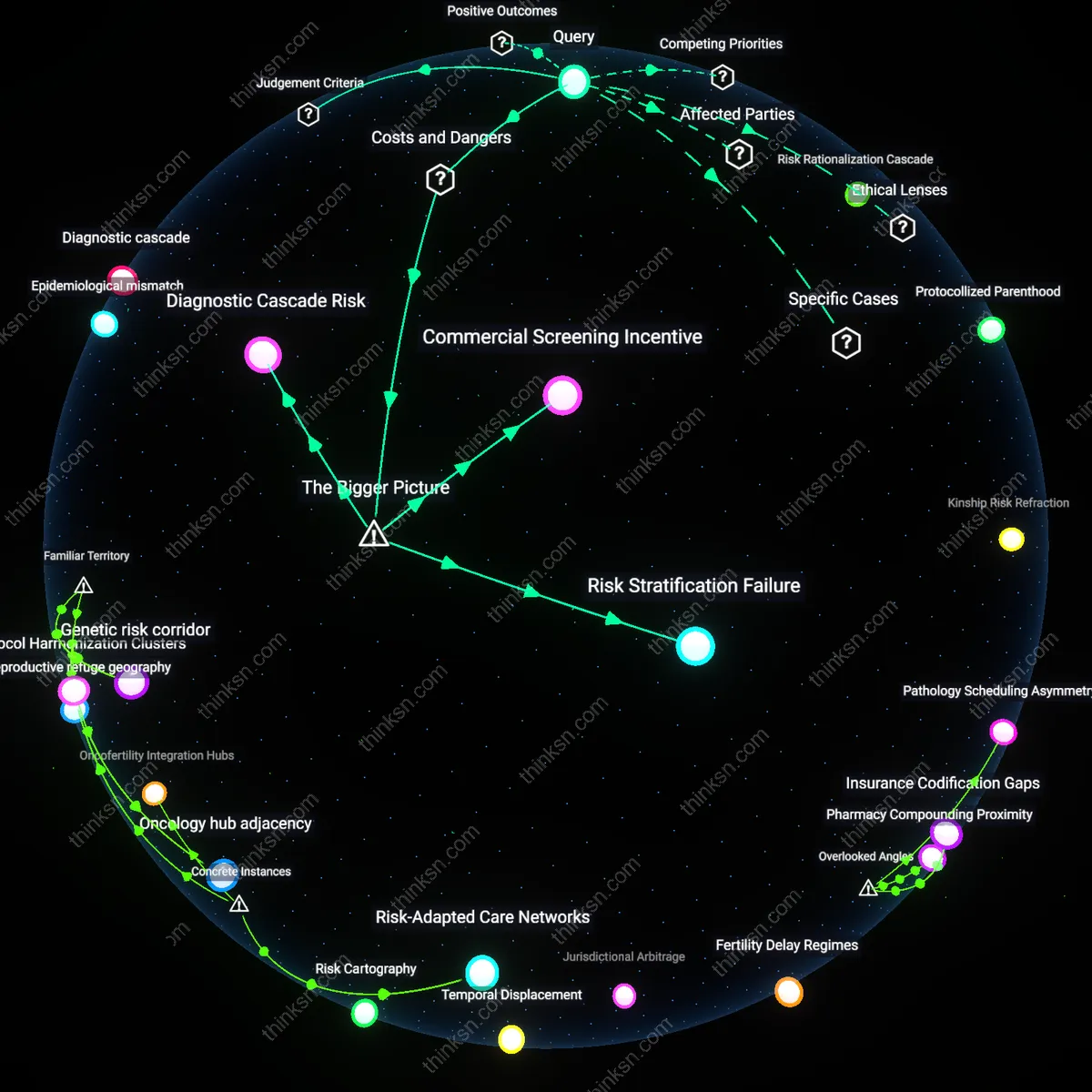
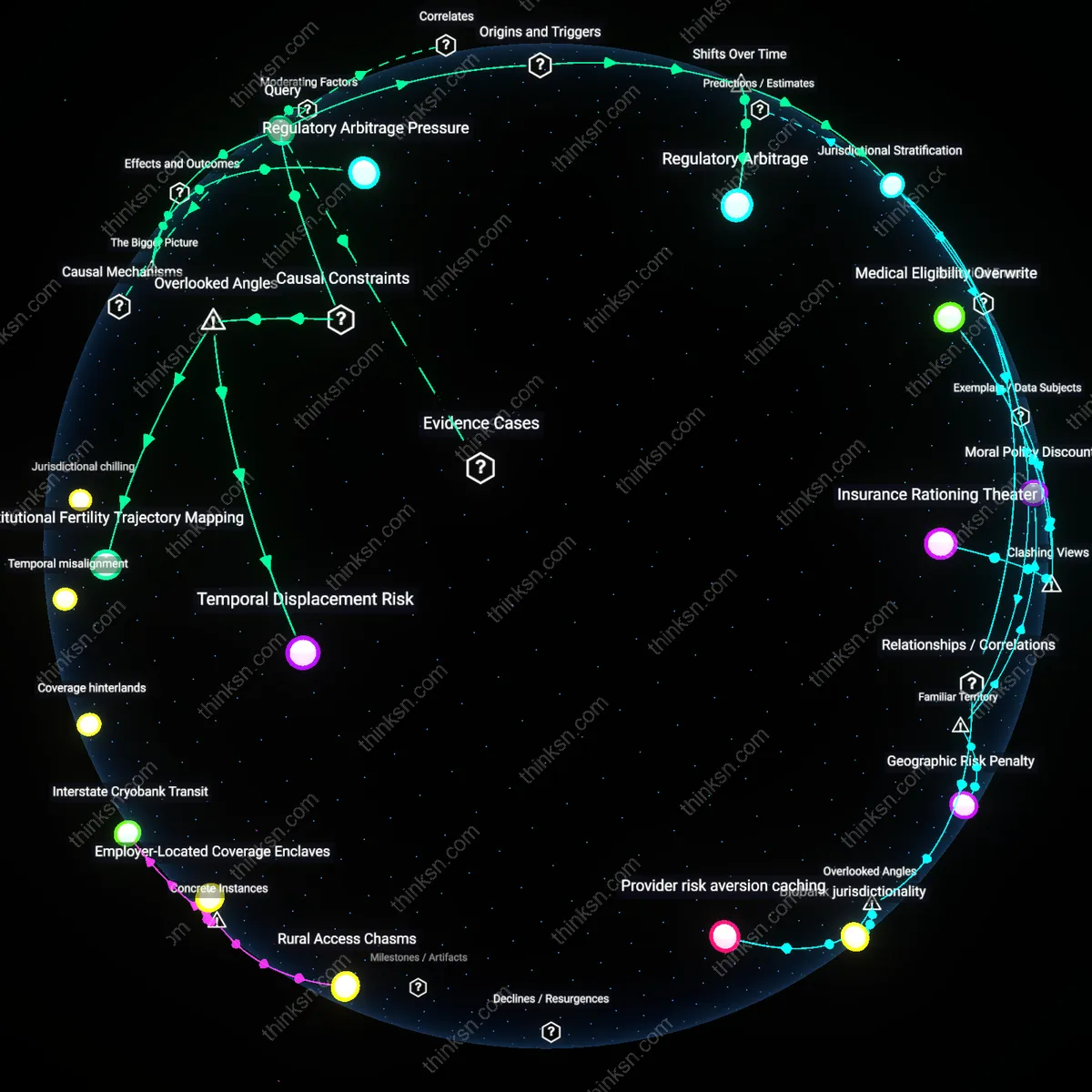
Fertility preservation services for BRCA-positive women are spatially clustered not around oncology centers but around academic medical systems with internal insurance billing innovation units that can reclassify fertility procedures under reproductive risk mitigation codes. These units exploit ambiguities in ICD-10-CPT crosswalks to justify coverage where standalone fertility preservation would otherwise be denied, creating dense service pockets in bioregions like Boston and San Francisco while leaving rural and Southern areas medically 'off-grid.' The overlooked mechanism—insurance code reclassification logic within self-insured academic hospitals—matters because it shifts the determinant of access from geographic proximity to cancer stage and instead to the presence of administrative teams skilled in strategic medical coding, a factor absent from public health maps of fertility care access.
Pathology Scheduling Asymmetry
The scheduling conflict between fertility preservation and cancer screening in BRCA-positive women is disproportionately resolved through ad hoc pathology lab overbooking in tertiary referral hospitals during non-biopsy seasons, where frozen-section analysis capacity is temporarily redirected from surgical margins to ovarian tissue diagnostics. This seasonal repurposing of pathology infrastructure—driven not by patient demand but by annual lulls in surgical oncology volume—creates a latent fertility preservation corridor in winter months at institutions like MSKCC and Dana-Farber, a rhythm invisible to care coordination platforms that treat lab capacity as static. The overlooked factor is the seasonal fluctuation of surgical pathology workloads, which silently governs the feasibility of synchronizing IVF cycles with risk-reducing timelines, thereby making temporal access a function of institutional surgical calendars rather than patient biology.
Pharmacy Compounding Proximity
Young BRCA-positive women receive fertility preservation drugs faster when near specialty pharmacy compounding facilities certified in non-FDA-compliant gonadotropin preparations, particularly in states with looser enforcement of federal compounding regulations like Texas and Florida. These pharmacies, often co-located with fertility clinics operating under 'research exception' protocols, bypass national drug shortages by reformulating protocols at the edge of regulatory tolerance, thus compressing the time between genetic confirmation and oocyte retrieval. The overlooked dependency—on-site compounding capabilities as a temporal accelerator—matters because national guidelines assume uniform drug availability, yet the true bottleneck shifts from clinical scheduling to local pharmaceutical logistics, reshaping the spatial distribution of timely care around regulatory arbitrage zones rather than oncology density.
Jurisdictional Arbitrage
Fertility preservation clinics for young BRCA-positive women operate predominantly in cross-border medical hubs like Tel Aviv, Zurich, and Bangkok, where national regulations on embryo creation and storage are more permissive than in countries with restrictive reproductive laws. These clinics function through deliberate jurisdictional relocation, enabling patients from Germany, Italy, or Canada—where BRCA status alone doesn’t expedite access—to bypass domestic screening synchronicity requirements by receiving fertility services abroad while maintaining cancer surveillance at home. This spatial decoupling reveals that clinical coordination is less a medical challenge than a regulatory workaround, undermining the assumption that integrated care must occur within a single national health system.
Temporal Displacement
The dominant model assumes fertility preservation must align temporally with cancer screening cycles, but leading programs like those at MSKCC and Rigshospitalet now intentionally desynchronize the two by medically accelerating puberty or inducing temporary ovarian quiescence to create procedural gaps for egg retrieval outside standard screening windows. This deliberate misalignment reframes reproductive urgency not as a constraint to be managed within existing oncology timelines but as a condition that can structurally distort biological tempo, exposing how clinical authority can override chronological synchrony in the service of preemptive reproduction.
Risk Cartography
Clinics offering coordinated fertility and screening services for BRCA-positive youth are not distributed according to cancer incidence or healthcare funding but along fault lines of legal tolerance for reproductive risk—visible in outlier programs in Amsterdam, Melbourne, and Palo Alto that function as cartographic exceptions where liability norms permit doctors to jointly adjust screening intervals and freezing protocols. These sites don’t reflect medical best practices per se but instead reveal a hidden mapping of acceptable risk deviation, showing that geographic access is determined not by medical need but by localized thresholds for professional liability absorption.
Oncology hub adjacency
Clinics offering fertility preservation for young BRCA-positive women are primarily located within or adjacent to major academic oncology centers in urban medical districts, such as those in Boston, New York, and San Francisco. These clinics operate through integrated multidisciplinary teams that co-locate oncologists, reproductive endocrinologists, and genetic counselors, enabling rapid coordination between cancer risk management and fertility interventions. The proximity to high-volume cancer screening infrastructure allows these programs to adjust screening timelines in sync with ovarian stimulation cycles or cryopreservation procedures, a coupling that is often invisible to patients who assume fertility services are standalone. What’s underappreciated in public understanding is that the physical adjacency to oncology hubs—not just clinical affiliation—is what enables the scheduling plasticity these women need, making spatial location a functional enabler of medical flexibility.
Genetic risk corridor
Fertility-preserving programs for BRCA-positive women cluster along established corridors of high-density hereditary cancer clinics, such as those radiating from Myriad Genetics’ historical referral partners or the National Comprehensive Cancer Network (NCCN) member institutions. These zones form a de facto 'genetic risk corridor' where screening protocols are already calibrated to BRCA-specific guidelines, allowing fertility programs embedded within them to adapt ovulation induction schedules around early MRI or mammography timelines. The mechanism relies on shared electronic health records and protocol harmonization across subspecialties, which only mature over time in regions with concentrated BRCA surveillance activity. Most people associate genetic risk with individual testing, not recognizing that the geographic concentration of expertise creates a permissive environment for fertility interventions to be safely sequenced within shortened cancer screening windows.
Reproductive refuge geography
The most accessible programs are situated in states with protective reproductive health policies, such as California, Illinois, and Massachusetts, where legal shielding of fertility services enables clinics to initiate preservation even when cancer risk is imminent but not yet active. These locations function as reproductive refuges by decoupling fertility intervention from immediate cancer diagnosis, allowing BRCA-positive women to undergo egg or embryo freezing before prophylactic surgeries or intensified screening regimens begin. The enabling condition is state-level regulatory space that permits preemptive care, which in turn attracts specialized funding and personnel. While the public often frames fertility preservation as a clinical decision, its geographic distribution reveals it is equally shaped by jurisdictional sanctuary effects—where policy, not just medicine, defines accessibility.
Genomic Transit Hubs
Major academic medical centers like MD Anderson and Dana-Farber began serving as destination nodes for BRCA-positive young women migrating from regions with limited reproductive oncology infrastructure starting in the mid-2000s, driven by the consolidation of specialized fertility preservation clinics within NCI-designated cancer centers. These institutions became spatial anchors where prophylactic surgery timelines are recalibrated alongside egg retrieval cycles, functioning as fixed points in an emergent national referral network. The non-obvious temporal shift lies in how post-2010 clinical guidelines formalizing fertility-sparing protocols transformed previously ad hoc patient migrations into structured flows shaped by insurance approval lags and windowed treatment windows, revealing a routinized form of high-risk gynecological pilgrimage.
Fertility Delay Regimes
Between 2013 and 2018, multidisciplinary clinics at sites like the University of Pennsylvania and UCSF institutionalized time-bending protocols that intentionally decelerate standard BRCA-risk management trajectories to accommodate oocyte cryopreservation prior to risk-reducing salpingo-oophorectomy. These programs operate through coordinated halts in the traditional ‘diagnose–screen–operate’ sequence, inserting elective delays into screening schedules that were once rigidly age-based. The historically distinct feature of this shift—anchored in the widespread uptake of preimplantation genetic testing—is not just medical accommodation but the deliberate pathologization of temporal inflexibility itself, making delay a newly legitimized therapeutic category rather than a deviation.
Oncofertility Integration Hubs
The Oncofertility Consortium at Northwestern University coordinates fertility preservation with oncology care for BRCA-positive young women by embedding reproductive endocrinologists within cancer centers, enabling real-time adjustments to screening and fertility protocols. This integration operates through a multi-specialty referral network linking the Center for Fertility Preservation and the Robert H. Lurie Comprehensive Cancer Center, where genetic risk informs both cryopreservation timing and delayed breast surveillance. The significance lies in its operationalization of concurrent risk management—fertility preservation is no longer sequenced after cancer risk mitigation but co-planned, revealing that structural co-location of specialties enables temporal alignment of competing clinical priorities.
Protocol Harmonization Clusters
Memorial Sloan Kettering Cancer Center’s BRCA Young Adult Program adjusts MRI-based breast screening schedules to bracket oocyte retrieval cycles, ensuring that intensified surveillance does not disrupt fertility interventions. By compressing screening windows around hormonal stimulation phases, the program exploits the short-term predictability of ovarian response to tailor imaging timelines, thus avoiding delays in egg freezing. This case reveals that protocol plasticity—adjusting screening cadences to reproductive biology rather than rigid annual intervals—is clinically feasible and hinges on protocol-level coordination, not just provider communication.
Risk-Adapted Care Networks
The Manchester Centre for Genomic Medicine implements a centralized risk-adapted care pathway for BRCA1/2 carriers that integrates fertility timelines into personalized cancer surveillance plans using a digital decision-support platform shared across gynecologic oncology, reproductive medicine, and clinical genetics. This system flags fertility preservation windows during initial genetic counseling, triggering concurrent referrals before risk-reducing surgeries are scheduled. The non-obvious insight is that data infrastructure—not just clinical will—enables preemptive coordination, making fertility preservation visible in upstream genetic workflows rather than as a reactive afterthought.