Do HSAs Change the Game for Sick Self-Employed Folks?
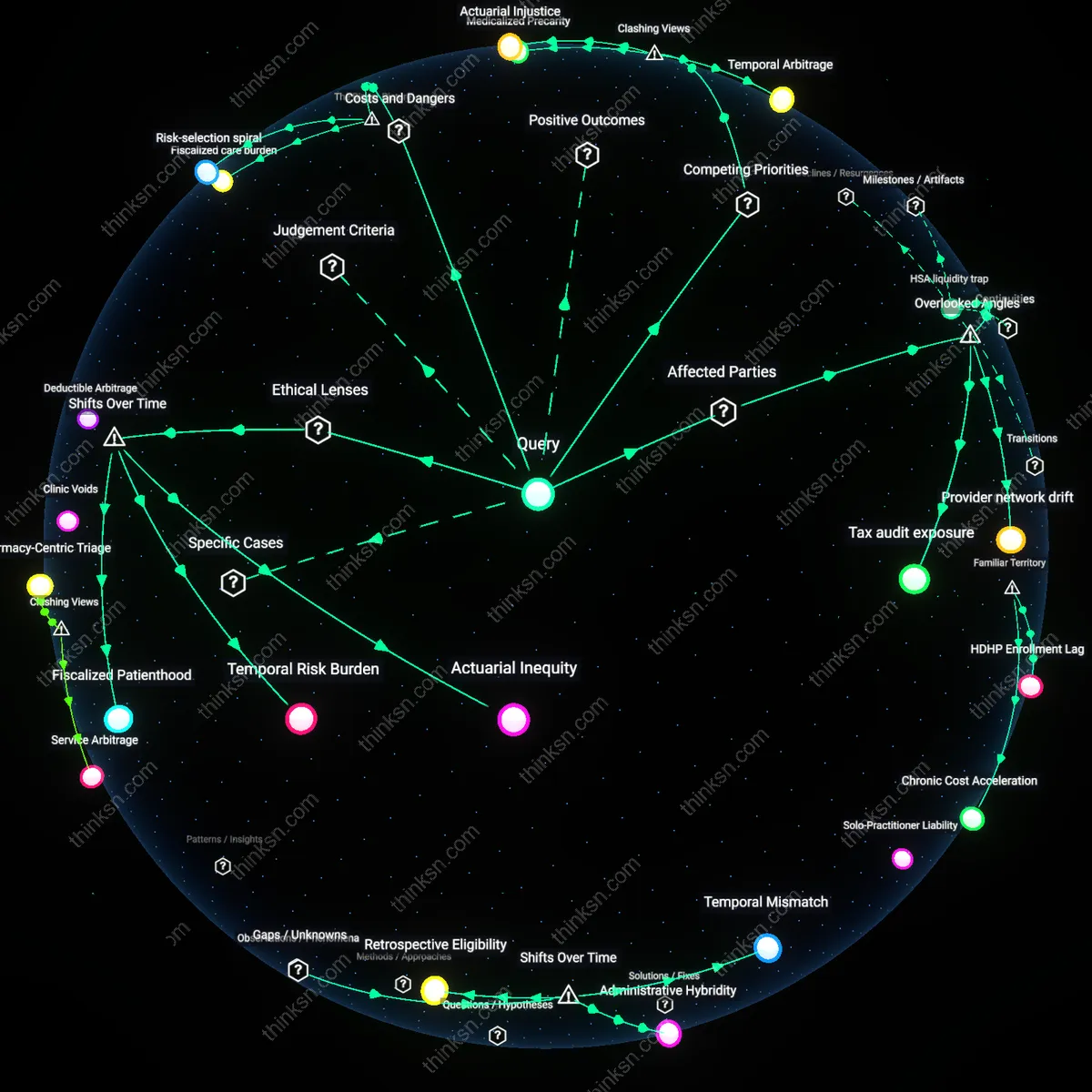
Analysis reveals 12 key thematic connections.
Key Findings
HSA liquidity trap
For a self-employed person with a chronic condition, having a health savings account (HSA) option can worsen short-term affordability despite long-term tax advantages because early-year out-of-pocket costs often exceed the HSA contribution flow, forcing reliance on high-interest credit or delayed care. This dynamic particularly affects freelancers with irregular monthly income—such as independent contractors in gig platforms—who cannot time medical expenses to match HSA fund availability, creating a liquidity gap that undermines the assumed cost-benefit superiority of high-deductible plans paired with HSAs. The overlooked mechanism is the temporal mismatch between when care is needed and when HSA funds accumulate via payroll-like contributions, which matters because most benefit analyses assume smooth, annualized spending rather than episodic, urgent demand. This reveals the HSA liquidity trap as a structural flaw for income- and health-vulnerable groups.
Provider network drift
The presence of an HSA-eligible plan significantly alters treatment access for chronically ill self-employed individuals by incentivizing insurers to narrow provider networks in ways that covertly shift cost-sharing onto patients through out-of-network care, even when they believe they are staying within coverage. Because HSA plans are tied to high-deductible health plans (HDHPs), insurers minimize risk by contracting selectively with lower-cost clinics, which changes over time as providers exit networks due to reimbursement disputes—particularly in rural counties where specialists for chronic conditions like rheumatology or endocrinology are scarce. Most cost-benefit models treat network stability as fixed, but in reality, the volatility of participating providers under HDHPs creates a hidden re-contracting risk that can invalidate projected savings, thereby making the HSA-linked plan more expensive in practice than anticipated. The phenomenon of provider network drift exposes a temporal fragility in access that is rarely priced into individual calculations.
Tax audit exposure
Opting into an HSA increases the likelihood of IRS scrutiny for self-employed individuals with chronic conditions because irregular contributions, misclassified expenses, or improper reimbursements from HSAs trigger disproportionate audit risk relative to other tax-advantaged accounts, especially when medical claims are high and recurring. These individuals often manage filings without professional support—common among sole proprietors using platforms like TurboTax—and may retroactively withdraw funds for past expenses without proper documentation, violating IRS substantiation rules. While HSAs offer triple tax advantages, the compliance burden and evidentiary trail required (e.g., receipts stored for years, precise coding of eligible items) create an underappreciated administrative tax exposure that can erase financial benefits if penalties accrue. This dimension reframes HSAs not just as savings tools but as vectors of fiscal surveillance, where health vulnerability translates into heightened audit risk.
Risk-selection spiral
Offering a health savings account with a marketplace plan intensifies adverse selection by incentivizing only healthier enrollees to adopt high-deductible plans, which destabilizes risk pools and increases cost exposure for chronically ill self-employed individuals. Insurers respond to this imbalance by raising premiums or narrowing coverage, a dynamic amplified in state-based marketplaces where participation is limited and regulatory oversight permits tiered product segmentation. This mechanism is masked by the surface-level benefit of tax-advantaged savings, obscuring how account eligibility reshapes aggregate risk distribution through individual enrollment behavior, ultimately elevating systemic costs for the most medically vulnerable.
Fiscalized care burden
For a self-employed person with a chronic condition, tying healthcare affordability to a health savings account transforms medical necessity into a fiscal performance obligation, where consistent outlays for care compete directly with retirement savings, tax compliance, and business liquidity needs. This shift depends on the IRS-defined HDHP structure that forces enrollees to manage care timing and intensity based on accumulated HSA balances rather than clinical necessity—a condition enforced by lack of federal wealth subsidies comparable to employer-sponsored plans. The underappreciated systemic effect is that clinical decision-making becomes administratively mediated by account balance monitoring, effectively offloading risk management costs onto individuals least equipped to absorb them.
Policy asymmetry trap
The inclusion of an HSA option in marketplace plans entrenches a structural inequity where self-employed individuals face higher net costs than employer-affiliated peers due to absent payroll-based HSA funding and mismatched tax treatment, creating a hidden penalty for non-wage labor. This arises because federal tax code enables employers to contribute to HSAs pre-tax while self-employed individuals can only deduct contributions post-income calculation, weakening effective subsidy rates. The broader consequence—rarely visible in individual cost-benefit analyses—is that policy design incentivizes informality or underreporting of income to avoid cost exposure, feeding a cycle of precarious coverage and downward pressure on marketplace sustainability.
Medicalized Precarity
Having an HSA option intensifies financial risk exposure for self-employed individuals with chronic conditions because it shifts long-term care costs from pooled insurance mechanisms to individual capital accumulation under the guise of 'empowerment,' making metabolic health management a form of speculative self-investment. This mechanism favors episodic, preventable care over sustained therapeutic continuity, as HSA incentives align with tax-advantaged savings rather than disease-modifying treatments. The non-obvious contradiction is that the freedom to save tax-free undermines the stability needed to manage irreversible health decline—revealing that the account’s structural logic treats illness as a calculable risk to be managed through market discipline, not as a lived condition requiring guaranteed support.
Actuarial Injustice
HSA eligibility disproportionately excludes sicker self-employed enrollees from deductible-driven savings, rendering the benefit functionally inaccessible when most needed and reinforcing a paradox where the promise of cost control strengthens only for the relatively healthy. The marketplace plan’s design couples high deductibles with HSA access, which presumes sustained out-of-pocket capacity—an assumption violated by chronic disease trajectories. This exposes the counterintuitive reality that the more medical care one requires, the less the HSA option improves cost-benefit outcomes, revealing a systemic bias where financial incentives are structured to reward low utilization, not high need.
Temporal Arbitrage
The HSA option reconfigures healthcare decision-making for chronically ill self-employed individuals around future tax savings rather than present therapeutic necessity, privileging delayed fiscal benefit over immediate health maintenance. Because contributions accrue tax-free and withdrawals for qualified expenses are untaxed, the account incentivizes postponing treatment to align with funding cycles, effectively turning medical timing into a financial optimization problem. The underappreciated conflict is that this framework rewards strategic non-treatment, framing cost efficiency as intertemporal gain rather than care adequacy—revealing how fiscal planning mechanisms can distort clinical judgment through stealth.
Actuarial Inequity
The introduction of Health Savings Accounts (HSAs) in the mid-2000s under the Medicare Prescription Drug, Improvement, and Modernization Act of 2003 redefined cost-benefit rationality for self-employed individuals with chronic conditions by privileging long-term saving logics over immediate care access, embedding a neoliberal ethical framework that frames health responsibility as individualized and market-mediated; this shift transformed high-deductible plans from fringe options into mainstream vehicles, disproportionately disadvantaging those with ongoing medical needs whose expenditures rarely reach the deductible threshold where catastrophic coverage activates, thereby normalizing a form of actuarial discrimination that remains invisible under consumer-choice rhetoric.
Temporal Risk Burden
Prior to the Affordable Care Act’s underwriting reforms in 2014, self-employed individuals with chronic conditions faced medical underwriting that often excluded them from favorable HSA-eligible plans altogether, but the post-ACA era inverted this exclusion by legally guaranteeing access while retaining high-deductible structures, thereby shifting the ethical burden from overt denial to deferred financial risk; this transition, anchored in the tension between the ACA’s egalitarian access mandates and the HSA’s origins in conservative small-government ideology, produces a temporal dislocation where cost-benefit calculations favor the financially resilient over the chronically ill, whose future health instability is monetized but not mitigated.
Fiscalized Patienthood
The integration of HSAs into marketplace plans since 2010 has progressively recast self-employed individuals with chronic conditions not as patients within a care continuum but as fiscal agents managing tax-advantaged accounts within a privatized health economy, a transformation accelerated by IRS rulings that prioritize contribution limits and rollover privileges over medical utility; this evolution, rooted in the Reagan-era separation of insurance from employment-based security and culminating in 21st-century health consumerism, institutionalizes a political ideology where ethical worth is measured by financial preparedness rather than medical need, revealing how chronic illness is now managed through budgeting disciplines rather than therapeutic ones.