Why Do Retaliation Claims Fail in Tech More Often Than Not?
Analysis reveals 9 key thematic connections.
Key Findings
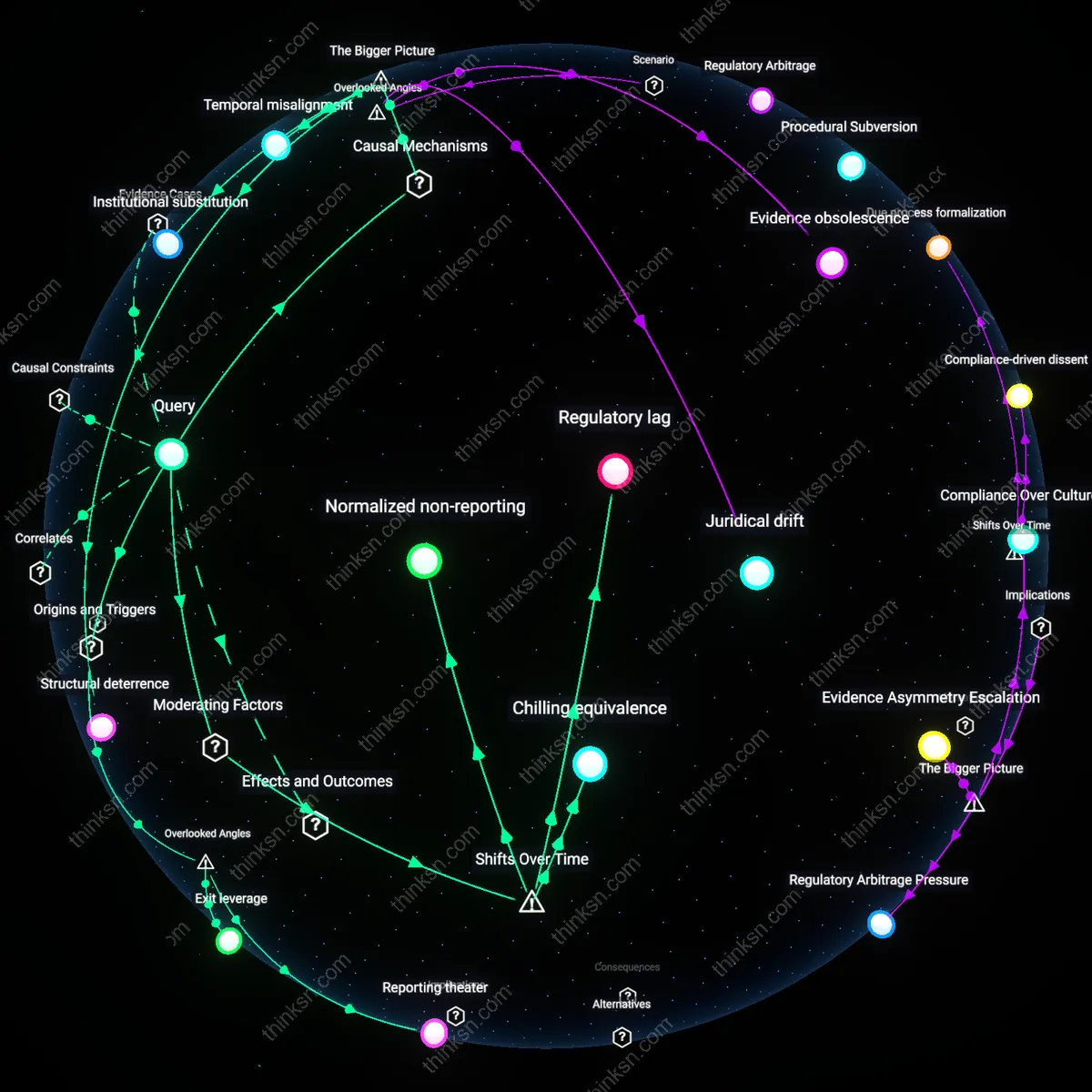
Reporting theater
The low rate of successful retaliation claims in the tech sector indicates that internal reporting functions more as a procedural performance than a protective channel, designed primarily to satisfy compliance optics rather than enable meaningful redress. Tech companies, particularly in Silicon Valley, have structured internal ethics and HR systems to document reports exhaustively while insulating decision-makers through layered delegation and neutralized escalation paths. This creates an institutional illusion of responsiveness—what functions as 'reporting theater'—where employees are heard but rarely empowered, and outcomes favor the preservation of managerial discretion over substantive change. What is typically overlooked is that the procedural adequacy of internal systems, not their fairness or efficacy, determines legal defensibility, which decouples their design from actual protection and embeds a hidden incentive to perform concern without enabling accountability.
Credibility arbitrage
The low success rate of retaliation claims reveals that employees who report internally in tech firms often unknowingly surrender epistemic authority over their own experiences to corporate-defined narratives of misconduct. When incidents are reported, tech companies deploy forensic HR units and internal investigations that reframe events using sanitized, behaviorally coded language—transforming whistleblowing into 'cultural misalignment' or 'interpersonal friction'—thereby stripping the original claim of its moral and legal valence. This dynamic of credibility arbitrage allows firms to re-author the meaning of the offense in ways that preempt legal standing, a mechanism rarely visible in discussions that assume evidence speaks for itself. Most analyses miss that control over narrative construction, not evidence collection, is the decisive battleground in retaliation cases, fundamentally altering the power geometry of internal reporting.
Exit leverage
The rarity of successful retaliation claims reflects not the ineffectiveness of external legal action, but the extent to which tech workers with credible claims opt out of both internal and legal channels in favor of rapid labor market exit. High-demand technical roles, especially in software engineering and AI research, grant employees a unique form of exit leverage—where moving to another firm is faster, less risky, and more rewarding than enduring the reputational and emotional toll of a formal dispute. This silent attrition drains the pool of legally actionable cases before they materialize, creating a false impression that internal reporting works or that grievances are minor. The overlooked reality is that market liquidity for skilled labor functions as a shadow dispute resolution mechanism, one that suppresses legal data while masking systemic harm under the appearance of functional mobility.
Structural deterrence
The low rate of successful retaliation claims in the tech sector indicates that internal reporting is structurally deterred by hierarchical power asymmetries within engineering-driven organizations. In most large tech firms, reporting channels route through managerial chains where technical leads and HR jointly control access to investigation resources, creating a built-in conflict of interest when supervisors are implicated; this suppresses formal escalation not because reporting fails externally, but because legitimacy is withdrawn from grievances before they reach legal thresholds. The underappreciated dynamic is that retaliation often occurs preemptively—via sidelining in project assignments or denied promotions—rendering victims ineligible for legal standing before a claim can even be filed, which reflects how organizational design functions as a silent enforcement mechanism.
Institutional substitution
The low rate of successful retaliation claims in the tech sector indicates that internal reporting systems function as institutional substitutes for external legal action, absorbing grievances without resolving their root causes. Tech companies deploy ombudspersons, anonymous hotlines, and A/B-tested employee feedback loops that simulate accountability while insulating executives from liability, effectively transmuting legal risks into human resources workflows managed internally. This substitution is sustained by venture capital governance models that reward rapid scaling over compliance depth, making procedural demonstration of 'concern' more valuable than outcome equity—revealing that the legal system is being quietly offloaded onto corporate mediation architectures that mimic justice without enforcing it.
Temporal misalignment
The low rate of successful retaliation claims in the tech sector indicates that external legal action is undermined by temporal misalignment between bureaucratic adjudication timelines and industry employment cycles. Whistleblower lawsuits often take 3–5 years to resolve, but median job tenure in tech is under two years, meaning employees typically exit before proceedings mature, forfeiting continuity of claim and evidentiary control to legal teams funded by well-resourced defendants. This time divergence is structurally exploited through settlement offers timed to coincide with career transitions, exposing how the velocity of labor mobility in innovation economies becomes a systemic enabler of impunity despite legal availability.
Normalized non-reporting
The low rate of successful retaliation claims in the tech sector since the mid-2010s indicates that internal reporting has become structurally disincentivized due to the normalization of non-disclosure and informal resolution practices. As tech firms scaled rapidly post-2010, they substituted formal compliance channels with HR-mediated peer review and culture-fit mediation, which deprioritized documentation and legal accountability in favor of team cohesion and speed—making employees less likely to escalate externally even when harmed. This shift reveals how the sector’s growth-era emphasis on agility has suppressed formal grievance pathways not by blocking access but by culturally neutralizing their legitimacy, rendering retaliation claims rare because incidents are reframed as cultural mismatches rather than legal wrongs.
Regulatory lag
The scarcity of successful external retaliation claims since the early 2020s reflects the declining alignment between internal reporting outcomes and external legal standards, as tech sector self-regulation evolved faster than labor enforcement frameworks. After the 2018 wave of platform worker protests and whistleblower disclosures, companies implemented AI-driven monitoring and rapid response teams that preemptively absorbed complaints before they could escalate, yet these systems were designed for brand protection, not regulatory compliance—creating a gap where internal resolution appears effective while legal violations remain unaddressed. This decoupling of internal efficacy from legal success reveals how the pace of technological management innovation has outstripped judicial interpretation, producing a lag where retaliation is diffuse, algorithmic, and thus legally unrecognizable.
Chilling equivalence
The persistent failure of retaliation claims after 2023 indicates that internal reporting is no longer seen as an alternative to legal action but as a performative substitute, shaped by the post-pandemic rise of hybrid work and surveillance infrastructure. As remote management tools normalized constant feedback loops and digital 'engagement' tracking, employees began to interpret internal reporting not as a protected act but as a career-risking deviation from expected digital compliance—where being 'visible' in the right way matters more than raising concerns. This shift reframes the low success rate not as proof of internal mechanisms working, but of a new threshold where speaking up internally is legally indistinguishable from self-incrimination, chilling both reporting and litigation equally.