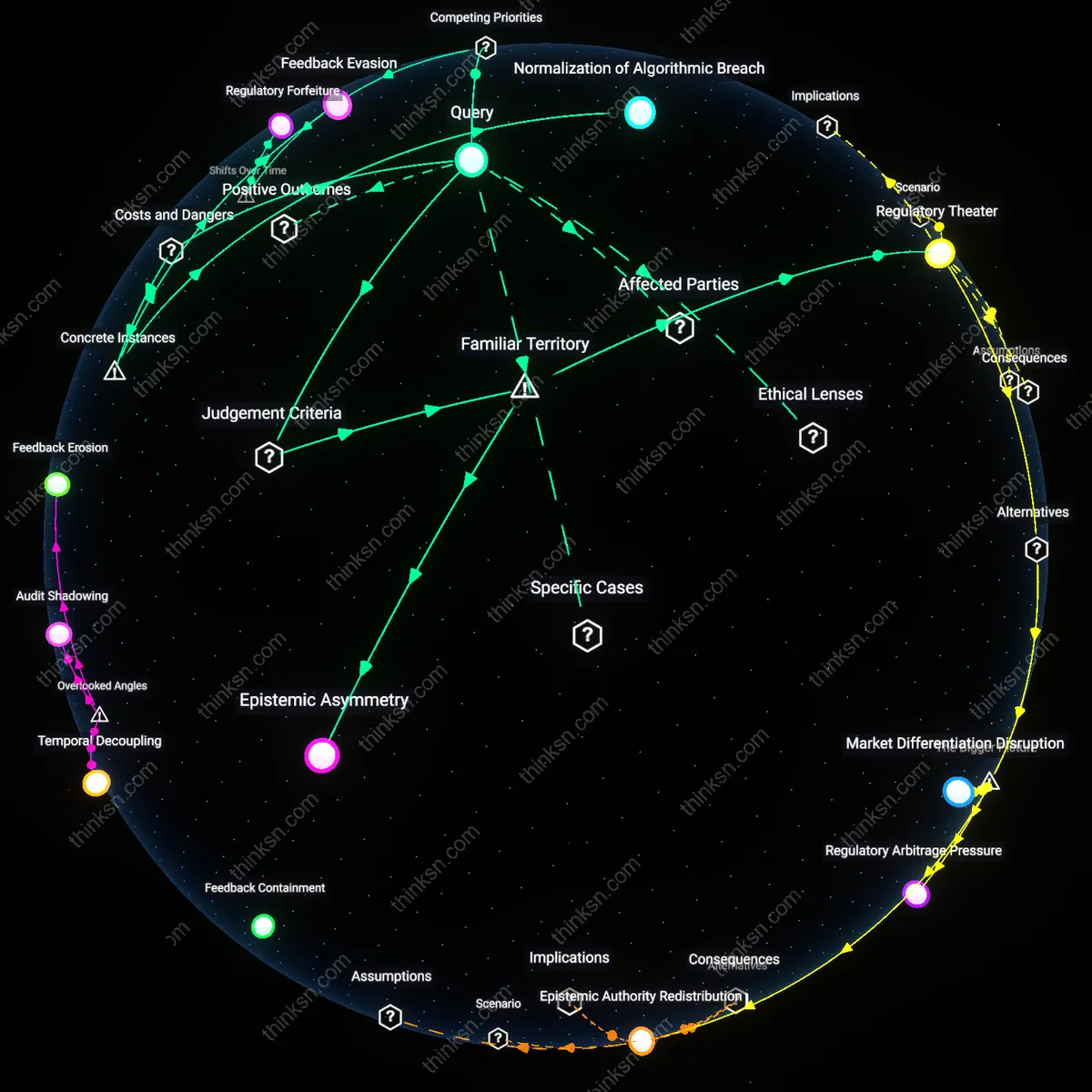
Procedural Arbitrage
Informal networks of compliance officers and auditors in the European Central Bank’s Supervisory Review and Evaluation Process (SREP) began shaping regulatory outcomes by exploiting ambiguities in implementation timelines and reporting thresholds across member states, enabling them to de facto set enforcement norms through localized interpretation, a mechanism invisible to central policymakers because it operated within approved procedures. This arbitrage emerged in Frankfurt between 2015–2017 when national auditors from Germany, France, and Italy coordinated peer reviews outside formal channels, aligning capital adequacy assessments to avoid destabilizing cross-border banks—revealing how procedural flexibility, when coupled with inter-institutional trust, allows mid-level officials to collectively adjust policy outcomes without altering written rules.
Epistemic Backflow
Auditors at the U.S. Government Accountability Office quietly redefined cybersecurity compliance standards for federal agencies after the 2015 OPM breach by embedding NIST framework adaptations into routine IT audits, which later became codified in OMB circulars despite no formal mandate to do so. This shift occurred when GAO auditors, working with agency CIOs in discrete remediation cycles between 2016 and 2018, established de facto benchmarks for incident response readiness that upper-tier policymakers eventually adopted as official policy—demonstrating how technical feedback from audit execution can reverse hierarchy, turning compliance verification into a source of policy innovation when crisis exposes gaps in central guidance.
Shadow Standardization
In 2011, compliance officers from major Canadian banks convened informal working groups in Toronto to harmonize interpretation of anti-money laundering rules issued by FINTRAC, leading to a uniform risk-scoring model for suspicious transactions that was later adopted verbatim by regulators in 2014. This standardization emerged not through rulemaking but through repeated inter-firm alignment in audit documentation practices, where shared templates and verification protocols created a de facto regulatory template—exposing how private coordination among auditors, motivated by operational efficiency and regulatory predictability, can preempt and shape public policy when oversight bodies lack technical bandwidth to specify implementation.
Regulatory Arbitrage Pathways
Informal networks of compliance officers and auditors began shaping policy when transnational firms exploited jurisdictional misalignments by circulating standardized compliance templates across borders, creating de facto regulatory harmonization that bypassed formal treaty processes. Compliance professionals, embedded in multinational corporations and accounting firms, replicated risk assessment frameworks initially designed for internal use—such as AML checklists or SOX controls—across subsidiaries in jurisdictions with weaker oversight, effectively exporting regulatory norms without state coordination. This diffusion, driven by efficiency pressures and liability minimization, created a feedback loop wherein regulators in emerging economies adopted these private templates as public benchmarks due to resource constraints and perceived legitimacy, making corporate compliance practices the blueprint for state policy. The non-obvious force here is not coordination among officials but the structural power of replicated operational tools to preempt democratic standard-setting through routine implementation.
Epistemic Cascades
Policy influence emerged when audit firms and compliance departments, clustered in global financial hubs like London, Singapore, and New York, began treating recurring findings from sector-wide risk assessments as proxies for systemic risk, thereby redefining regulatory priorities through aggregated private data. As these professionals shared anonymized audit exceptions and compliance breaches in closed forums—such as the International Compliance Association or Big Four internal networks—they constructed a consensual narrative of emerging threats, like third-party vendor risk or ESG reporting gaps, which then surfaced in regulatory consultations as 'industry-wide concerns.' Regulatory agencies, facing information asymmetry and relying on expert submissions, incorporated these consensus positions into draft rules, mistaking private coordination for public interest. The critical dynamic is that influence arose not from lobbying but from the systemic conversion of operational noise into regulatory signal via shared interpretive communities.
Compliance Infrastructure Lock-in
Once firms invested heavily in digital compliance systems—automated KYC platforms, AI-driven transaction monitoring, or integrated GRC software—they standardized workflows across regions to maximize ROI, rendering divergent national regulations economically disruptive and practically unenforceable. Compliance officers, tasked with maintaining these systems, lobbied not for specific rules but for regulatory 'predictability,' which policymakers interpreted as harmonization with existing private architectures, effectively locking in de facto standards shaped by software logic and vendor design. Regulators in overburdened agencies, observing widespread adoption and operational stability, deferred to these architectures as 'proven models,' thereby legitimizing privately built control systems as public policy foundations. The underappreciated shift is that influence stemmed not from advocacy but from sunk costs in technical infrastructure that made deviation politically costly and administratively unfeasible.
Compliance Drift
Informal networks of compliance officers and auditors began shaping policy through repeated micro-adjustments in regulatory interpretation during routine audits, where localized risk-aversion became codified into national standards without centralized approval. These actors, operating within rigid legal frameworks, exercised discretionary judgment to resolve ambiguities in real-time—decisions that accumulated into de facto policies across multinational firms and eventually influenced formal regulations through path dependency. This mechanism reveals how procedural fidelity, meant to ensure top-down control, actually enabled bottom-up policy formation through an underappreciated logic of incremental enforcement. The non-obvious insight is that compliance was never passively received but actively redefined at the point of implementation, challenging the assumption that regulatory influence flows only from authority to execution.
Audit Shadowplay
Policy influence emerged not through formal feedback channels but through strategic performances during audit reviews, where auditors and compliance officers engaged in ritualized negotiations that subtly reframed organizational risk, thereby shifting executive perception of what was normatively acceptable. By emphasizing certain violations and overlooking others, these mid-level actors shaped which risks were elevated to board-level concern, effectively steering strategic priorities under the guise of neutral assessment. This dynamic operated through the theatricality of audit reporting, where the selective highlighting of data created a distorted mirror of organizational behavior that leadership trusted as objective—revealing how epistemic authority was seized through performative rigor rather than positional power. The dissonance lies in exposing audits not as oversight tools but as covert sites of agenda-setting, contrary to their image as passive evaluative mechanisms.
Regulatory Folklore
Unofficial policy influence took root through the transmission of cautionary narratives among compliance and audit communities, where stories of past failures evolved into shared heuristics that preempted formal rulemaking. These oral traditions—exchanged in training sessions, cross-institutional forums, and internal memos—instilled behavioral norms that spread faster and with greater adherence than official directives, effectively creating a parallel compliance ontology. Because these narratives were framed as lessons rather than rules, they bypassed scrutiny while embedding risk-averse practices into everyday decision-making across regulatory boundaries. The overlooked mechanism is that cultural transmission, not institutional hierarchy, became the carrier of regulatory change—challenging the orthodox view that policy evolves through deliberate design rather than collective memory and anecdotal consensus.
Audit Trail Authority
Routine examination of financial discrepancies by corporate auditors during post-2008 compliance sweeps led them to standardize corrective protocols that regulators later formalized into disclosure rules. These auditors, operating within firms like Lehman Brothers and AIG, produced detailed forensic reports that were not initially intended for policy use but became reference templates during congressional hearings and Basel III deliberations. The mechanism—documented anomaly tracking repurposed as regulatory design—gave technical back-office roles unexpected influence over systemic risk frameworks. This is non-obvious because audit work is publicly associated with retrospective oversight, not prospective rule-making, yet these artifacts functioned as de facto blueprints.
Compliance Precedent Cascade
Internal memos from multinational banks’ compliance departments, particularly those generated during FATF-mandated anti-money laundering reviews between 2012 and 2020, began circulating informally through inter-firm working groups and IMF technical consultations. These documents, structured as risk-rating matrices and customer onboarding filters, were adopted by regional regulators in the UK and Singapore who lacked in-house modeling capacity. The mechanism—peer-vetted operational templates bypassing formal consultation—allowed frontline enforcement logic to migrate into sovereign regulatory codes. This influence remains underappreciated because compliance is commonly seen as mere rule-following, not rule-forming, despite these memos becoming embedded in official guidance.
Enforcement Feedback Loop
Field-generated case files from SOX compliance officers in major U.S. public companies, documenting evasion tactics and control gaps, were aggregated by the PCAOB into anonymized enforcement databases that directly shaped subsequent inspection priorities and disclosure mandates. These records, originating in mid-level corporate offices, revealed patterns of off-balance-sheet manipulation that neither lawmakers nor standard-setters had anticipated during SOX enactment. The mechanism—bottom-up anomaly aggregation feeding top-down policy adjustment—allowed operational insights to rewrite audit scope definitions. This is overlooked in public discourse because enforcement is assumed to flow downward, not upward, even though these field reports became the basis for revised AS5 and AS18 guidance.