Do Drug Courts Support Broader Diversion or Targeted Programs?
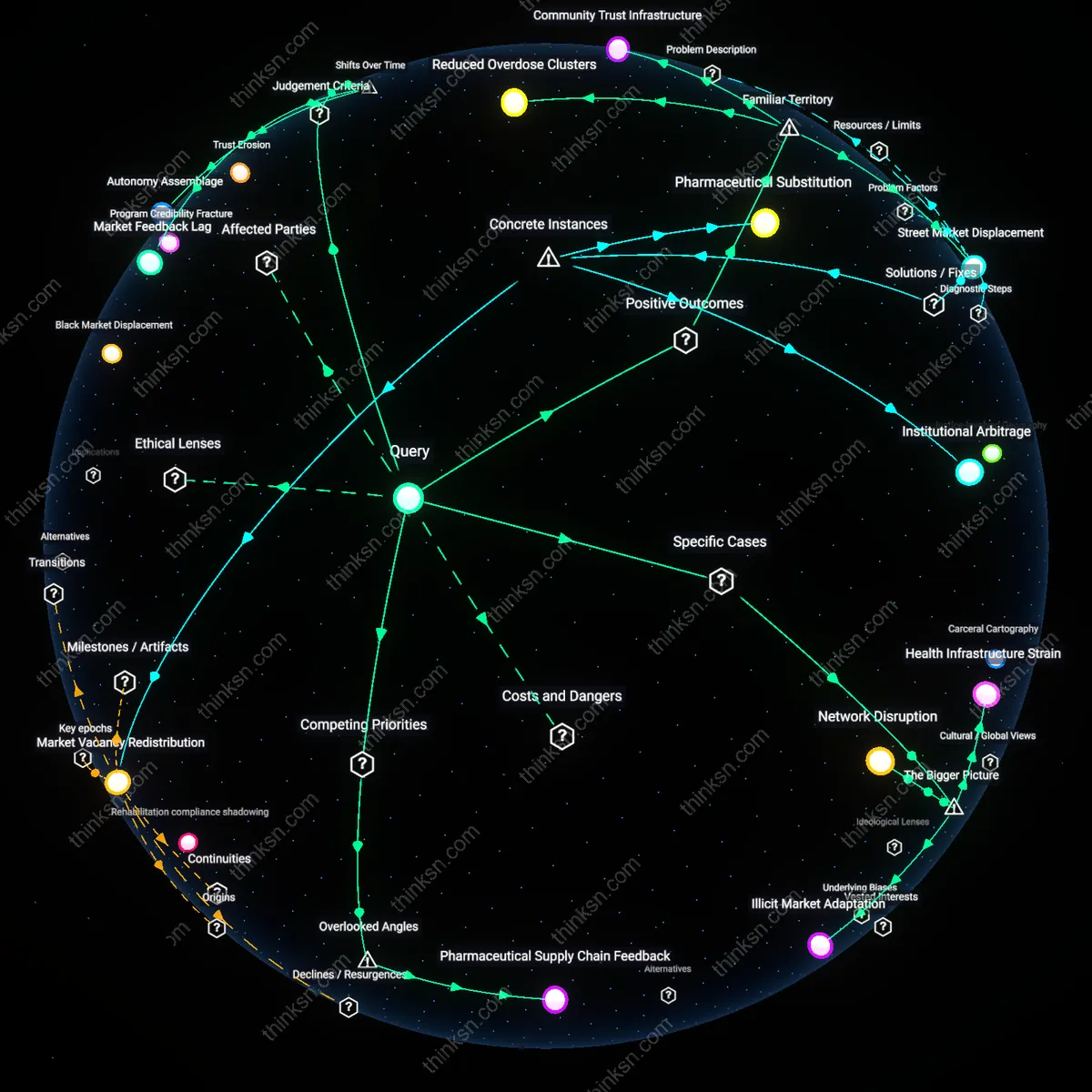
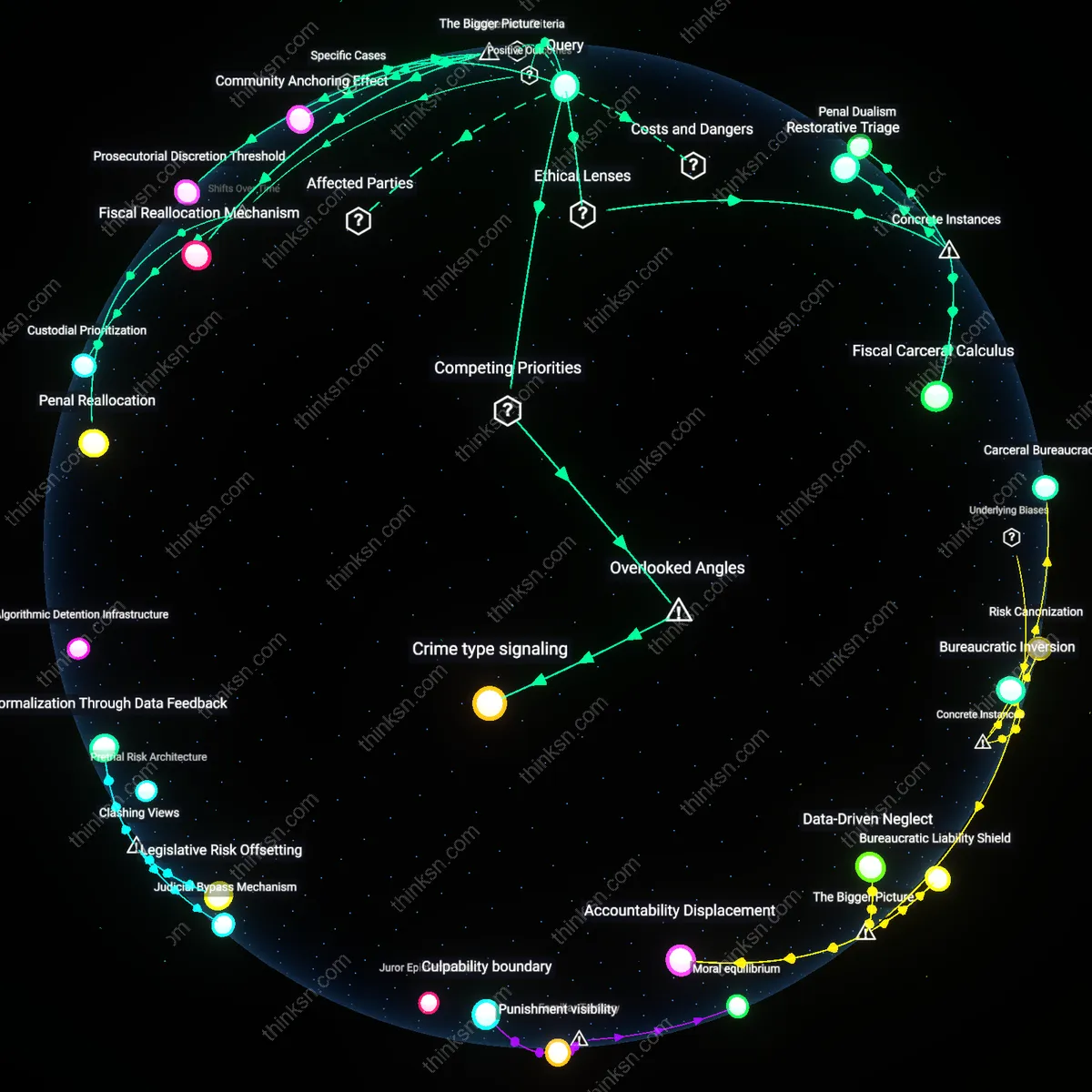
Analysis reveals 7 key thematic connections.
Key Findings
Thresholded Eligibility
Diversion programs must expand only within strict clinical and criminal history thresholds because post-2008 risk-assessment reforms revealed that recidivism reduction in drug courts is concentrated among non-violent offenders with documented substance use disorders, not polysubstance users or those with prior violent convictions. The mechanism—actuarial tools like the Level of Service Inventory—became standardized after the Second Chance Act, creating a feedback loop where funding followed measurable outcomes, thus narrowing viable expansion to those already deemed ‘rehabilitatable’ by algorithmic screening. This shift from blanket eligibility to data-driven triage, cemented in the 2010s, reveals that expansion is politically feasible only when bounded by historically calibrated risk profiles, obscuring the structural exclusion of high-need populations who destabilize success metrics.
Funding Path Dependency
Diversion programs should not expand indiscriminately because federal grant structures since the 2001 Drug Court Discretionary Grant Program condition disbursement on demonstrated recidivism declines, which pressures local courts to underreport failures and exclude high-risk defendants ex ante. The mechanism—performance-based funding—entrenched a self-reinforcing cycle where only programs with historically strong outcomes receive scaling resources, reinforcing geographic and demographic inequities established during the 1990s 'war on drugs' rollout. This shift from capacity-building to outcome-compliance financing, cemented in the 2008–2012 audit era, reveals that expansion is systemically constrained by the need to preserve past success rates, making targeted implementation a bureaucratic necessity rather than a clinical choice.
Judicial Incentive Alignment
Link judicial performance reviews to post-release stability metrics tracked over eighteen months, not just short-term program completion rates. In Multnomah County, judges now receive quarterly dashboards comparing their participants’ housing retention and employment continuity, creating a feedback loop that adjusts bench behavior beyond the familiar 'treatment over jail' framing; this reframes judicial discretion as an operational lever rather than a moral stance. The underappreciated mechanism is that judges respond to institutional signals as much as to evidence, making the courtroom a site of administrative engineering rather than just moral leadership.
Geographic Service Chokepoint
Restructure referral pipelines so that only jurisdictions meeting minimum treatment capacity benchmarks can qualify for state drug court funding, as done in Washington’s Administrative Office of the Courts’ 2022 tiered allocation model. This forces localized investment in outpatient slots before new cohorts are admitted, grounding expansion in actual service availability rather than aspirational claims common in 'second chance' rhetoric. The overlooked reality is that political will often outpaces clinical infrastructure, turning diversion programs into bottlenecks rather than pipelines—something absent from typical 'expand or contract' debates.
Polarizing Adaptation
Drug courts in Miami-Dade County reduced recidivism among graduates but increased rearrest rates for those who failed, creating a bifurcated outcome where the program’s success intensified its expansion while simultaneously deepening penalties for noncompliance, revealing a reinforcing feedback loop in which perceived program efficacy justifies broader implementation even as it sharpens failure consequences, exposing how system stability can emerge from divergent individual trajectories rather than uniform improvement.
Thresholded Inclusion
The Bronx Mental Health Court selectively reduced recidivism only for participants with diagnosed schizophrenia and consistent case management, revealing that effectiveness depended on crossing a threshold of clinical and institutional support, illustrating a balancing loop where program sustainability hinges not on universal access but on identifying and resourcing high-responsivity subgroups, a dynamic previously obscured by aggregate success metrics.
Compliance Load
In California’s Proposition 36 implementation, drug courts reduced recidivism primarily for individuals with stable housing and employment who could meet frequent testing and attendance mandates, exposing how the very structure of compliance—intensified through judicial monitoring—becomes a barrier for those most in need, thus generating a hidden feedback loop where program design favors low-risk participants and self-reinforces exclusion of high-need populations.