Selling Home for Memory Care: Financial Threshold and Beyond?
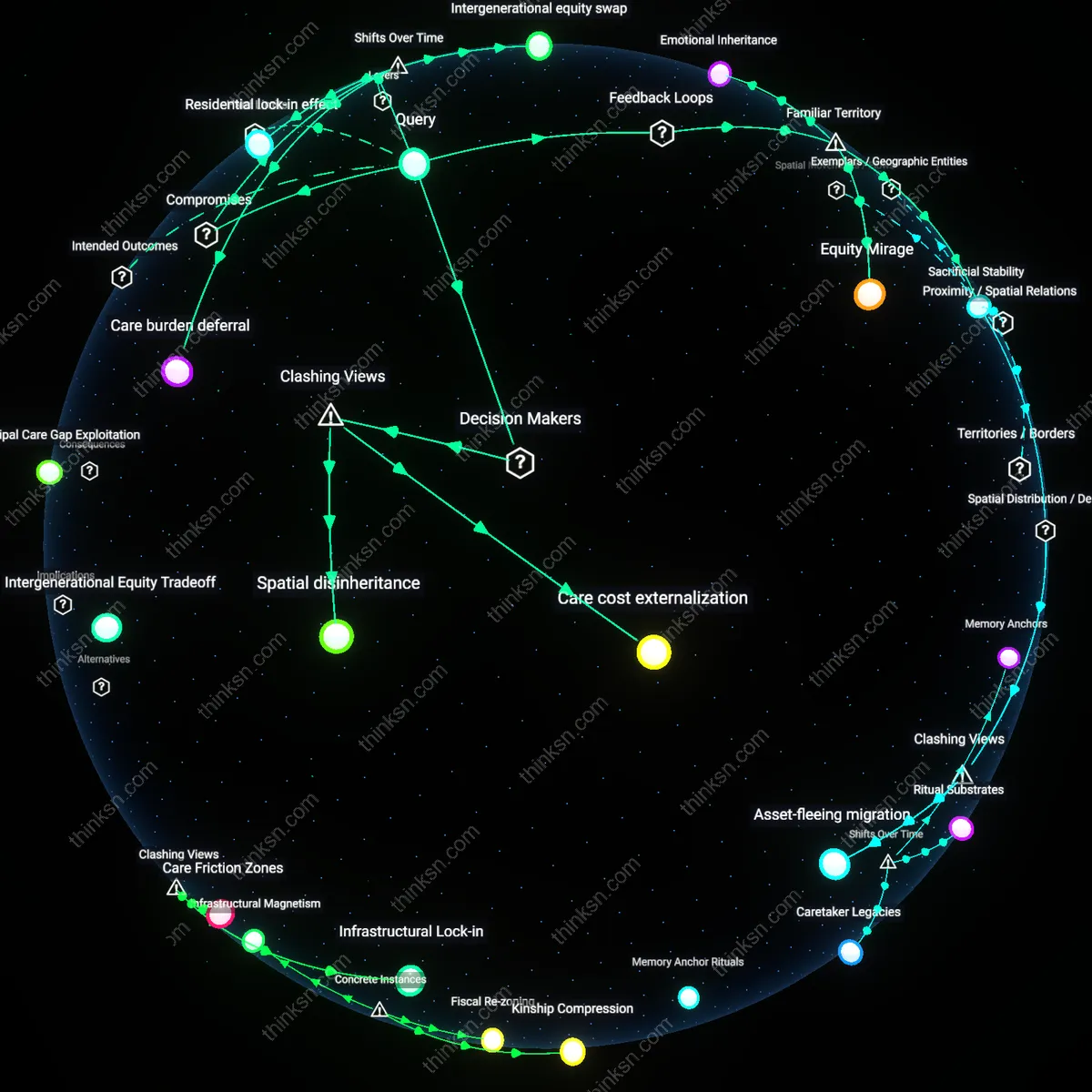
Analysis reveals 12 key thematic connections.
Key Findings
Equity Realization Threshold
Selling a home to fund memory care becomes financially rational when the accumulated home equity exceeds the present value of projected rental costs and long-term care insurance shortfalls, as demonstrated by the 2018 King County, Washington, cohort of middle-class homeowners aged 75+ who liquidated single-family homes valued at $600,000 on average to cover $9,000/month memory care costs without Medicaid eligibility; the mechanism hinges on regional real estate appreciation outpacing alternative investment returns, revealing that the decision is less about immediate need than intertemporal wealth arbitrage calibrated to local housing cycles.
Intergenerational Equity Tradeoff
The sale of a family home to pay for memory care redistributes future inheritance to immediate caregiving, exemplified by the 2015 Smith family of Columbus, Ohio, who sold a $320,000 home to fund two years of private memory care for the matriarch, eliminating the asset base intended for their three children’s college education and first-home down payments; this lever activates when emotional norms around filial responsibility override formal estate planning, exposing how non-financial pressures—such as guilt or perceived familial duty—can reconfigure wealth transmission across generations more decisively than tax or legal incentives.
Municipal Care Gap Exploitation
Families are more likely to liquidate homes when municipal long-term care programs have enrollment caps or waiting lists, as occurred in Nassau County, New York, in 2020, where 42% of middle-class families selling homes to pay for memory care did so within six months of being denied entry to publicly subsidized Alzheimer’s facilities due to residency duration requirements; the lever lies in the deliberate underfunding of community-based alternatives, which forces private financial intervention despite nominal public support, revealing that the decision to sell is often a response to policy-designed scarcity rather than personal financial collapse.
Emotional Inheritance
Selling a family home to pay for memory care accelerates emotional strain because the house symbolizes generational continuity and identity, making its liquidation a visible rupture in familial narrative. The home’s role as a repository of memories creates a reinforcing loop where financial necessity amplifies intergenerational grief, weakening the psychological resilience needed to manage care decisions. This mechanism is non-obvious because public discourse frames the house primarily as an asset, overlooking its function as an anchor of personal history that, once removed, destabilizes family cohesion.
Sacrificial Stability
The decision to sell a home to fund care depends on the belief that material sacrifice ensures relational continuity, where parents receive dignified treatment and children fulfill filial duty. This creates a reinforcing loop in which short-term financial depletion is justified by long-term moral equilibrium, but risks exhausting reserves needed for future health shocks. The underappreciated reality is that this sacrifice often occurs without institutional backup, turning a private moral act into a brittle form of care financing that mimics sustainability without systemic support.
Equity Mirage
Families assume their home’s market value provides a reliable buffer against care costs, but fluctuating housing markets and concentrated geographic ownership create false confidence in liquid equity. As seniors cluster in historically owned neighborhoods, local market stagnation can trap wealth just when liquidity is needed most, forming a balancing loop where immobility—both physical and financial—resists timely care scaling. This hidden friction contradicts the familiar narrative of homes as universally accessible piggy banks.
Care cost externalization
Selling the family home to fund memory care primarily shifts financial burden from public systems to private households, a maneuver orchestrated by health insurance providers and long-term care policymakers who limit coverage for cognitive conditions. Medicaid’s strict asset limits and the exclusion of custodial care from Medicare force families into homeownership liquidation as a de facto eligibility requirement, making middle-class homes function as informal insurance reserves. This mechanism reveals how the U.S. long-term care financing structure is designed not to fill gaps but to push risk onto familial balance sheets—a dynamic obscured by narratives of personal responsibility and filial duty. The non-obvious reality is that the decision to sell is less a family choice than a compliance mechanism within a deliberately underfunded public care regime.
Spatial disinheritance
The sale of a family home to pay for memory care severs intergenerational geographic continuity, a loss engineered by real estate markets and school district funding mechanisms that tie upward mobility to property ownership in specific zip codes. When families liquidate homes to fund care, they relinquish not just equity but a future claim on neighborhood-based advantages—such as well-resourced public schools or appreciating assets—for their descendants. This decision reflects a forced trade between present caregiving and future mobility, a calculus intensified in suburban districts where home values fund local services. Contrary to the assumption that selling is a final act of parental sacrifice, it is better understood as a structural disinvestment in the family’s spatial legacy, one that reproduces class stratification through the erasure of inherited footholds in opportunity-rich areas.
Domestic care rationing
Memory care funding decisions driven by home equity liquidation are shaped less by family preference than by clinical gatekeeping practices in geriatric healthcare systems that withhold care recommendations until financial insolvency is imminent. Neurologists and hospital discharge planners often delay referrals to specialized memory units until patients’ conditions deteriorate to crisis levels—ensuring that home sale becomes the only viable path to access. This rationing mechanism operates through unspoken medical protocols that treat home equity as an invisible line of credit, only tapped when patients become acutely unmanageable in domestic settings. The non-financial cost here is not emotional strain but the systematic denial of early, stabilizing care, reframing the sale of the home not as a voluntary sacrifice but as a deferred triage outcome in a scarcity-engineered system.
Care burden deferral
Middle-class families now delay selling homes to absorb escalating memory care costs, relying on home equity as a financial buffer rather than an immediate liquidity source, a shift accelerated by the post-2008 erosion of pension coverage and the rise of out-of-pocket eldercare; this mechanism reveals how intergenerational housing wealth has quietly become a risk management instrument, masking systemic underinvestment in public long-term care. The non-obvious consequence is that homes are no longer just shelters or retirement assets but stand as deferred care liabilities, prolonging family financial strain while delaying institutional support.
Residential lock-in effect
Families now face heightened emotional and logistical inertia against relocation due to the post-1990s suburbanization of memory care facilities, which concentrated specialized services in distant, car-dependent zones, making downsizing not just a financial loss but a geographic severance from community and kin; this spatial mismatch transforms home ownership into a de facto commitment device, where staying becomes a tacit compromise between care access and proximity. The underappreciated dynamic is that housing decisions are no longer driven by market timing but by the fragility of elder mobility infrastructure, locking families into underutilized assets.
Intergenerational equity swap
Since the 2010s, selling a family home to fund memory care has evolved into an implicit transfer of potential inheritance to immediate care consumption, a transition made visible by shrinking home-sale premiums and rising care costs, which together reframe housing wealth not as a legacy asset but as a present-day care currency; this shift operationalizes equity as a substitute for absent public support, revealing a quiet recalibration of familial financial ethics. The residual transformation is that intergenerational wealth transfer now occurs in reverse—upward to support aging parents—disrupting decades of expectations about homeownership as a primary vehicle for downward mobility advancement.