When Flexibility Becomes Requirement: The Remote Work Paradox?
Analysis reveals 11 key thematic connections.
Key Findings
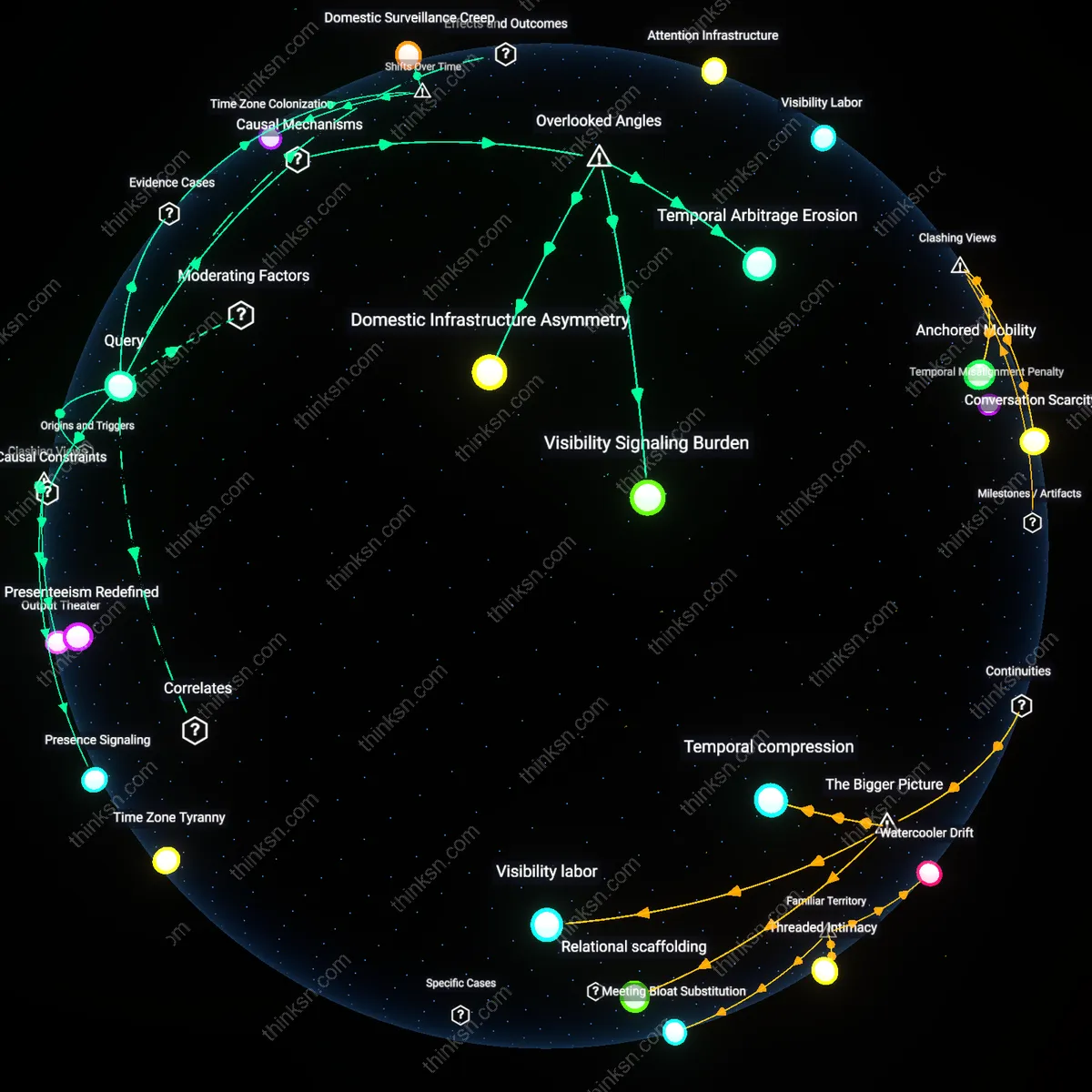
Presenteeism Redefined
A flexible work policy negates remote benefits when managers equate availability with productivity, demanding constant digital visibility through scheduled check-ins and real-time responses. This shifts productivity from outcome-based evaluation to surveillance of digital attendance, reinforcing white-collar presenteeism despite physical absence. The non-obvious insight is that remote work amplifies managerial anxiety about loss of control, triggering compensatory monitoring behaviors that replicate office-era oversight in virtual form.
Time Zone Tyranny
Flexible work undermines remote advantages when global coordination demands sacrifice local autonomy to maintain synchronized overlap hours across regions. Employees in disparate zones compress personal time to align with corporate hubs, effectively importing commute-equivalent burdens as temporal displacement. The overlooked reality is that 'flexibility' becomes a one-sided concession, preserving center-of-power schedules while expecting periphery workers to adapt, thus replicating colonial patterns in digital labor geography.
Proximity Bias Reinforced
Remote work benefits erode when promotion and trust accrue predominantly to those who happen to live near headquarters, reviving physical presence as an invisible criterion for advancement. Even under formal flexibility, decision-makers default to in-person interaction for high-stakes collaboration, creating a shadow hierarchy where co-located employees gain unspoken influence. The latent issue is that flexibility does not dismantle proximity-based privilege but obscures it, making exclusion appear incidental rather than structural.
Temporal Arbitrage Erosion
When managers require employees to align work hours precisely with headquarters’ time zones regardless of location, the geographic flexibility of remote work is functionally eliminated. This time zone colonization substitutes spatial proximity with temporal compliance, enforcing synchrony through mandatory overlap in core hours, which disproportionately burdens workers in distant regions who must adjust sleep cycles or compress workdays. The erosion of temporal arbitrage—historically a core efficiency of distributed work—is rarely acknowledged in policy design, despite being a primary mechanism through which flexibility is silently revoked under the guise of collaboration needs.
Visibility Signaling Burden
Employees in flexible remote roles often overuse digital activity signals—such as frequent status updates, off-hours messaging, or excessive meeting participation—to compensate for lack of physical presence, inadvertently normalizing constant availability. This behavioral adaptation emerges from asymmetric trust, where performance evaluation implicitly favors observable effort over output quality, particularly in hierarchical or surveillance-heavy cultures. The resulting 'visibility tax' distorts work patterns and mental bandwidth, revealing how unexamined appraisal systems transform policy flexibility into performative availability, altering the psychology of work without changing written rules.
Domestic Infrastructure Asymmetry
Remote work policies assume a baseline of private, quiet, and technologically stable home environments, but when employees lack access to such spaces—due to shared housing, caregiving roles, or under-resourced housing—organizations inadvertently incentivize office return through lack of infrastructure parity. Workers in high-density urban housing or multi-generational homes face recurring friction in meeting audio quality, lighting, or concentration standards, making sporadic office attendance functionally obligatory rather than optional. This hidden dependency on domestic spatial quality reveals how remote work equity is mediated by household capital, a precondition rarely addressed in policy frameworks despite shaping actual flexibility.
Presence Signaling
A flexible work policy negates remote work benefits when employees feel compelled to log in during core hours and respond instantly to demonstrate availability, regardless of location. This occurs because managerial trust is tacitly conditioned on visible online activity rather than output, transforming remote roles into surveillance-by-proxy arrangements—common in tech firms using Slack and Microsoft Teams as proxy performance metrics. The non-obvious insight is that digital visibility, not physical office presence, becomes the true compliance mechanism, preserving office-era power dynamics despite geographic decentralization.
Output Theater
The promise of remote work erodes when evaluative criteria shift toward quantifiable activity metrics—like message volume or login frequency—instead of project outcomes, as seen in outsourced customer support hubs managed through algorithmic oversight. Managers adopt these proxies to resolve uncertainty about remote diligence, inadvertently rewarding performativity over productivity. The overlooked mechanism is that inflexible evaluation systems, not scheduling demands, reproduce office-based surveillance, exposing how administrative risk aversion can sabotage autonomy even in fully distributed settings.
Performative Availability
A flexible work policy negates remote work benefits when employees at companies like Amazon post-2020 increasingly felt compelled to maintain visible online presence across Slack, email, and calendar to signal productivity despite location independence. This shift—from early pandemic-era trust in asynchronous outcomes to a post-2022 norm of digital visibility as proxy for effort—transformed flexibility into a regime of implicit surveillance, where the freedom to work remotely became indistinguishable from the expectation to appear constantly reachable. The mechanism is not formal policy but normalized signaling behaviors reinforced by promotion criteria still calibrated to office-era visibility, revealing how cultural inertia regresses remote autonomy into remote attendance.
Time Zone Colonization
Remote work benefits erode at global firms like GitLab and Shopify when, after their formal embrace of asynchronous workflows between 2019 and 2021, leadership teams concentrated in North American time zones inadvertently normalized high-stakes meetings and decision-making cadences that marginalized engineers in Asia-Pacific regions by 2023. The shift from ad hoc coordination to structurally entrenched scheduling patterns—justified as 'flexibility' but operating as de facto temporal alignment—reveals how autonomy for some reproduces temporal domination for others. This transition re-inscribes centrality not through geography but through rhythm, exposing a hidden continuity between colonial administrative timing and digital headquarters’ temporal hegemony.
Domestic Surveillance Creep
At firms like Apple and Google during the 2022–2024 hybrid mandate phases, flexible remote policies effectively collapsed into office-equivalent expectations when voluntary return-to-office justifications masked escalating use of productivity monitoring tools—such as login frequency, document edit logs, and meeting engagement metrics—that redefined home workspaces as data-transparent extensions of corporate oversight. The shift from physical check-ins to behavioral quantification reframed flexibility as conditional trust, where autonomy persists only if domestic labor becomes legible and quantifiably comparable to office output. This trajectory reveals that the residual boundary of control is not place but perceptibility, producing compliance through algorithmic visibility rather than spatial co-location.