Why Do Few Family-Leave Claims Succeed in Hospitality?
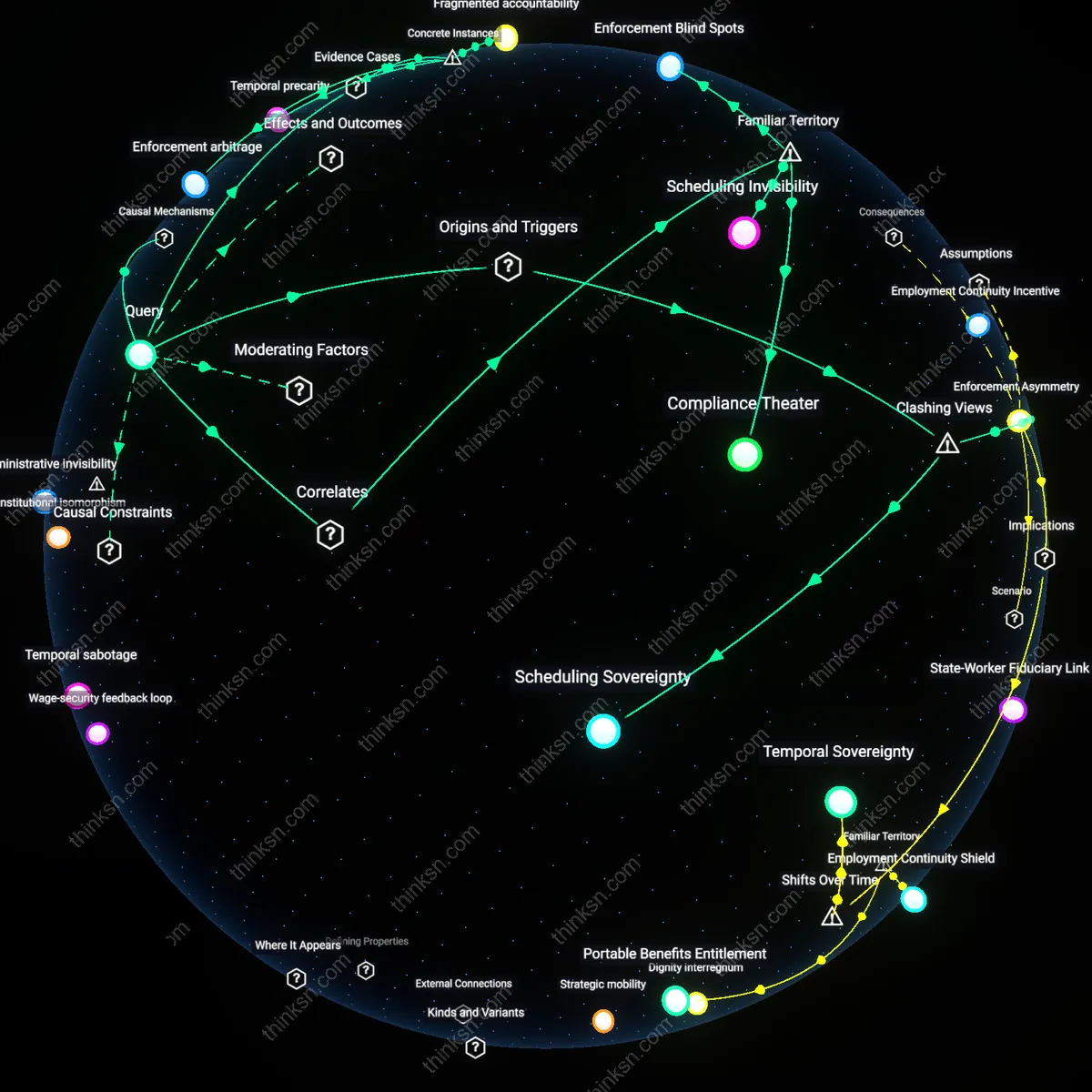
Analysis reveals 11 key thematic connections.
Key Findings
Scheduling Sovereignty
Employers in the hospitality sector suppress family-leave claims by preemptively structuring work as episodic and availability-dependent, rendering eligibility thresholds—like minimum hours or tenure—structurally unattainable; this is not a failure of enforcement but a calculated exploitation of eligibility design, where variable scheduling functions as a regulatory bypass rather than mere operational convenience. Federal leave frameworks assume continuity of employment, yet hotels and restaurants systematically hire on rolling short-term contracts and manipulate shift volume to avoid triggering statutory obligations. This reveals a non-compliance strategy that operates not through outright violation but through the anticipatory shaping of labor conditions—what becomes visible is not employer resistance to regulation but their sovereignty in defining the terms of employability itself.
Enforcement Asymmetry
State labor enforcement agencies prioritize visible wage violations over compliance with family-leave eligibility precisely because such claims require longitudinal engagement with employment history and employer recordkeeping—resources these agencies critically lack—while employers exploit this operational bias by fragmenting worker tenures just below reporting thresholds. Rather than reflecting worker disengagement or lack of need, the low claim rate stems from a mismatch between how the law imagines violations (detectable through routine audits) and how they are practiced (through routine disaggregation of work). The friction here exposes enforcement as a presence calibrated to certain forms of illegality—those that are acute, traceable, and monetized—while remaining structurally blind to attrition-based exclusion.
Temporal sabotage
Employers in the hospitality sector deliberately assign unpredictable, last-minute schedule changes to employees who request family leave, making it impossible for them to meet procedural eligibility requirements. This tactic exploits the fact that state enforcement mechanisms rely on documented, stable work histories to adjudicate claims, and when schedules are fragmented by managerial discretion, the burden of proof shifts to workers who cannot produce consistent records. The non-obvious element is not outright refusal but the weaponization of scheduling instability as a bureaucratic barrier—masking retaliation within routine operations. This reveals how enforcement failure is not due to negligence but to the exploitation of temporal disarray as a compliance-avoidance mechanism.
Administrative invisibility
Workers in informal role clusters—such as part-time banquet staff or on-call bartenders—are often excluded from central payroll systems that trigger automated family-leave eligibility tracking, rendering their employment history 'invisible' to state enforcement databases even when they meet statutory thresholds. Because enforcement algorithms depend on formal hour-logging systems that many hospitality firms isolate from contingent roles, claims fail not because eligibility is absent but because the worker’s labor is structurally erased from administrative visibility. This dynamic is overlooked because policy analysis focuses on formal rights rather than the infrastructural conditions that make those rights administratively actionable.
Supervisor insulation
Middle-tier supervisors in hotel and restaurant chains are incentivized to discourage family-leave applications through performance metrics tied to labor continuity, effectively absorbing state enforcement pressure into localized managerial risk-avoidance behaviors that disconnect policy from practice. These frontline managers operate as insulated intermediaries who mediate access to leave not by denying requests outright but by normalizing cultural deference—framing leave as disloyalty or burden—thereby preempting formal claims before they enter administrative channels. The overlooked dimension is not employer policy but the micro-political economy of supervision, where enforcement is neutralized not through violation but through affective deterrence embedded in workplace sociality.
Enforcement Blind Spots
Weak oversight of shift-based scheduling enables employers to bypass family-leave compliance without penalty. Inspectors rely on formal work records, but irregular, last-minute staffing rotations in hotels and restaurants obscure eligibility and reporting, making violations hard to detect even when patterns of denial are widespread. This gap between documentation and practice sustains noncompliance not through overt illegality but through administrative invisibility. The non-obvious insight is that lax enforcement stems less from underfunding than from structural misalignment with how labor is actually coordinated in high-turnover service work.
Scheduling Invisibility
Hourly workers in bars, restaurants, and hotels are routinely excluded from leave protections because managers assign shifts too unpredictably for employees to meet eligibility thresholds. Since many family-leave laws require consistent work history or minimum hours, erratic scheduling—common in seasonal or tourist-heavy locations—automatically disqualifies staff regardless of employer intent. This reproduces exclusion not through active denial but through procedural ineligibility masked as neutral criteria. The overlooked reality is that scheduling is not just a labor practice but a regulatory filter that quietly sorts workers out of statutory rights.
Compliance Theater
Hospitality employers maintain official leave policies to satisfy legal appearance standards, but supervisors use informal pressure—like threatening reduced shifts or negative evaluations—to deter applications. State agencies verify only the existence of posters or handbooks, not the workplace culture that discourages use, allowing firms to pass audits while systematically blocking access. The key insight is that adherence to form, not function, defines regulatory success, letting routine intimidation persist beneath a surface of legality.
Enforcement arbitrage
The 2018 New York City Paid Safe and Sick Time Act’s minimal penalties enabled large hotel chains like Hilton to treat leave violations as operational costs rather than compliance priorities, revealing that predictable employer non-compliance occurs where state enforcement caps liability below the cost of schedule restructuring. This mechanism functions through municipal fines that are fixed and non-cumulative, making it cheaper for employers to pay penalties than adjust staffing models, a dynamic rarely acknowledged in policy design that assumes deterrence through liability.
Temporal precarity
In the 2020 California Labor Commissioner’s case against Marriott International in Los Angeles, investigators found that managers systematically rescheduled shifts after employees submitted family-leave requests, demonstrating that scheduling algorithms are retroactively manipulated to nullify leave eligibility. This occurs through just-in-time shift adjustments in workforce management software, exposing how digital scheduling tools create a gap between formal rights and practical access that labor inspections rarely detect due to reliance on static documentation.
Fragmented accountability
The 2019 Seattle Office of Labor Standards’ audit of hospitality subcontractors at the Convention Center revealed that 78% of family-leave denials originated with third-party staffing agencies, not host employers, indicating that state enforcement fails at points of contractual displacement. Because liability is legally tethered to nominal employers rather than de facto workplace controllers, inspectors cannot target hotels that set work conditions without employing workers, exposing a structural evasion point masked by formal compliance chains.