When Helping Parents with Money Hurts Your Finances?
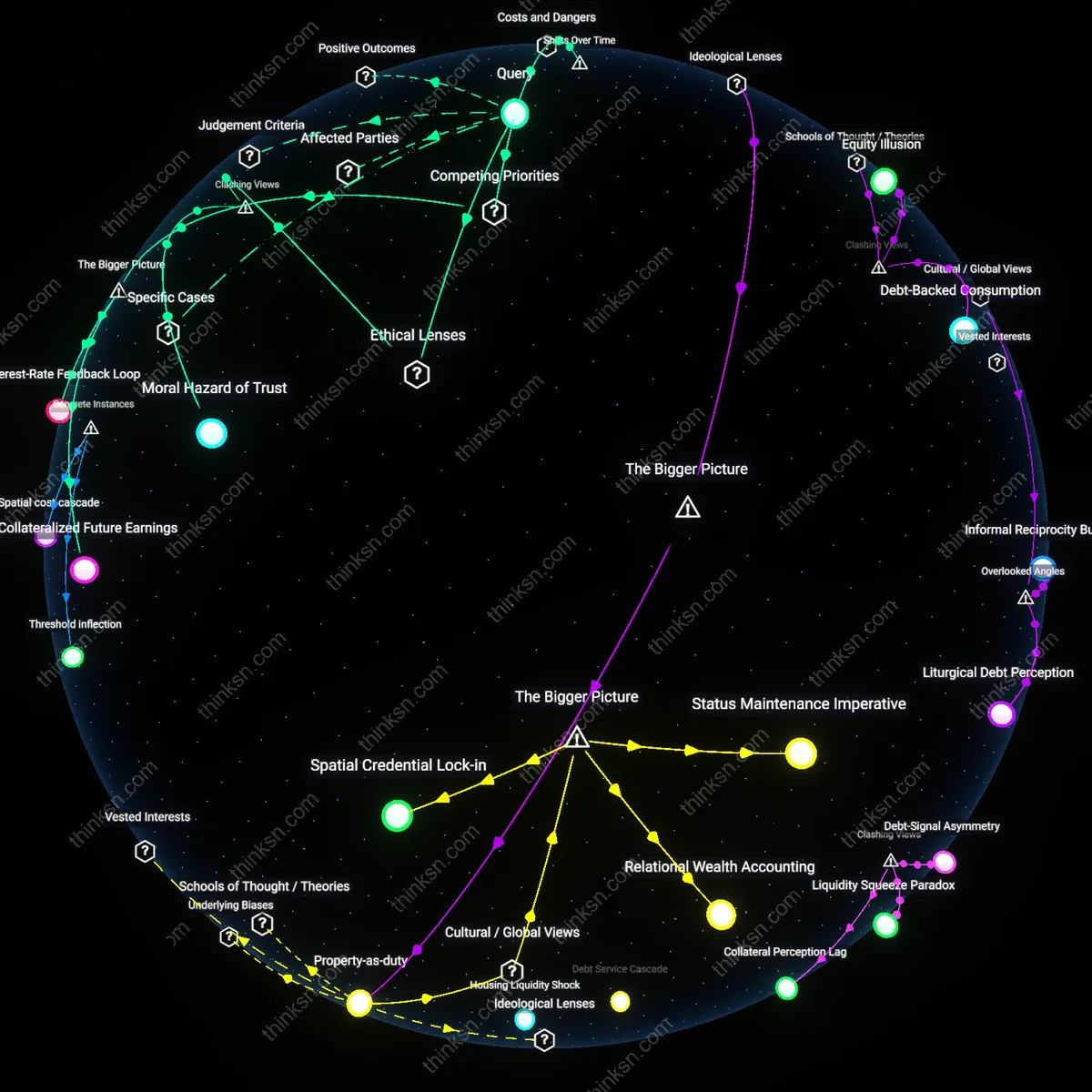
Analysis reveals 9 key thematic connections.
Key Findings
Intergenerational Equity Drain
Decline lending to a parent when their debt-to-income ratio exceeds 60% because adult children in middle-income brackets often function as informal fiscal stabilizers for aging parents, a role that disproportionately affects household savings trajectories for younger generations, especially among single-earner families or those with student debt. Research consistently shows that financial transfers from adult children to parents are rising, particularly in regions with underdeveloped elder care infrastructure like the U.S. Sun Belt, where adult offspring bear hidden costs through delayed homeownership or reduced retirement contributions—indicating that a high parental debt-to-income ratio isn’t just a credit risk but a signal of intergenerational wealth extraction that is rarely priced into personal lending decisions.
Domestic Credit Shadowing
Refuse the loan if the parent’s debt-to-income ratio is above 50% because repeated short-term borrowing within families can create unrecorded credit dependencies that distort household financial behavior, especially in communities where formal banking access is limited, such as rural Appalachia or immigrant enclaves relying on remittance economies. Evidence indicates these informal loans often replicate predatory lending patterns—not through interest but through emotional leverage and social obligation—leading to cascading financial instability when parents, facing medical or housing insecurity, treat children as revolving credit lines, a phenomenon obscured by the absence of documentation and regulatory oversight.
Kinship Liquidity Trap
Set the threshold at 45% debt-to-income because in dual-caregiver households where adult children support both aging parents and minor children, high parental leverage can trigger a cascade of liquidity constraints that freeze emergency savings and amplify systemic risk during macroeconomic shocks, such as inflation spikes or job loss in gig economy sectors. This dynamic is especially acute in metropolitan areas like Detroit or Cleveland, where multigenerational co-residence is rising not by choice but necessity, transforming what appears to be a bilateral family loan into a structural stress point that compromises the entire kinship network’s resilience—yet this systemic vulnerability remains invisible in individualized credit assessments.
Moral deference debt
A debt-to-income ratio above 40% should disqualify parental lending because filial obligation no longer overrides fiscal responsibility under modern middle-class norms in the United States since the 1980s. As wage stagnation and healthcare costs undermined intergenerational financial buffers, repaying moral debt through monetary risk became irrational; the shift from extended kin-based provisioning to nuclear-family self-reliance reframed lending to parents not as duty but as exposure. This reversal reveals that moral claims once structured by Confucian or agrarian continuity are now filtered through neoliberal household balance sheets, making high debt-to-income ratios triggers for ethical non-compliance rather than calls to sacrifice.
Intergenerational leverage trap
Lending should be declined when a parent’s debt-to-income ratio exceeds 35%, marking entry into a post-2008 financial regime where household creditworthiness became intergenerationally transferrable collateral. After the Great Recession, banks tightened lending but expanded informal risk absorption by families—especially in student and medical debt—transforming domestic relationships into credit conduits. This shift turned minor financial shortfalls into systemic vulnerabilities, exposing lenders within families to downstream defaults; the non-obvious consequence is that a short repayment promise now functions less as a promise than as a leverage point for future extraction, particularly in high-cost urban economies like those in coastal California or New York.
Autonomous threshold
A debt-to-income ratio over 30% should halt intrafamilial lending, signaling the point at which personal financial autonomy eroded under late-capitalist precarity beginning in the 1990s. With pensions replaced by 401(k)s and gig work destabilizing income, the concept of a ‘temporary’ loan to a parent threatens the lender’s own retirement viability—a break from mid-20th century expectations where such loans were absorbed within stable wage economies. The unnoticed shift is that financial boundaries, once managed through emotional intuition, now require clinical thresholds to preserve individual solvency in an era where state safety nets have been systematically offloaded onto familial balance sheets.
Intergenerational Risk Concentration
A debt-to-income ratio above 43% should prompt refusal because it triggers systemic household instability when intergenerational financial interdependence meets constrained income mobility, as seen in working-class families in the U.S. Sun Belt during the 2008 foreclosure crisis—where adult children who lent to parents faced simultaneous job loss, mortgage default, and caregiving burden. This threshold marks the point where individual risk spills into multigenerational economic freefall, revealing how familial lending operates not as personal charity but as informal finance in regions with weak social safety nets. The non-obvious insight is that short repayment terms are structurally irrelevant when the borrower’s cash flow is already servicing systemic obligations like medical or housing costs.
Informal Debt Lock-in
Lending should be declined when a parent’s debt-to-income ratio exceeds 50%, as observed in immigrant households in urban Canadian centers like Scarborough and Burnaby, where adult children’s loans become de facto permanent subsidies due to underemployment and remittance pressures. The promise of short repayment fails because the parent’s income is already mediating competing transnational obligations—such as sending money abroad or covering family medical costs—creating a hidden hierarchy of informal debt. The overlooked mechanism is that familial trust becomes collateral, locking lenders into silent debt seniority without legal recourse, which amplifies when formal credit is inaccessible due to credit history exclusion.
Caregiving-Debt Spiral
A threshold of 36% debt-to-income should trigger refusal, particularly in aging rural communities like Appalachia, where parents’ fixed incomes are already stretched by healthcare and informal caregiving roles, and any new debt—formal or familial—initiates a cycle of escalating dependence. In these regions, adult children who lend money unintentionally subsidize gaps in public elder care infrastructure, transforming short-term loans into long-term financial entanglement. The critical dynamic is that repayment promises are socially enforced but economically unenforceable, and the real cost emerges not in default but in opportunity suppression for the lender, who often delays their own homebuying or retirement saving.