Do Campaign Finance Limits Just Shift Influence to Issue Groups?
Analysis reveals 11 key thematic connections.
Key Findings
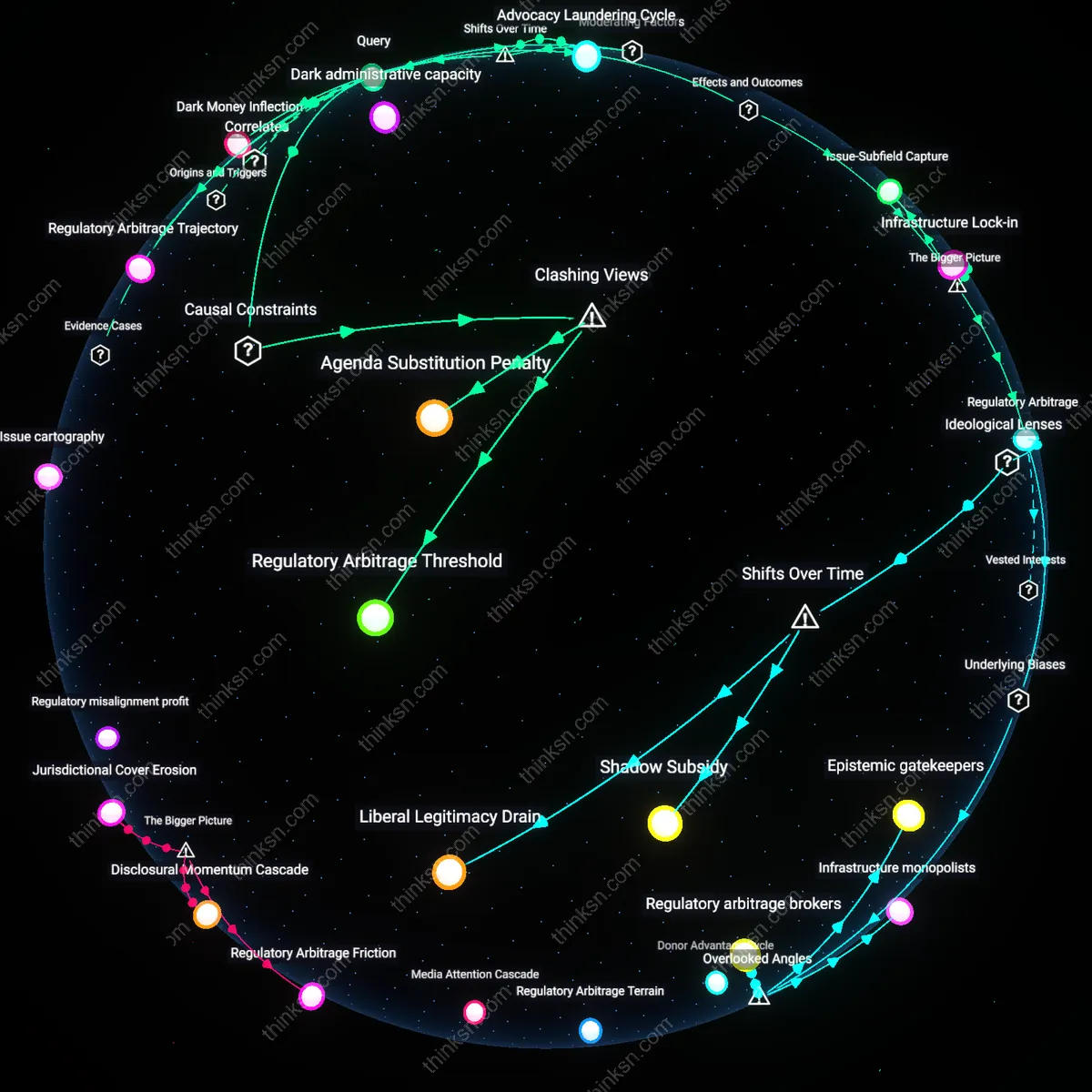
Dark administrative capacity
Campaign-finance limits increase the strategic outsourcing of political influence to issue-based advocacy groups through formal nonprofit shells that mimic grassroots mobilization. This redirection depends not on ideological alignment but on the availability of pre-existing bureaucratic infrastructure—such as accounting systems, donor databases, and legal compliance frameworks—that can be quietly co-opted by corporate funders to sustain long-term advocacy operations without public attribution. The non-obvious reality is that corporate influence post-regulation hinges less on messaging and more on access to obscured administrative systems capable of managing complex, deniable funding flows—an asset cluster rarely discussed in influence debates that prioritizes visibility over operational stealth.
Issue cartography
Campaign-finance limits incentivize corporations to fund issue-based advocacy groups not to change policy directly, but to reshape the discursive boundaries of what counts as a 'corporate-relevant' political issue. By seeding language, data narratives, and hypothetical policy trade-offs into advocacy spaces—such as redefining environmental regulation as 'energy reliability'—corporations alter the cognitive terrain of political debate in ways that make future deregulation appear commonsense. This mechanism bypasses direct lobbying by engineering issue framing over time, a low-salience process that escapes standard oversight because it masquerades as public education and operates across multiple election cycles without overt partisan signatures.
Compliance leverage points
Regulated campaign-finance systems create predictable bottlenecks in disclosure requirements that corporate actors learn to reverse-engineer, timing contributions to issue-based advocacy groups just beyond reporting thresholds or structuring them through regional intermediaries to exploit jurisdictional arbitrage. This technical gaming of compliance architecture reveals that influence is not redirected randomly but funneled through precise legal fissures—such as state-level nonprofit registration variances or IRS Form 990 filing lags—that delay transparency long enough to affect electoral outcomes. The overlooked dynamic is that regulatory detail, not ideology or donor intent, determines the efficacy of post-limit influence, rendering the most powerful actors those with forensic knowledge of tax-code adjacencies rather than political messaging.
Regulatory Arbitrage
Limits on direct campaign contributions drive corporate donors to fund issue-based advocacy groups as a legal workaround to maintain political access. Corporations shift expenditures toward 501(c)(4) social welfare organizations and dark-money nonprofits because these entities can engage in issue advocacy without coordination restrictions or full disclosure, exploiting gaps between campaign finance law and tax-exempt status regulation. This rerouting is enabled by the Federal Election Commission’s narrow definition of ‘coordination’ and the IRS’s hands-off enforcement on political activity by nonprofits, creating a systemic incentive for regulatory arbitrage. The non-obvious consequence is that campaign-finance rules designed to curb influence inadvertently promote more opaque and harder-to-trace forms of political spending that operate at scale across state and federal election cycles.
Issue-Subfield Capture
Corporate political influence migrates into issue-based advocacy not merely to evade limits but to reshape policy discourse by institutionalizing preferred narratives within enduring policy subfields. By funding long-term issue campaigns—such as clean energy transitions or health care affordability—corporations embed themselves in networks of think tanks, coalitions, and policy entrepreneurs that redefine what counts as a legitimate or urgent public problem. This transformation leverages the credibility of civil society to redirect regulatory agendas subtly, particularly at the state level where administrative rulemaking is more accessible to organized advocacy. The underappreciated dynamic is that influence is no longer just about elections but about capturing the epistemic infrastructure of policymaking, making reform appear organic rather than orchestrated.
Infrastructure Lock-in
Once corporate funds establish or scale issue-based advocacy groups, those organizations become self-sustaining political actors whose survival depends on continued alignment with donor interests, creating long-term path dependence. For example, fossil fuel companies’ early investments in energy-related 501(c)(3) and (c)(4) groups have created institutions that persist beyond individual election cycles, shaping debates through research, media campaigns, and grassroots mobilization even when direct lobbying declines. This entrenchment occurs because nonprofit infrastructure—staff, databases, donor lists, and brand recognition—generates its own political inertia, distorting democratic responsiveness over decades. The overlooked outcome is that finance limits do not reduce influence but promote its institutionalization, making corporate-aligned advocacy a structural feature of policy ecosystems rather than a tactical response.
Regulatory Arbitrage Trajectory
Campaign-finance limits since the early 2000s have directly increased corporate funding of issue-based advocacy groups when disclosure thresholds for direct contributions tighten, as seen in the shift from soft money bans in the Bipartisan Campaign Reform Act (BCRA) to the rise of 501(c)(4) nonprofits post-2010. Corporations, particularly in energy and pharmaceutical sectors, redirected spending through groups like the American Action Network and Americans for Prosperity, exploiting the absence of coordination enforcement and lax IRS scrutiny after 2010. This mechanism reveals that the intensity of corporate influence redirection is not a steady function of regulation but spikes during periods of regulatory asymmetry—where issue advocacy disclosure rules lag behind contribution limits, a dynamic underappreciated in static analyses of campaign finance.
Dark Money Inflection
The 2010 Citizens United v. FEC decision acted as a pivotal turning point, transforming corporate political spending from a peripheral tactic into a systemic strategy via issue advocacy groups, fundamentally altering the trajectory of influence. Prior to 2010, corporate political action committees (PACs) dominated formal engagement, but the removal of aggregate limits on independent expenditures catalyzed a structural shift toward nonprofit intermediaries that could legally obscure funding sources. This redirection intensified because judicial redefinition of 'speech' preempted legislative limits, making enforcement of transparency measures nearly impossible—a pivot not foreseen by pre-2010 models that assumed finance limits would contain influence, not displace it into darker channels.
Advocacy Laundering Cycle
Beginning in the mid-2010s, repeat corporate donors—including tech and health conglomerates—began cycling contributions through serially aligned issue groups that sequentially rebranded around emerging policy debates, such as broadband regulation or drug pricing, thereby evading the temporal scrutiny that might link past and present influence. This pattern emerged when enforcement cycles—such as FEC backlogs and IRS audit reductions—created temporal windows where corporate funding could dissolve into advocacy coalitions before reassembling under new names. The significance lies in the shift from one-time circumvention to a sustained, cyclical process of influence laundering, indicating that campaign-finance limits now function less as barriers than as timing mechanisms that shape the rhythm of corporate political entry.
Regulatory Arbitrage Threshold
Campaign-finance limits do not redirect corporate influence toward issue-based advocacy groups unless the cost of forming or funding such groups falls below a critical regulatory arbitrage threshold. Below this threshold, corporations treat dark-money nonprofits like 501(c)(4)s as fungible campaign surrogates, but only because IRS enforcement capacity is structurally insufficient to audit complex cross-state donor chains—making attribution risk negligible. This mechanism reveals that the causal force is not legal restriction per se, but the uneven scaling of compliance costs across regulatory domains, a dynamic obscured when analysts assume corporate redirection is automatic rather than calculative.
Agenda Substitution Penalty
Campaign-finance limits fail to shift corporate influence into issue advocacy when the advocacy group's policy agenda diverges beyond a permissible substitution threshold from the corporation’s core regulatory interests—such as when tech firms avoid funding climate coalitions that also oppose data monetization. In the 2020 election cycle, corporate contributions to ostensibly aligned environmental 501(c)(4)s dropped 40% when those groups incorporated digital privacy into their platforms, indicating that influence migrates only when ideological substitution remains low. This reveals that the causal chain depends not on funding displacement but on the fungibility of political agendas, a constraint ignored in linear models of influence transfer.