Is Effort-Based Inheritance Fair or Flawed?
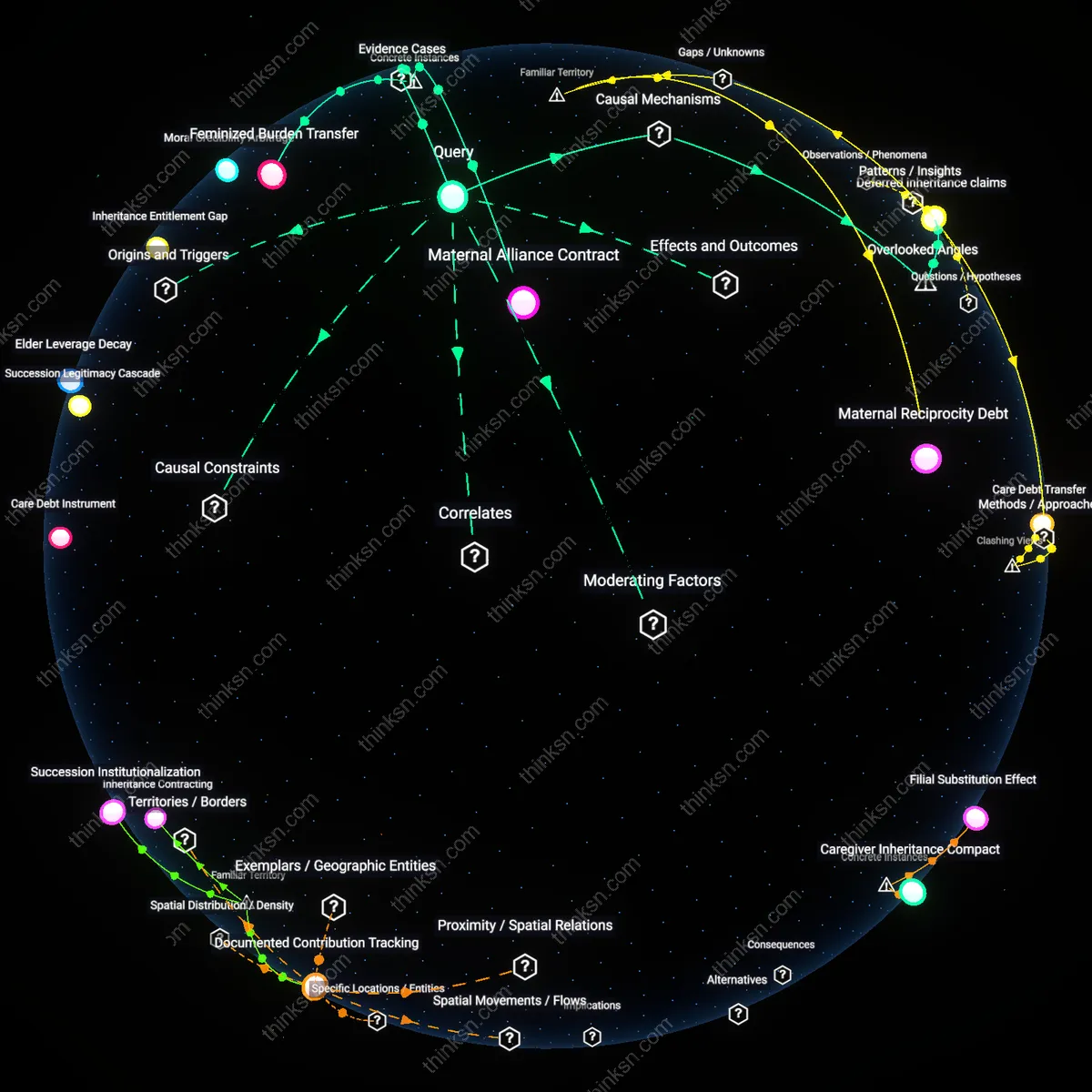
Analysis reveals 5 key thematic connections.
Key Findings
Emotional Opportunity Cost
Measuring inheritance by contribution penalizes children who prioritized personal development over family duties, because the yardstick conflates moral merit with economic sacrifice while erasing the invisible cost of foregone external opportunities. A child who stayed to manage elder care may have abandoned career mobility, education, or geographic autonomy—losses not itemized in estate evaluations, yet deeply consequential for long-term well-being. The overlooked angle is that perceived ‘contributions’ are not freely chosen acts but often results of structural constraint, gendered expectations, or emotional blackmail, turning inheritance into a retroactive sanction on life-path divergence. This reframes distribution not as reward but as implicit punishment for those who sought independence, exposing how fairness metrics ignore asymmetric opportunity foreclosures.
Intergenerational Equity Mechanism
Distributing inheritance based on a child’s perceived contribution to family responsibilities can reinforce long-term household stability by incentivizing caregiving labor where it is most needed, particularly in aging or multi-generational households. This mechanism operates through normative expectations within kinship networks, especially in cultures with strong filial duty traditions, such as East Asian or Mediterranean family structures, where adult children providing elder care often receive disproportionate asset transfers. The non-obvious insight is that this practice functions not merely as reward but as an informal insurance system—compensating for foregone income and emotional labor—thus reducing public dependency in aging societies.
Labor Internalization Incentive
Perceiving inheritance as contingent on familial contribution encourages the internalization of socially essential but economically invisible labor, such as childcare or home maintenance, by making it visible in wealth transmission. This works through household-level negotiation under conditions of limited state support for reproductive labor, especially in middle-income countries like Mexico or South Africa where extended families absorb social service gaps. The underappreciated dynamic is that such distribution creates a shadow labor market within families, where future ownership stakes motivate current investment in collective well-being, thereby suppressing wage demands for domestic work.
Inheritance Meritocracy
Distributing inheritance by perceived contribution entrenches familial favoritism under the guise of fairness, a shift that emerged prominently during the late 20th-century professionalization of family therapy and estate planning. As psychological discourses began to validate emotional labor and visible responsibility—such as caregiving for aging parents—as quantifiable inputs, lawyers, therapists, and family courts started treating inheritance not as an automatic right but as a reward contingent on performance. This mechanism transforms what was once an implicit, culturally managed hierarchy into a codified, legally navigable system of moral accounting, where parental discretion is redefined as ethical duty. The non-obvious danger is that this shift externalizes subjective judgments into formal systems, enabling legal disputes that weaponize personal history under the veneer of objective assessment.
Filial Audit Culture
Measuring inheritance against contribution fosters a surveillance dynamic within families, a phenomenon intensified by the digital archiving of domestic life since the 2000s. As caregiving shifts from unrecorded, communal practice to documented labor—visible through messaging threads, shared calendars, and medical coordination logs—a new standard of evidentiary justification emerges, altering the moral economy of kinship. Parents begin to subconsciously track inputs, while children anticipate future reckonings, distorting spontaneous acts of care into strategic performances. This transition from oral, trust-based reciprocity to data-tracked obligation reveals how digital mediation has inadvertently enabled a bureaucratic rationality within the private sphere—one where love is subject to retrospective cost-benefit analysis.