Can Prosecutorial Discretion Maintain Public Trust in Justice?
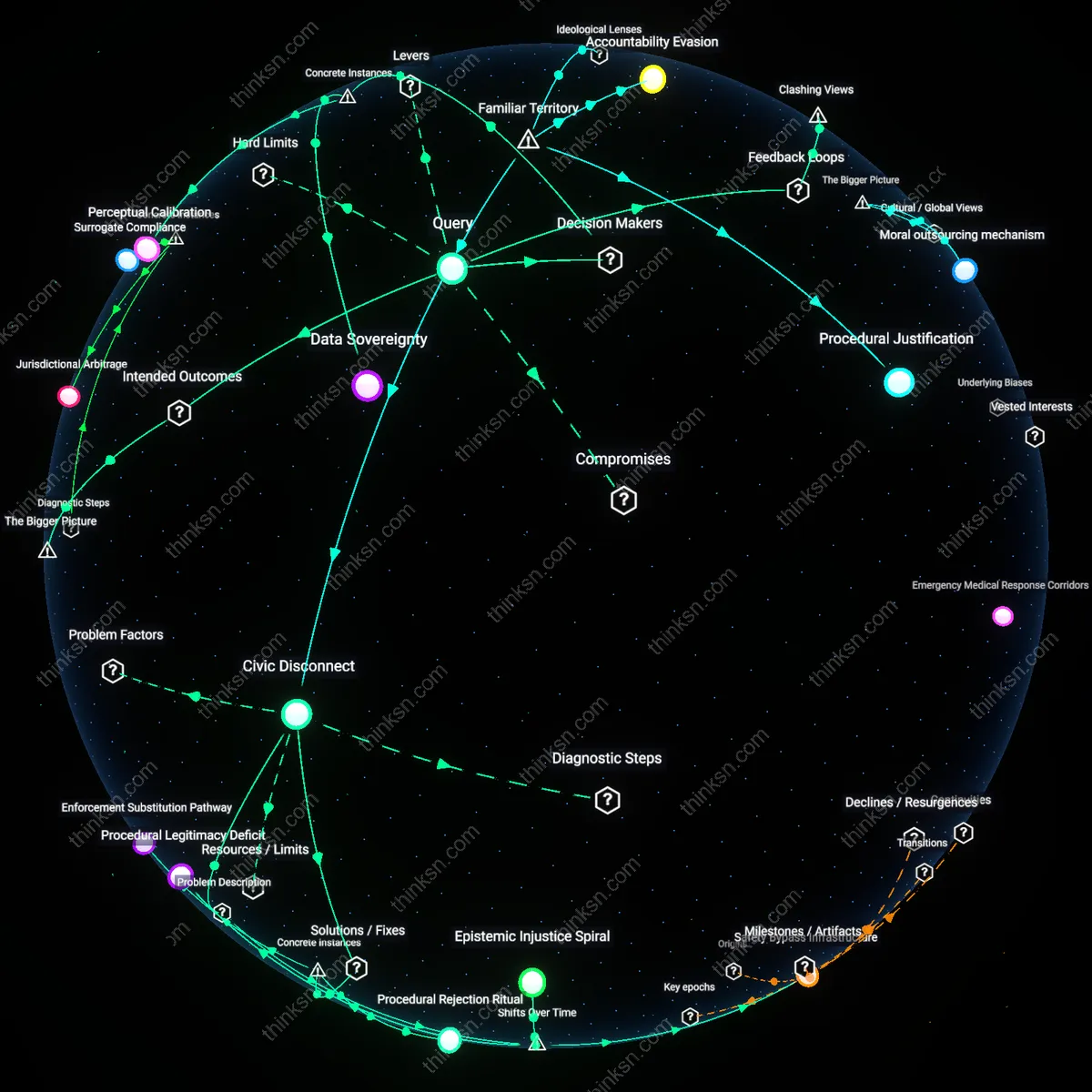
Analysis reveals 9 key thematic connections.
Key Findings
Charging Transparency Loops
Mandate public, real-time disclosure of charging decision rationales at the case level through district attorney dashboards that log prosecutorial justifications against statutory thresholds. This creates feedback pressure not from appellate courts or lawmakers but from community legal advocates and beat reporters who can identify pattern deviations invisible in aggregate data, triggering corrective interventions by ethics boards when discrepancies accumulate. The overlooked mechanism is not accountability through punishment but through local reputational friction—routine, low-stakes visibility that reshapes informal norms among line prosecutors who adjust practices to avoid public peer contrast. Most oversight focuses on outcomes or bias audits, missing how granular transparency recalibrates discretionary judgment through social rather than hierarchical control.
Prosecutorial Transparency
Publish detailed charging guidelines and outcome metrics to constrain arbitrary decision-making. When district attorneys’ offices publicly release standardized criteria for charge selection alongside aggregate data on race, geography, and offense type, they activate a feedback loop where community scrutiny reinforces procedural consistency. This works through local oversight bodies and media watchdogs who amplify disparities, creating political pressure that penalizes outlier prosecutors—a balancing loop that counters the reinforcing cycle of selective enforcement eroding public confidence. The non-obvious insight is that transparency doesn’t just expose bias—it alters internal office incentives, making predictable charging a survival tactic in an environment of public accountability.
Charging Precedent
Establish inter-office norms that treat past charging decisions as binding reference points for similar cases. When mid-level prosecutors in offices like Manhattan or Cook County treat peer-reviewed charging memos as de facto precedent, it creates a self-correcting system where deviations require justification, dampening the reinforcing instability of idiosyncratic judgment. This emerges through internal promotion criteria and inter-jurisdictional networking, where professional legitimacy depends on alignment with established patterns. What’s underappreciated is that informal precedent—though not legally binding—functions like common law within prosecutor culture, turning peer conformity into a quiet stabilizer of perceived fairness.
Prosecutorial Accountability Loops
Public trust in equal justice is maintained when independent oversight bodies systematically audit charging patterns across jurisdictions and release findings to legislative and media actors, because these audits expose disparities that would otherwise remain hidden within opaque prosecutorial workflows. This mechanism works through mandated data transparency laws, such as those emerging in states like California and New York, where district attorneys must report granular case-level charging decisions by defendant demographics and offense type. The non-obvious impact lies in how these feedback loops convert internal prosecutorial discretion into an externally regulated process, not by restricting discretion itself but by altering the consequences of its misuse—shifting incentives toward equity.
Community Prosecution Thresholds
Balancing discretion with trust requires aligning charging decisions with community norms through formalized input channels, such as civilian review boards with binding thresholds for prosecutorial deviation in low-level offenses. In cities like Philadelphia, progressive district attorneys have institutionalized community advisory councils that co-define what constitutes a 'just' application of discretion in offenses like drug possession or fare evasion, embedding localized legitimacy into prosecutorial frameworks. The underappreciated systemic effect is that these thresholds transform prosecutorial discretion from a top-down authority into a negotiated standard, reducing perception gaps between legal outcomes and public expectations.
Resource-Allocation Feedback
Equal justice erodes not from individual prosecutorial bias alone but from how funding structures compel over-charging in high-volume courts to manage caseloads, especially in overburdened urban systems like Cook County. When prosecutors face performance metrics tied to conviction volume and disposal rates, discretion becomes skewed toward plea bargains induced by inflated initial charges—a practice sustained by chronic underfunding of public defense and court staffing. The critical insight is that public distrust stems less from isolated abuses than from structural incentives that make aggressive charging a survival mechanism, meaning reform must target budgetary and operational constraints, not just ethical guidelines.
Charging Thresholds
Prosecutorial discretion can be balanced with public trust by codifying legally binding charging thresholds, as seen in Germany’s principle of mandatory prosecution (legality principle) under the Bundesgesetz über die Verfolgung von Straftaten, which requires prosecutors to file charges upon sufficient evidence, minimizing arbitrary non-prosecution. This structural constraint on discretion ensures consistent application across cases, counterintuitively enhancing both accountability and predictability without eliminating prosecutorial judgment at later stages. The non-obvious insight is that limiting discretion at the charging stage does not erode prosecutorial efficacy but institutionalizes procedural equity, making selective enforcement harder to conceal.
Public Prosecution Panels
In South Africa following the 2007 Nkandla scandal, where President Zuma faced allegations of corruption but was not prosecuted, public trust was partially restored through the post-hoc creation of multi-agency prosecution panels that included civil society observers in reviewing charging decisions. These panels institutionalized transparency by embedding external legitimacy in discretionary calls, thereby transforming prosecutorial independence into a collectively scrutinized process rather than an opaque executive function. The overlooked dynamic here is that trust accrues not from uniform charging but from inclusive deliberation, especially where power asymmetries are historically entrenched.
Discretion Audits
In Philadelphia under District Attorney Larry Krasner’s administration (2018–present), the implementation of mandatory prosecutorial discretion audits—systematic, third-party reviews of charging decisions disaggregated by offense type, defendant race, and neighborhood—exposed patterns of deviation from stated policy, prompting corrective adjustments and public accountability. Unlike performance metrics that measure conviction rates, these audits assess alignment between declared prosecutorial doctrine and actual behavior, revealing hidden gaps in implementation. The underappreciated insight is that auditability functions not as punishment but as calibration, making discretion legible and ethically actionable over time.