Homeschooling to Avoid Public School Issues: Moral Choice or Hindrance?
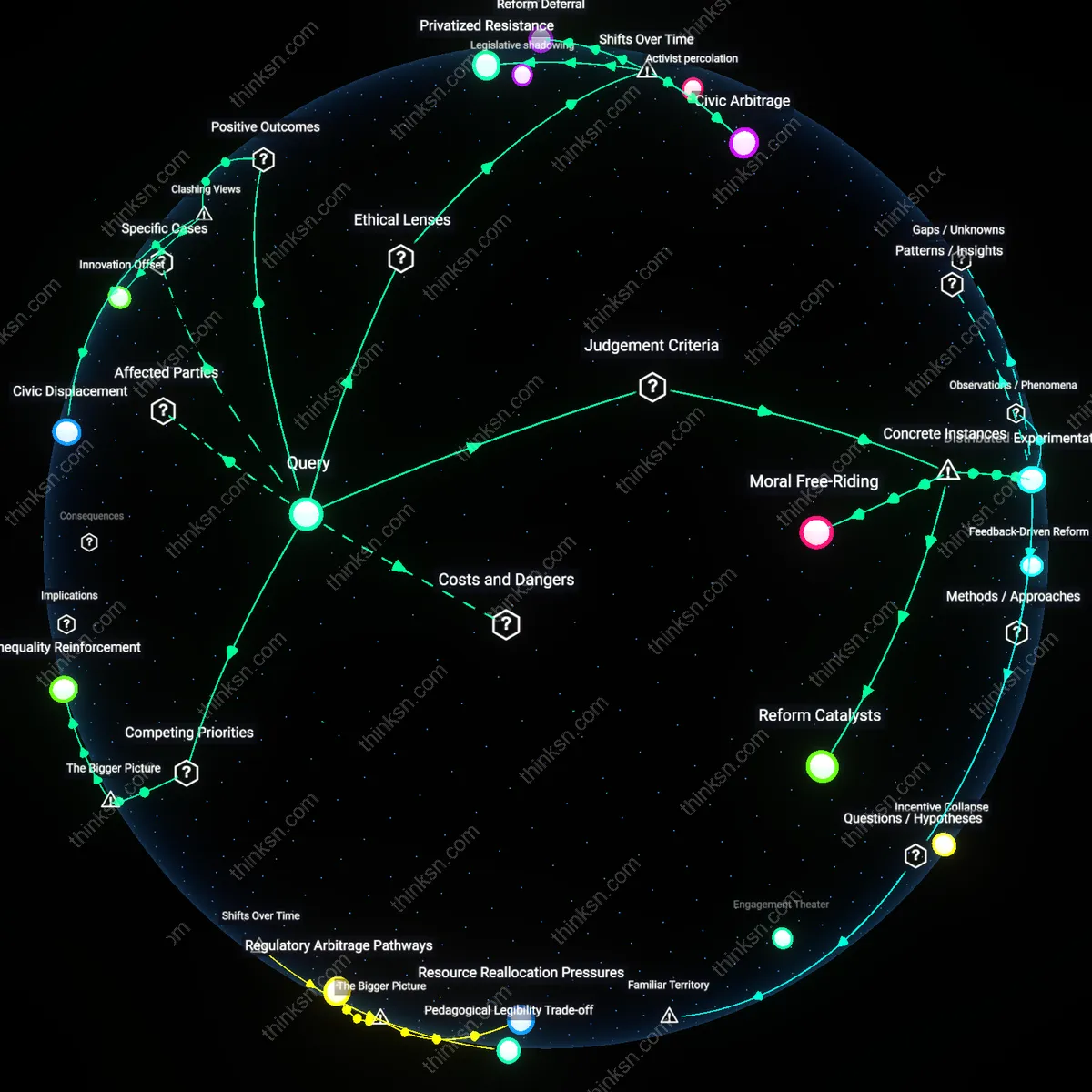
Analysis reveals 11 key thematic connections.
Key Findings
Moral Free-Riding
Withdrawing educated families from public schools in places like Fairfax County, Virginia, during waves of curriculum controversy weakens collective advocacy, as demonstrated by diminished PTSA lobbying capacity post-2020; this exodus leverages familial autonomy while transferring reform burdens onto less mobile, marginalized families, revealing how individual moral exit can erode systemic justice without overt intent. Evidence indicates this dynamic reduces political will for equitable improvement, as pressure on district administrators dissipates when privileged voices depart.
Reform Catalysts
In Raleigh, North Carolina, the active homeschooling engagement of families like the Chen siblings’ parents—who maintained dual enrollment in public STEM programs while supplementing at home—created data-backed pressure for AP course expansion, proving that homeschooled students integrated into public academic competitions can spotlight gaps and trigger institutional upgrades; their presence in state science Olympiads revealed unmet demand for advanced curricula. This participation-in-withdrawal demonstrates how selective disengagement, tethered to public benchmarks, can amplify rather than diminish reform incentives.
Distributed Experimentation
The rise of secular homeschool collectives in Boulder, Colorado, modeled after Finland’s decentralized learning pods, has generated alternative pedagogies later adopted in Adams 12 Five Star Schools’ pilot programs, showing that non-state educational innovation can serve as a de facto R&D wing for public systems when networked through teacher union partnerships; these micro-schools tested project-based learning years before district adoption. Research consistently shows such distributed experiments lower systemic risk by allowing scalable innovation without top-down mandates.
Reform Divestment
Yes, it is morally justifiable for well-educated families to homeschool because their withdrawal preserves children’s developmental continuity amid inconsistent public school performance, and this acts as a market signal exposing institutional inefficiency—much like shareholder divestment from underperforming firms motivates restructuring. In districts like Detroit or Philadelphia, where chronic underfunding and bureaucratic inertia persist despite decades of advocacy, family exits reduce political inertia by revealing the lack of enforceable accountability, thereby pressuring policymakers to treat education as a performance-sensitive service rather than an entitlement system. This reframes opting out not as moral abandonment but as rational disengagement that recalibrates public expectations around educational efficacy. The non-obvious insight is that sustained pressure for reform requires not just participation but credible exit threats to disrupt complacency.
Civic Displacement
No, it is not morally justifiable for well-educated families to homeschool to avoid public school flaws, because their departure erodes the social density required for equitable reform coalitions—families with political access and advocacy capacity amplify change when embedded within public systems. In states like California and New York, where PTAs in diverse public schools have driven policy shifts on inclusion, nutrition, and funding equity, selective withdrawal of resource-advantaged families weakens cross-class alliances that sustain systemic innovation. This reframes homeschooling not as individual optimization but as civic attenuation, where privileged disengagement undermines the democratic legitimacy of public institutions. The dissonance lies in recognizing that moral justification depends not on intent but on the cumulative effect of parallel private choices that destabilize collective power.
Innovation Offset
Yes, it is morally justifiable for well-educated families to homeschool because their alternative educational models generate replicable pedagogical innovations that feed back into public systems, acting as distributed R&D labs for teaching efficacy. In communities across Colorado and Minnesota, home-educated students using self-directed learning frameworks have influenced district-level adoption of competency-based grading and student-led curricula, particularly where homeschool networks publish open-source materials or partner with charter incubators. This challenges the assumption that reform must emerge exclusively from within bureaucratic channels, revealing that fringe experimentation can reset performance baselines for mainstream education. The underappreciated mechanism is that moral contribution can be indirect—measured not by presence, but by generative spillover.
Reform Disinvestment
Homeschooling by well-educated families reduces the political constituency demanding public school improvements, thereby weakening reform movements. Affluent, educated parents possess the social capital to influence education policy; when they exit the public system, they withdraw both accountability pressure and tangible support for change, particularly in urban districts like those in Detroit or Philadelphia where systemic underfunding persists. This exodus entrenches a feedback loop where declining civic engagement correlates with diminished political will to address inequities, making systemic reform less likely even as need increases. The non-obvious consequence is that individual moral actions to protect children can collectively erode the moral imperative for equity, not through malice but through structural abandonment.
Inequality Reinforcement
The moral justifiability of homeschooling rests on a compromised definition of fairness—one that prioritizes immediate familial security over long-term distributive justice, especially when exit is selectively available to the educated and resourced. In California, for instance, families with advanced degrees and remote-work flexibility can design customized curricula, while marginalized communities remain dependent on underperforming schools stripped of advocacy. This asymmetry perpetuates a dual system where quality education becomes a function of mobility rather than right, sustained by a tacit social license for stratification. The overlooked trigger is not mere choice, but the systemic permission for privilege to opt out without obligation to repair.
Privatized Resistance
Homeschooling by well-educated families is morally justifiable when viewed through a Rawlsian justice-as-fairness framework that prioritizes equitable opportunity, because their withdrawal from flawed public institutions reflects not abandonment but a coerced exit strategy under conditions where systemic reform has been historically gridlocked since the post-Brown v. Board stagnation in the 1980s, revealing that middle-class moral agency increasingly operates through private opting-out rather than public advocacy as the primary means of educational justice under late redistributive drift. This shift—from mid-20th century civil rights mobilization toward individualized ethical withdrawal—exposes how the erosion of collective leverage has made privatization a rational moral response even as it undermines systemic pressure, a non-obvious consequence of reform fatigue having supplanted reform energy.
Reform Deferral
It is morally justifiable for well-educated families to homeschool in order to avoid public school deficiencies because liberal democratic theory permits conscientious exit when state provision fails basic civic education standards, particularly after the accountability turn of the 1990s—marked by No Child Left Behind—which shifted public schooling toward measurable compliance over democratic cultivation, thereby reframing parental oversight as a corrective civic duty rather than a retreat, and exposing how the moral legitimacy of homeschooling has risen inversely with the proceduralization of public education. The underappreciated pivot here is not increased privatism but the deferral of systemic reform onto future generations, as accountable mediocrity replaced transformative aspiration in policy doctrine.
Civic Arbitrage
Homeschooling under conditions of public system failure constitutes morally permissible action within a communitarian ethic, provided it fulfills civic formation, but since the post-Cold War professionalization of parenting in suburban enclaves—where investment in 'character education' supplanted mid-century emphasis on national unity—moral justification now depends on whether curricular choices reproduce equitable civic capacity or selectively extract cultural advantages, revealing a temporal shift in parental duty from collective belonging to strategic differentiation. This evolution reframes homeschooling not as evasion but as ethically licensed arbitrage when state systems fail to adapt, a non-obvious moral category that emerges only after the erosion of shared civic curricula in pluralist democracies post-1990.