When Does Burnout Need Professional Help? Insurance vs. Well-being
Analysis reveals 7 key thematic connections.
Key Findings
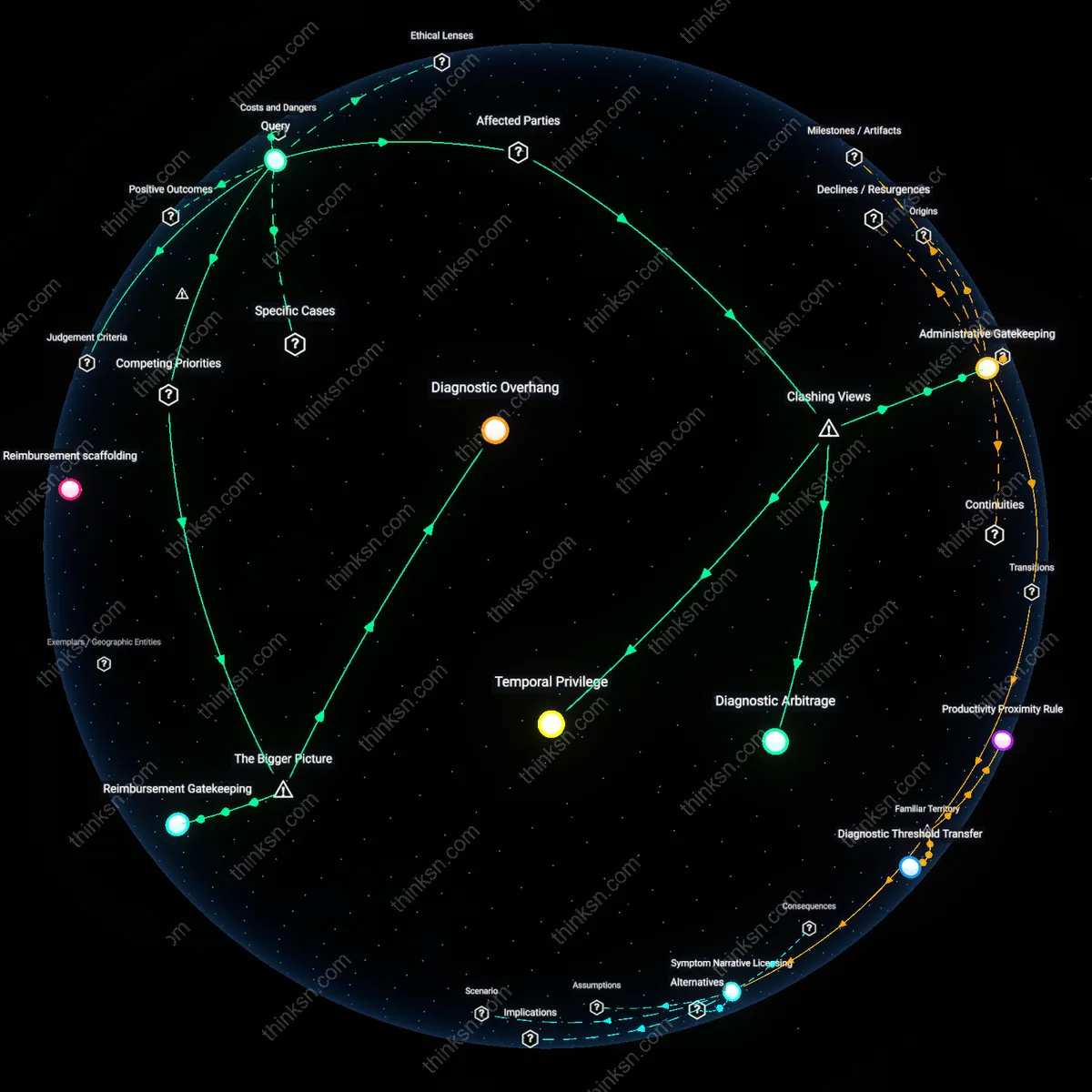
Administrative Gatekeeping
Self-diagnosed burnout warrants formal psychiatric evaluation when it disrupts productivity metrics monitored by employers using workplace wellness programs, not when symptoms first appear. Employers and their contracted Employee Assistance Programs (EAPs) act as de facto gatekeepers, requiring documented functional impairment before authorizing referrals—transforming clinical need into organizational risk management. This shifts the trigger for evaluation from subjective suffering to observable economic externality, rendering invisible those whose burnout persists beneath performance thresholds. The non-obvious consequence is that psychiatric evaluation becomes an administrative outcome, not a medical one, exposing how corporate workflows silently define mental health urgency.
Diagnostic Arbitrage
Self-diagnosed burnout gains legitimacy for psychiatric evaluation only when it can be recast as a reimbursable condition like adjustment disorder or major depressive disorder, due to insurance exclusions for non-clinical stress. Clinicians, caught between patient demand and payer rules, engage in diagnostic substitution to secure coverage—converting a socio-occupational diagnosis into a biopsychiatric one. This reveals burnout as a linguistic placeholder that must be metabolized into pathologized forms to access care, exposing a structural incentive to misdiagnose in order to treat. The friction lies in recognizing that insurance criteria don't merely constrain access—they actively reshape diagnostic identity.
Temporal Privilege
Formal psychiatric evaluation for self-diagnosed burnout is accessible only to those who can afford unpaid time off, upfront copays, or prolonged waitlists—typically salaried professionals with flexible schedules. Hourly, gig, or part-time workers face compounding delays because evaluation requires time they cannot spare, even when insurers technically cover services. This temporal barrier makes burnout evaluation a privilege indexed to labor stability, not symptom severity. The counterintuitive insight is that insurance criteria function less as medical filters than as temporal triage mechanisms, revealing how time—more than diagnosis or coverage—determines who gets seen.
Diagnostic sovereignty
Self-diagnosed burnout warrants formal psychiatric evaluation when it disrupts contractual labor obligations, because employers’ implicit role in validating distress through workplace accommodation policies creates a de facto threshold for medicalization. This mechanism operates through corporate HR systems that trigger insurance referrals only after productivity metrics fall below operational thresholds, not based on symptom severity—meaning the decisive yardstick is economic efficiency, not clinical need. What is overlooked is that individuals gain diagnostic legitimacy not by suffering sufficiently, but by threatening organizational continuity, making burnout recognition a function of workplace leverage rather than psychological criteria.
Reimbursement scaffolding
Formal psychiatric evaluation becomes accessible for self-diagnosed burnout only when symptoms align with DSM-5 criteria reframed as billable codes, because insurance underwriting protocols treat burnout as a non-reimbursable condition unless transposed into disorders like adjustment disorder or major depressive disorder. This translation occurs through clinician coding strategies that prioritize payer rules over diagnostic accuracy, embedding a hidden economic filter in clinical judgment. The overlooked dynamic is that insurance criteria do not merely gatekeep access—they actively reshape the clinical narrative, making reimbursement viability the silent architect of diagnostic formulation.
Reimbursement Gatekeeping
Self-diagnosed burnout triggers formal psychiatric evaluation when it intersects with insurance-covered treatment pathways, because insurers require DSM-coded diagnoses to authorize payment, transforming subjective distress into a bureaucratically mediated event. This mechanism operates through clinical gatekeepers—psychiatrists and primary care providers—who must recode burnout, a non-pathological strain response, into billable categories like adjustment disorders to unlock coverage, privileging reimbursement eligibility over diagnostic accuracy. The non-obvious consequence is that the clinical decision to escalate care becomes contingent not on symptom severity alone but on the availability of monetizable diagnostic labels, exposing how payment architectures reshape diagnostic thresholds.
Diagnostic Overhang
Self-diagnosed burnout warrants formal psychiatric evaluation when primary care providers detect comorbid mood disorders masked by occupational rhetoric, because time-pressured clinicians rely on patient-presented frameworks to triage, inadvertently allowing burnout narratives to delay recognition of major depression or anxiety disorders. This occurs within overburdened public health systems where visit durations average under 15 minutes, compelling clinicians to treat burnout as a diagnostic holding category while downstream referrals are bottlenecked by insurance preauthorizations. The systemic irony is that the initial act of patient self-advocacy—identifying burnout—can defer care for more severe conditions, as gatekeeping protocols amplify diagnostic uncertainty rather than resolve it.