When Does Disability Insurance Outweigh Earnings for Self-Employed?
Analysis reveals 5 key thematic connections.
Key Findings
Premium-to-Risk Inflection
Private disability insurance becomes rational for self-employed earners at $50,000 annual income due to a sharp increase in insurer approval rates and policy customization options at that level. Below $50,000, applications face higher denial rates and less favorable benefit periods, as underwriting models correlate lower incomes with higher moral hazard and claim frequency, especially in high-physical-demand occupations. The non-obvious insight is that this inflection is not driven by individual risk but by insurers’ portfolio optimization strategies, which treat $50,000 as a proxy for financial stability and occupational class, thus enabling more favorable terms.
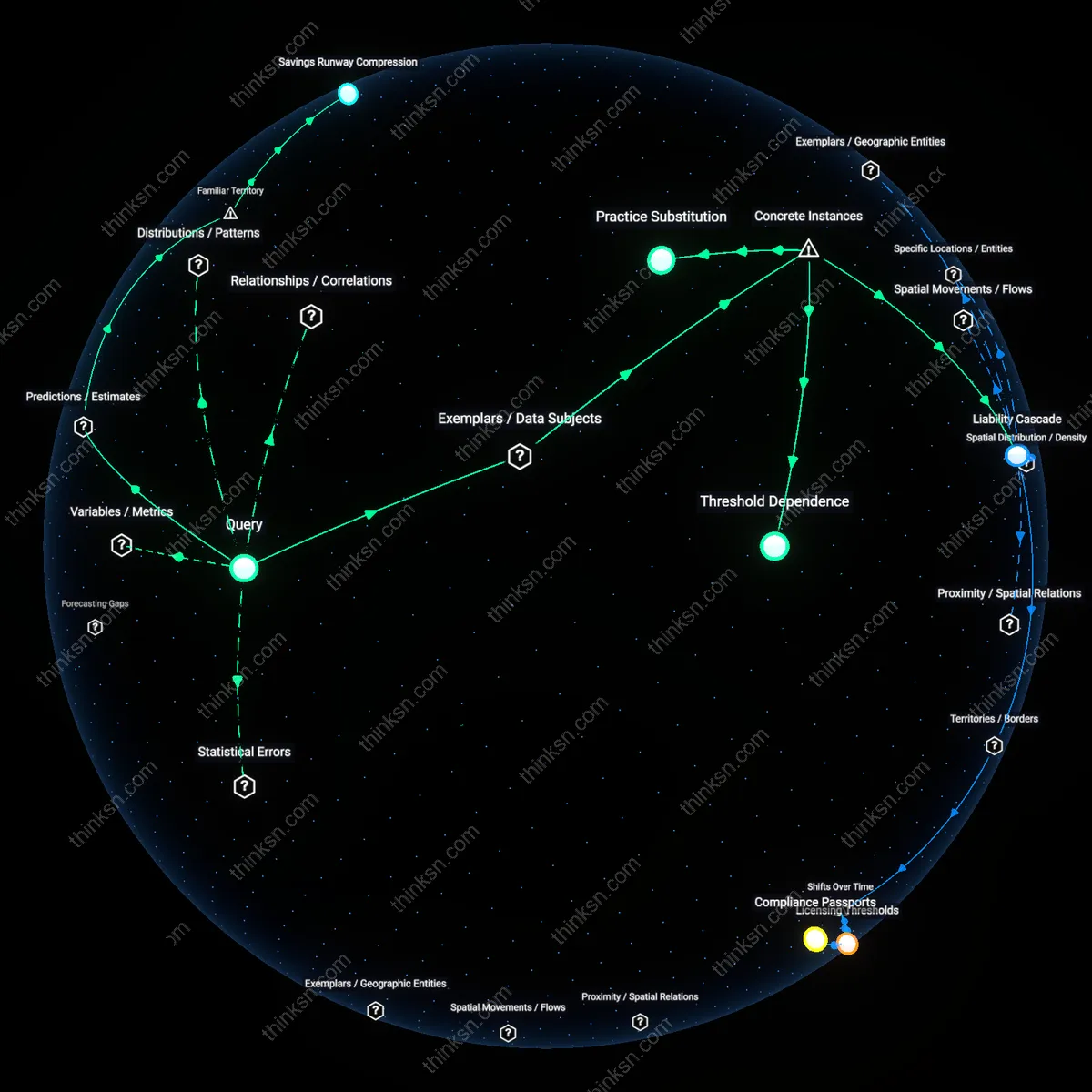
Savings Runway Compression
When self-employed individuals earn less than $40,000 annually, private disability insurance is rarely rational because typical savings and gig-work flexibility extend their income runway beyond the average disability onset latency of 11 months. Below this income, emergency reserve depletion occurs more slowly due to lower fixed expenses and greater access to public assistance buffers, reducing the urgency of formal insurance. This dynamic is overlooked in familiar framing because public discourse equates insurance need with income level alone, not with the interaction between savings duration and disability timing distributions.
Threshold Dependence
Income levels above $85,000 make private disability insurance financially rational for self-employed tech founders in Silicon Valley because below this threshold, high premium costs relative to income and the availability of lean operational models reduce the marginal value of income protection. At higher earnings, the cost of downtime due to health-related work loss—measured in forgone equity, delayed product cycles, and investor confidence—exceeds annual premiums of $6,000–$10,000, making coverage a risk-mitigation asset. This reveals that rationality in insurance demand is not linear but hinges on crossing an income threshold where business-scale consequences amplify personal risk, a dynamic underappreciated in individual-focused financial planning models.
Practice Substitution
Freelance clinical psychologists in New York City with steady incomes around $75,000 often forgo private disability insurance not due to miscalculation but because they embed income continuity within professional networks that redistribute client referrals during illness. These informal guild-like arrangements function as mutualized risk pools, delaying or replacing formal insurance uptake. The mechanism operates through trust-based reputation systems rather than financial calculations, showing that rationality is reconfigured by social infrastructure—revealing a hidden substitution between formal insurance and relational safety nets in knowledge-service professions.
Liability Cascade
Self-employed architects in post-recession Spain earning €50,000 annually purchased private disability insurance not primarily to protect income but to fulfill bonding requirements for municipal project tenders that mandate proof of business continuity plans. Here, the financial rationality emerges not from personal budgeting logic but from procurement regulations that externalize risk management onto solo practitioners. The trigger is not health risk but contractual access—illustrating how institutional gatekeeping can invert the causal chain, making insurance rational even at moderate incomes when it functions as a credential rather than a payout mechanism.