Tenant Lock Changes Signal Failure of Legal Protection?
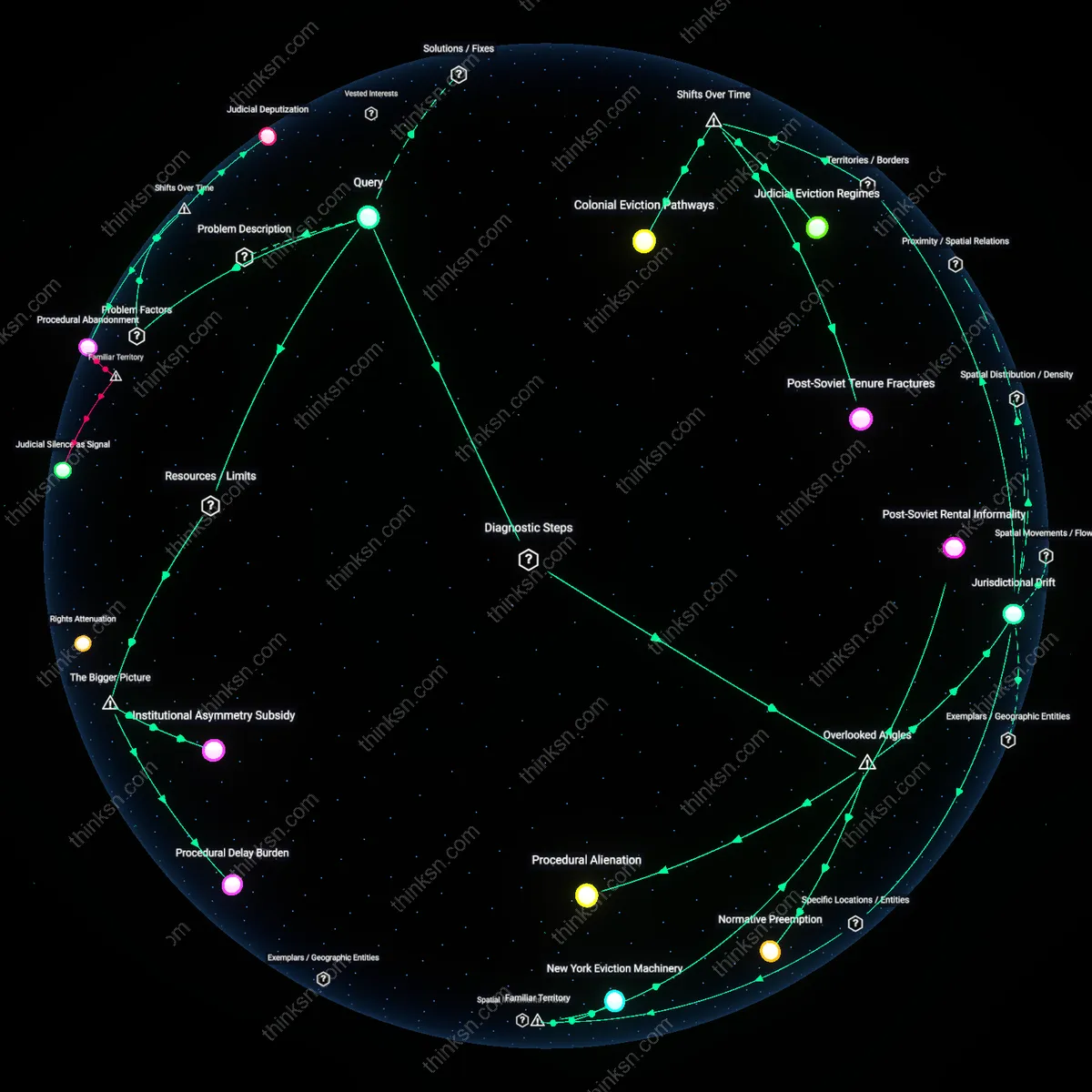
Analysis reveals 8 key thematic connections.
Key Findings
Procedural Abandonment
The increasing reliance on self-help remedies by tenants since the 1980s reveals that formal legal systems have been effectively disengaged due to deliberate underfunding and procedural delays in housing courts, particularly in cities like New York and Los Angeles where backlog exceeded two years by 2000. Housing courts, once accessible venues for enforcing habitability standards, became slow and hostile to tenant claims as legal aid funding declined by over 30% in real terms between 1980 and 1995, shifting the burden of enforcement onto tenants who lacked resources to wait. This transition—from state-mediated dispute resolution to individualized, informal enforcement—exposes how procedural inaccessibility, not just legal rights on paper, hollowed out tenant protections over time, making self-help not a choice but a forced adaptation to systemic withdrawal.
Rights-Implementation Gap
The surge in tenant self-help after the 2008 foreclosure crisis reflects a structural transformation in rental governance, where formal legal systems were unable to scale protections in tandem with the rise of absentee corporate landlords and financialized housing markets. As institutional investors like Blackstone acquired over 200,000 single-family homes by 2014, traditional tenant-landlord legal frameworks—designed for small, localized relationships—proved ineffective in enforcing repair timelines or contesting retaliatory evictions across diffuse, geographically dispersed portfolios. This shift from relational tenancy to asset-based ownership exposed a lag in legal enforcement capacity, turning self-help into a de facto regulatory mechanism and revealing that the law’s procedural design failed to evolve with the scale and anonymity of contemporary landlordism.
Judicial Deputization
The normalization of tenant self-help since the 1970s, particularly the right to withhold rent or repair-and-deduct in jurisdictions like California and Massachusetts, demonstrates a quiet judicial delegation of enforcement power to tenants as courts faced rising caseloads and legislative pressure to reduce housing court congestion. Beginning with the 1971 Green v. Superior Court decision, courts progressively recognized implied warranties of habitability, not as a direct expansion of remedies, but as a means to shift compliance burdens away from overburdened legal institutions and onto tenants themselves. This transition—from courts as arbiters to tenants as frontline enforcers—reveals that self-help is not a failure of the legal system per se, but a strategic recalibration where the judiciary outsourced oversight to the very parties most exposed to risk, thereby institutionalizing tenant action as a cost-free extension of legal authority.
Procedural Alienation
Tenant use of self-help remedies reveals that court procedures are so structurally misaligned with tenants’ temporal and logistical realities that even legally available recourses feel inaccessible. Most analyses focus on legal rights or enforcement gaps, but rarely examine how court hours, document requirements, and the sequential rigidity of filings effectively exclude those without stable internet, child care, or paid time off—disproportionately impacting low-income renters. This procedural inaccessibility functions as a quiet disqualification mechanism, where the law remains technically valid but operationally irrelevant, shifting resolution into informal arenas not because tenants distrust law, but because law cannot be scheduled.
Normative Preemption
High rates of tenant self-help indicate that informal norms around housing upkeep—such as reciprocal tenant-landlord repair expectations—routinely precede and displace legal invocation, even when formal systems are accessible. In aging rental stock like that in post-industrial cities (e.g., Pittsburgh or Buffalo), landlords and tenants often operate within tacit agreements where minor breaches are informally negotiated, making legal action a relational last resort. This reveals that legal systems are not primarily failing due to weakness, but are being bypassed by socially embedded practices that define rights as situational rather than codified, undermining doctrinal enforcement through everyday coordination.
Jurisdictional Drift
Tenant self-help proliferates in municipalities where housing courts have been administratively recategorized as 'efficiency units' under municipal finance reforms, shifting their performance metrics from dispute resolution to case closure speed. In cities like Detroit and Cleveland, this reclassification silently reorients judicial behavior toward dismissal over due process, leading tenants to anticipate non-adjudication and act preemptively. The root issue is not lack of access to law, but law’s incremental redefinition as a throughput system, where tenant self-action emerges not as defiance but as adaptation to a legal venue that no longer treats housing as a rights-based domain.
Procedural Delay Burden
Widespread tenant reliance on self-help remedies reveals that formal legal systems are hindered by procedural delays that disproportionately affect low-income renters, as eviction timelines in jurisdictions like New York City routinely extend over months due to court backlogs and mandatory mediation steps, effectively rendering legal remedies inaccessible in time-sensitive housing crises. This delay creates a functional void where tenants must either risk homelessness or resort to informal actions—such as withholding rent or repairing habitability issues themselves—because the system's pace fails to align with material survival needs, exposing how procedural design, meant to protect due process, becomes a structural barrier under resource constraints. The non-obvious consequence is that due process mechanisms, while legally sound, act as de facto enablers of landlord noncompliance when timing determines housing stability.
Institutional Asymmetry Subsidy
Tenant use of self-help remedies exposes how formal legal systems implicitly subsidize institutional asymmetry by requiring parity of legal capacity that does not exist between landlords and tenants, particularly in cities like Los Angeles where property owners deploy standardized eviction machinery backed by legal teams, while tenants navigate complex filings without counsel. The system functions efficiently for those with resources but collapses for unrepresented individuals, forcing them toward self-enforcement such as repair-and-deduct or rent escrow—acts that bypass courts not due to disregard for law, but because access mechanisms assume literacy, time, and stability that housing precarity erodes. This reveals that legal neutrality on paper enables de facto privileging of repeat players who exploit procedural inertia, making the formal system a terrain of asymmetric enforceability rather than equal protection.