Slowing Wind Project Approvals: Permits vs. Decarbonization Urgency?
Analysis reveals 12 key thematic connections.
Key Findings
Permitting Gridlock
Environmental review delays directly bottleneck offshore wind deployment, halting steel in the water despite climate mandates. Federal agencies like BOEM face escalating legal and bureaucratic demands to assess ecosystem impacts—especially on fisheries and marine mammals—slowing lease auctions and construction timelines along the Northeast coast. What’s underappreciated is how this familiar clash between conservation goals and clean energy rollout reveals that environmentalism’s procedural tools have become institutional chokepoints, even when outcomes align with decarbonization.
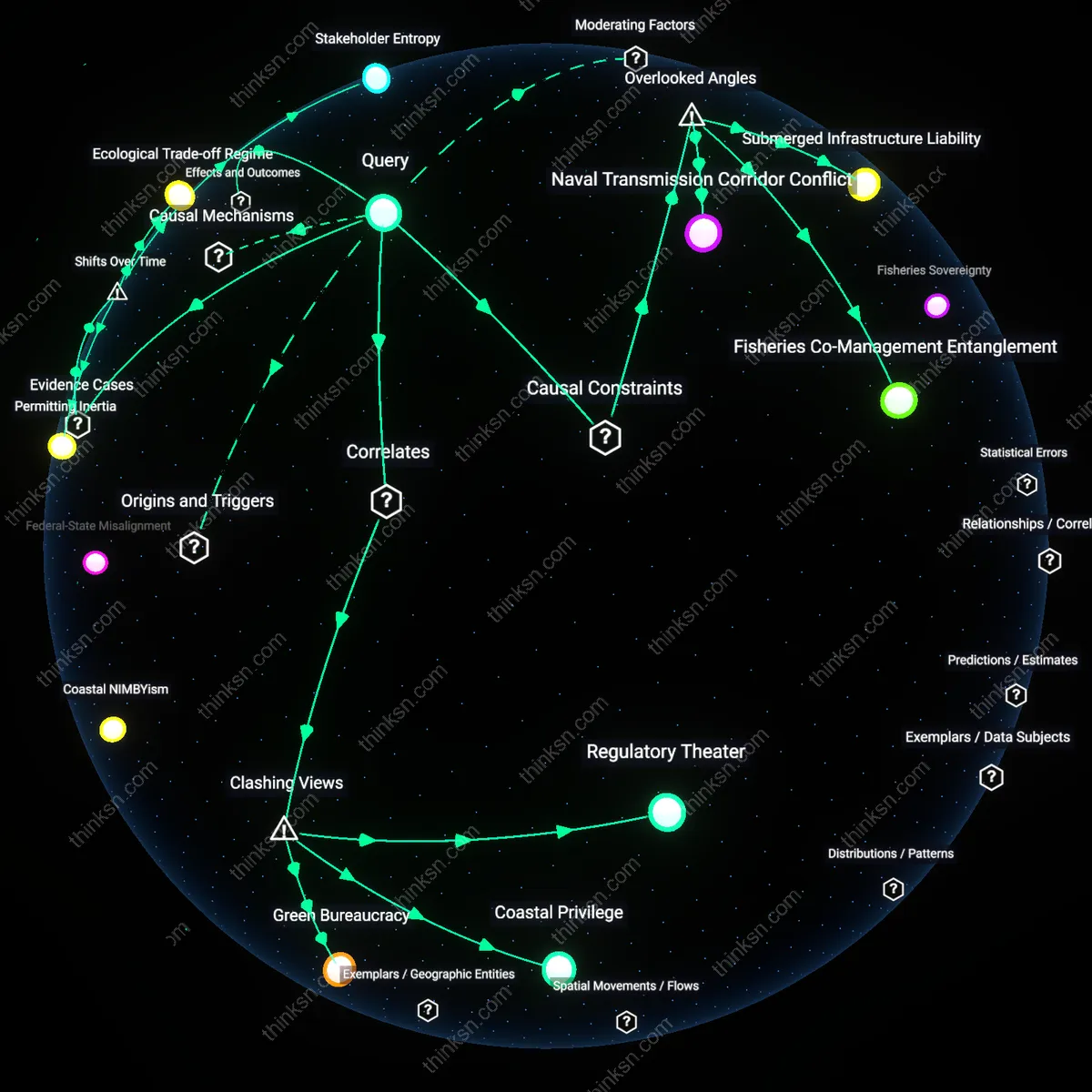
Coastal NIMBYism
Local opposition from coastal property owners and tourism boards directly stalls offshore wind approvals, overriding regional climate commitments. Visible turbine arrays threaten sightlines and perceived real estate values from wealthy enclaves in Nantucket to Long Island, triggering litigation and political lobbying that exploit permitting loopholes. The non-obvious insight here is that public enthusiasm for renewable energy collapses at the point of visibility—revealing a geographic hypocrisy where support for decarbonization is contingent on out-of-sight infrastructure.
Federal-State Misalignment
Divergent timelines between federal permitting and state-level clean energy mandates directly create project uncertainty, freezing private investment in offshore wind. While states like New Jersey and Massachusetts set binding offshore power purchase obligations, the federal pace of environmental review under NEPA fails to sync with those deadlines. The underappreciated reality is that even when political will exists locally, the federal bureaucracy operates on a different temporal logic—one that treats environmental compliance as a standalone checklist, not a mission-critical enabler of climate strategy.
Regulatory Theater
The recent slowdown in offshore wind approvals reveals not a conflict between environmental protection and decarbonization but a performance of compliance by federal agencies that preserves the appearance of ecological diligence while enabling political deferral. Agencies like BOEM are caught between White House climate mandates and localized resistance from coastal fishing communities and state governors, leading them to extend review timelines and layer procedural checks that correlate with environmental rigor but do not meaningfully enhance it; this bureaucratic elongation functions less as a substantive brake on ecological risk and more as a mechanism to absorb political risk, displacing blame onto ‘thorough review’ while actual decarbonization momentum stalls. The non-obvious reality is that the permitting process has become a stage where ecological accountability is mimicked rather than enacted, allowing multiple actors to claim fidelity to environmental values without requiring them to resolve material trade-offs.
Coastal Privilege
The approval delays expose how elite coastal enclaves successfully reframe environmental justice as aesthetic and recreational preservation, effectively weaponizing environmental review to block industrial-scale decarbonization infrastructure they deem visually or culturally intrusive. In states like Massachusetts and New Jersey, affluent shoreline communities invoke marine habitat protections and fishing zone integrity—issues statistically correlated with environmental concern—but the selective mobilization of these arguments only against offshore wind, not against fossil fuel infrastructure, reveals a latent class-based exclusion from climate sacrifice; the machinery of environmental permitting thus becomes a gatekeeping device that allows privileged groups to export the visible burdens of decarbonization elsewhere. This challenges the dominant narrative that delays stem from technical or ecological caution, exposing instead a spatially stratified politics where low-impact clean energy is treated as a public nuisance if it disrupts high-value views or leisure economies.
Green Bureaucracy
The bottleneck in offshore wind approvals demonstrates that environmental agencies have become structurally incentivized to prioritize risk aversion over systemic climate urgency, effectively transforming their mission from enablers of green transition to guardians of procedural orthodoxy. Entities such as the U.S. Fish and Wildlife Service and NOAA Fisheries apply migratory species models and seabed disturbance thresholds developed for localized conservation contexts to massive energy infrastructure, treating each project as a standalone risk rather than part of an aggregate decarbonization imperative; this institutional lens, while technically rigorous, lacks adaptive capacity to scale evaluation methods in proportion to climate thresholds, privileging ecological fidelity at the project level while obscuring the cumulative climate cost of delay. The underappreciated dynamic is that the very agencies tasked with protecting ecosystems are now functionally conserving the status quo by default, revealing that bureaucratic rationality, not public opposition or technical limits, has become the primary constraint on energy transformation.
Submerged Infrastructure Liability
The recent slowdown in offshore wind approvals reveals that decommissioned undersea oil and gas pipelines—often uncharted or poorly documented—create legal and physical obstacles that halt new projects, because developers cannot secure permits until seafloor conflicts are resolved. These submerged relics generate liability risks for new infrastructure, triggering mandatory environmental reviews under the National Historic Preservation Act and Clean Water Act, yet no centralized inventory exists to preemptively identify them. This bottleneck is overlooked because decarbonization narratives emphasize technological readiness and policy will, while ignoring the literal wreckage of prior energy systems now constraining alternatives.
Fisheries Co-Management Entanglement
Delays in offshore wind permitting stem from legally mandated consultations with regional fishery management councils, which possess de facto veto power through their authority over marine habitat protection, yet their decision-making timelines and risk tolerances are misaligned with climate urgency. Fishermen’s organizations, embedded in these councils, leverage procedural rights to demand further study on species like Atlantic cod and surfclams, stalling leases even when ecological impact forecasts are favorable. This reveals that decarbonization depends not just on energy policy but on the political economy of co-management regimes—a dependency ignored in mainstream models that treat permitting as a linear regulatory hurdle rather than a contested governance ecosystem.
Naval Transmission Corridor Conflict
The U.S. Department of Defense has quietly objected to multiple offshore wind projects along the Atlantic coast due to interference with low-frequency sonar training and submarine detection systems, which require unobstructed underwater acoustic pathways that wind farm cabling and vessel traffic disrupt. Because these security-related constraints are classified or communicated informally through interagency channels, they do not appear in public environmental impact statements, making the causality between national defense protocols and clean energy delays invisible to external observers. This hidden dependency reframes permitting slowdowns not as environmental trade-offs but as unacknowledged energy-security compromises, a dimension absent from both climate advocacy and regulatory analysis.
Permitting Inertia
The recent slowdown in offshore wind approvals reveals that environmental review processes designed for localized industrial projects are now structurally incompatible with the scale and urgency of climate infrastructure deployment. Federal agencies like the Bureau of Ocean Energy Management (BOEM), operating under National Environmental Policy Act (NEPA) frameworks refined during the 1970s–1990s for individual oil and gas leases, now apply incremental scrutiny to multi-gigawatt offshore arrays that require rapid, coordinated action across state and federal jurisdictions—exposing a procedural lag between decarbonization mandates and regulatory tempo. This mismatch has become acute since 2021, when the Biden administration set aggressive offshore wind targets just as supply chain fragilities and fisheries conflicts amplified review complexity, revealing that legacy permitting systems evolved for environmental containment now constrain environmental protection at systemic scales.
Ecological Trade-off Regime
The stringency of offshore wind approvals has increased not due to lack of political will but because marine ecosystems themselves have shifted, forcing regulators to confront newly documented risks to migratory species and benthic habitats—risks that were either absent or poorly understood in earlier renewable energy planning. In regions like the Mid-Atlantic, where the Atlantic Large Whale Take Reduction Plan now overlaps spatially and temporally with wind energy areas, permitting delays reflect a transition from treating ocean space as a generalized commons to managing it as a mosaic of ecologically sensitive, temporally dynamic zones. This shift, crystallized between 2018 and 2023 through improved bioacoustic monitoring and species tracking, reveals that decarbonization is no longer trading off against aesthetic or economic concerns alone, but against granular, real-time ecological accountability.
Stakeholder Entropy
Offshore wind permitting has slowed because the set of recognized stakeholders has broadened and diversified since the first generation of projects like Cape Wind, transforming approval processes from top-down administrative decisions into contested polycentric negotiations. Where in the 2000s developers primarily engaged state coastal zones and federal agencies, by the 2020s commercial fishing alliances like the Responsible Offshore Development Alliance, tribal nations such as the Wampanoag, and regional fisheries management councils have gained formal consultative rights—each introducing new sources of procedural delay that did not exist during earlier, more technocratic phases of energy development. This institutional accretion, particularly evident in the 2022–2023 pause of Vineyard Wind 2, reveals that the democratization of environmental governance generates legitimacy at the cost of velocity, especially when overlapping mandates lack integrative decision-making venues.