Could Universal Pre-K Empower States Over Private Daycare?
Analysis reveals 7 key thematic connections.
Key Findings
Licensing arbitrage
A universal pre-K program could incentivize private daycare providers to reclassify as licensed preschools to access public funding, thereby shifting regulatory oversight from health and safety departments to education authorities. This reclassification exploits gaps between state childcare licensing—focused on ratios and sanitation—and academic standards required for pre-K, allowing providers to gain subsidies while avoiding deeper pedagogical integration, a move most analyses overlook because they assume sector switching is purely financial rather than regulatory. The realignment transforms compliance strategy into a competitive asset, altering power by enabling private actors to selectively absorb state support without ceding autonomy. This exposes how regulatory heterogeneity creates covert pathways for privatization within public education expansion.
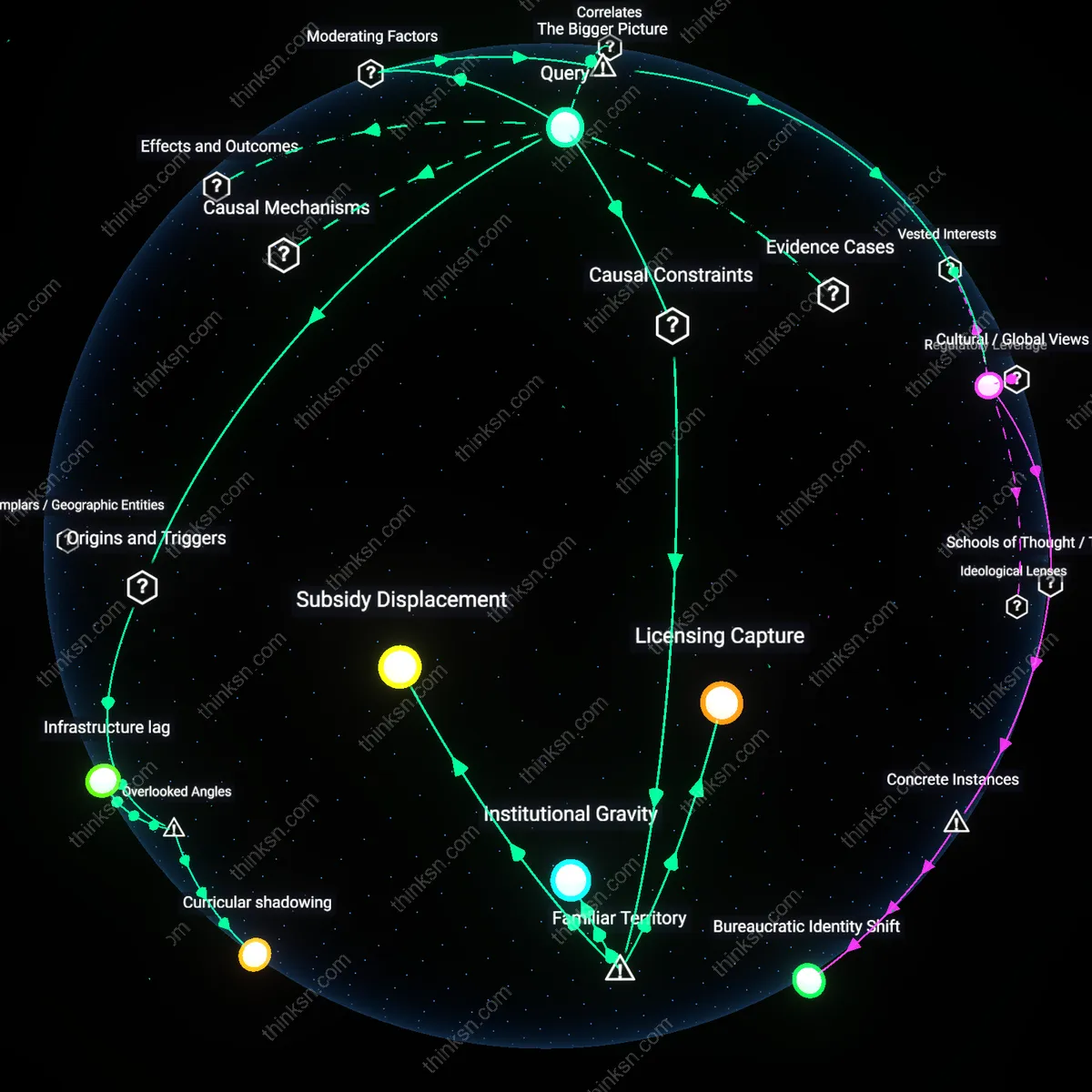
Curricular shadowing
Universal pre-K will induce private daycares not receiving public funds to mimic state-approved curricula covertly, eroding the authority’s monopoly on early learning standards by creating a de facto private adoption of public frameworks. This silent alignment occurs because parents equate pre-K branding with quality, pressuring unaffiliated providers to emulate—but not submit to—state oversight, a dynamic rarely considered as most focus on direct competition rather than imitative compliance. By enabling private providers to gain legitimacy without accountability, the state unintentionally disseminates its educational model beyond its enforcement reach, weakening its leverage while appearing to expand it.
Infrastructure lag
State education authorities will face disproportionate pressure to repurpose underutilized school buildings for pre-K, giving them nominal control over physical spaces while private providers capitalize on faster, decentralized setup in residential zones. This spatial mismatch—between the state’s slow capital planning and private agility in leasing strip malls or church basements—becomes a hidden determinant of market share, one absent from most policy assessments that treat access as purely programmatic. By ceding locational convenience, education agencies forfeit enrollment dominance even when funding flows, revealing how infrastructural inertia becomes a silent transfer of operational power to private networks.
Regulatory Leverage
State education authorities gain regulatory leverage over private daycare providers when a universal pre-K program mandates alignment with public standards, such as curriculum, teacher qualifications, or facility safety. This shift enables states to condition public funding on compliance, effectively extending bureaucratic control into previously autonomous private operations—particularly in mixed-delivery systems like those in New York City or Washington state. The non-obvious consequence is that even privately operated centers become de facto administrative extensions of state policy, reshaping market dynamics through indirect governance rather than direct ownership.
Subsidy Displacement
A universal pre-K program shifts public funding from private daycare providers to state education authorities by establishing publicly funded, school-based pre-K classrooms as the default option. This redirection of taxpayer dollars weakens private providers’ financial viability, particularly in low- and middle-income communities where cost sensitivity is highest, and re-centers administrative control within school districts and departments of education. The non-obvious consequence under familiar assumptions about 'school readiness' is that displacement occurs not through direct regulation but through budgetary crowding-out—parents naturally choose free, high-quality-seeming programs embedded in familiar school buildings, even if state-run pre-K is not objectively superior.
Licensing Capture
State education authorities will likely use universal pre-K implementation to expand their regulatory jurisdiction over early childhood standards, effectively raising licensing requirements that align private daycare operations with public program norms. By setting curriculum, teacher credentialing, and facility standards as prerequisites for public reimbursement or co-enrollment pathways, states pull private providers into compliance with state-designed frameworks, transforming them into de facto extensions of the public system. The underappreciated dynamic is that familiar concerns about 'quality' and 'accountability' in early education become levers for administrative consolidation, not just improvement.
Institutional Gravity
Universal pre-K strengthens the institutional dominance of public education systems by anchoring early childhood care within K–12 infrastructure, making school districts the central node for family engagement, data collection, and service referrals. As parents begin their children’s educational journey in state-operated classrooms, continuity pressures and informational asymmetries naturally pull subsequent choices—such as kindergarten placement and after-school programs—toward the public orbit. What’s rarely acknowledged in public conversation is that proximity and path dependency, not coercion or cost alone, reshape power by making state authorities the default coordinator of childhood development.