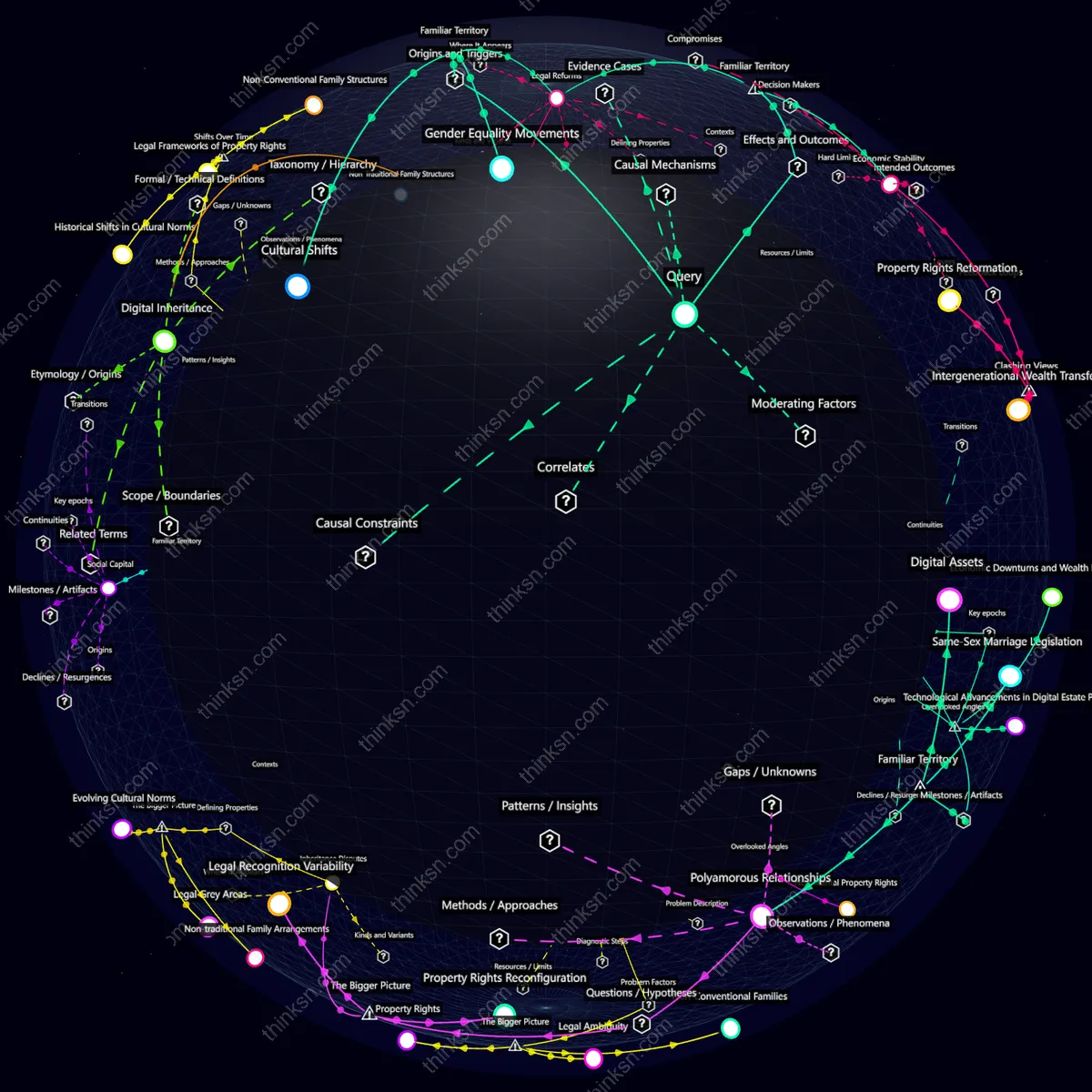
Genetic Immortality and Family Structures in Law
Key Findings
Inheritance After Immortality
Inheritance will shift from blood descent to memory records because synthetic immortality removes the need for reproduction as the basis of personal continuity.
If people can live indefinitely through synthetic biology, the need to have children for personal survival fades. This change weakens the biological basis of family lineage. Inheritance systems have long relied on blood descent, as seen in laws like the Napoleonic Code and primogen traditions. Without biological necessity, family ties lose their legal power. Distinctions between direct descendants and other relatives blur. Existing inheritance rules no longer make sense. Legal systems will shift toward tracking identity through recorded memories. These memory records will replace reproduction as the basis of personal continuity. The shift is similar to how post-war human rights and digital identity systems treat personhood. Inheritance law is not tied to blood but to recognized forms of continuity. When lineage is no longer the main measure, identity archives become the new foundation. Inheritance will continue, but its basis will change. Personal narrative, not biological descent, will define who inherits. The core of inheritance law shifts from reproduction to memory-based identity.
Deeper Analysis
What happens to inheritance claims if memory registries can be altered or falsified, undermining their role as the foundation of identity and entitlement?
Inheritance And Record Keeping
Inheritance claims survive false records when authorities enforce consistent registration, because legal rights depend on traceable identity, not memory accuracy.
Inheritance systems rely on accurate identity records held by government registries. These records link a person to their property rights after death. The connection holds only if the registry is the final judge of who is who. Courts and permanent documents have historically backed this authority. Without independent review or stable records, fake or altered registries can undermine claims. This happened when noble families lost titles in revolutionary France. False records did not lead to random property grabs. Instead, new systems arose that required proof of continuous identity. These systems treat consistent registration as the basis for rightful inheritance. The key is not whether memories are true, but whether officials agree on what the records show. In the end, inheritance depends on trusted records, not personal truth.
Family Proof In Crisis
Inheritance claims endure through kinship records preserved by religious and communal institutions because their long-standing legitimacy outlasts state systems during crises.
Inheritance systems survive identity disputes mainly through religious and community record-keeping, not state systems. This happens because religious and communal groups have long kept family records. Even during war or regime change, these groups preserve genealogical authority. Examples include Islamic waqf endowments in Arab states and Orthodox parish registers in Eastern Europe. These records keep working when state registries collapse. Their legitimacy comes from lasting tradition, not state approval. Because of this, people turn to them when state records are lost or doubted. They serve as trusted proof of family ties. Legal inheritance relies more on this trusted history than on digital registries. When state systems fail, people rely on these older community sources.
Identity Records
Inheritance claims rely on state-controlled identity records because only official verification ensures a person’s identity remains legally consistent over time.
Legal systems use memory registries to verify identity for inheritance. These registries must be reliable for claims to hold. If they can be changed or faked, the claims fail. This is not because family lines are unclear. It is because the official record of identity breaks down. State institutions must control access to these records. Only they can verify that a person’s identity remains consistent over time. This control prevents private tampering. It ensures continuity and trust in legal status. In Europe, this system grew after World War II. National identity frameworks were strengthened under data protection rules. When only the state can authenticate identity over time, inheritance claims remain secure. Without this, personal stories cannot stand as legal proof. The link between past and present identity is broken.
Memory And Inheritance
Inheritance rights depend on secure, unchangeable records because personal memories alone cannot withstand legal challenges without verified documentation.
When people lose their homes and records during conflicts, proving who owns what becomes extremely difficult. Many rely on personal stories to claim property and rights. But stories alone cannot stand up to legal scrutiny without solid proof. Systems that track identity and ownership must be secure and unchangeable. In places like the former Yugoslavia, courts were overwhelmed by claims that could not be verified. Germany and Sweden avoid this problem with trusted, centralized registries. These systems ensure that rights can be proven across generations. They anchor personal identity in reliable records, not memories. If records can be changed or faked, only strong institutions with verified data will decide who owns what. Personal stories, no matter how believable, will no longer count in law. Legal rights depend on traceable proof, not narrative truth.
False Inheritance Claims
Inheritance claims fail when registries are falsified because the absence of an independent check allows self-validating loops in identity verification.
Inheritance claims rely on memory registries to prove identity over time. These registries work only if they are trusted to be accurate. But a problem arises when the same institutions that manage records also settle disputes about them. This happens in civil law systems like France's Etat Civil. When courts accept registry data without question, falsified records can go unchallenged. During the German occupation of France, courts used altered registries to decide property cases. This gave false claims a legal basis. The system fails not because of technical flaws but because there is no independent check on identity. In English common law, personhood is tied to physical existence and legal rights like habeas corpus. This provides an external anchor. Without such a safeguard, credibility comes only from the registry itself. This creates a loop of self-justifying validation. When registries are falsified, the foundation of inheritance claims breaks down. Procedural consistency cannot save them because there is no outside standard to verify truth. Therefore, the system cannot sustain inheritance claims when records are manipulated. The collapse is systemic, not accidental.
Memory Replacing Blood
Inheritance now depends on the credibility of memory records because legal systems treat narrative coherence as proof of identity instead of biological descent.
Inheritance claims are shifting from blood ties to recorded memory. Modern systems now use official records to prove identity. These include ID cards and biometric databases. They replaced family stories and genetic links as proof of belonging. The state decides who belongs based on its records. It no longer relies on lineage or DNA. What matters is the state's version of personal continuity. When memory becomes the basis of identity, the records can be changed. This alters who can inherit. It is not a flaw in enforcement. It is a result of treating stored memories as property. People still make inheritance claims. But their foundation is now the trustworthiness of memory archives. Courts now accept a coherent story over proven descent. Legal rights depend on recognized narratives. They do not depend on biological facts. The institution decides what counts as real connection.
Explore further:
- What happens to inheritance systems when individuals can alter their genetic identity records outside state-monitored registries, such as through decentralized DNA editing platforms?
- If synthetic DNA allows for editable genetic identities, under what conditions would civil registries still be able to enforce a stable link between biological lineage and legal personhood?
- What happens to inheritance claims when memory registries are privately owned and subject to commercial interests rather than state oversight?
What happens to inheritance systems when individuals can alter their genetic identity records outside state-monitored registries, such as through decentralized DNA editing platforms?
Genetic Identity Changes
Inheritance systems become unstable when genetic identity changes outside state control because authority over identity verification fragments, breaking the single timeline on which legal claims depend.
Some countries keep strict records of births, deaths, and family ties. These records form the basis of legal identity over time. When people can change genetic identity data through decentralized tools outside government control, the state's authority over these records weakens. This does not happen because DNA itself changes, but because control over identity verification spreads. Without a single official source, different versions of family history can appear. There is no central way to settle which version is correct. Inheritance claims rely on clear, state-verified timelines of who is related to whom. When those timelines lose their legal authority, inheritance systems become unstable. This breakdown is not due to confusion about genetics, but because only one trusted system once held the power to confirm identity. That unity is now gone.
Wealth Passes Down
Inheritance persists because legal rules prioritize wealth continuity over identity proof, using long-standing fictions to bypass challenges to verification.
Inheritance systems remain stable even when technology changes. This is not because identity records are secure or well kept. It is because wealth passes through legal structures that existed long before modern registries. Trusts and other legal forms protect how assets move from one generation to the next. Even when old aristocratic systems broke down, these tools kept working. The U.S. updated its trust laws, but the outcome stayed the same. What matters is not proof of identity but the legal rules that uphold family wealth. Courts treat property rights as lasting, no matter who challenges them. Legal fictions like the corporation sole help preserve this order. The intent behind a will matters more than exact identity records. As a result, even if identity data is changed or lost, inheritance continues. Courts put wealth continuity above strict proof. The system protects distribution patterns more than it verifies individuals.
If synthetic DNA allows for editable genetic identities, under what conditions would civil registries still be able to enforce a stable link between biological lineage and legal personhood?
Identity Authority Collapse
Legal personhood loses stability when private genetic editing bypasses state authority, because identity definition shifts from public law to private control.
Legal personhood stays stable when the state controls identity verification. This control relies on centralized registries like those created by the Napoleonic Code. These systems gave states exclusive power to define identity. When people can change biological traits through private genetic editing, state registries lose authority. This shift bypasses state oversight of identity creation. It undermines the state's role in defining who exists legally. The result is not just record fragmentation. It is the loss of state monopoly on defining personhood. Without this monopoly, civil registries no longer anchor identity. Personhood becomes shaped by private acts, not public law. Historical parallels exist in post-colonial Africa. There, destroyed records caused identity disputes. Multiple registries led to inheritance conflicts. Stability depended not on centralized records alone. It depended on unchallenged state authority over identity. When such authority fails, personhood loses continuity. The root problem is not broken systems. It is that private actors now control identity creation.
Birth Records Matter
Civil registries maintain birth-based identity because international norms and data systems require genealogical proof.
Legal identity and inheritance rights around the world depend on birth, not memory. Key international agreements tie personhood to birth and nationality. Most countries use birth certificates or baptismal records to confirm belonging. Even digital systems like India’s Aadhaar require proof of parentage. The European Union also standardizes records based on descent. Some argue that new biological technologies could shift legal ties from blood to memory. This would break the link between biology and identity. But civil registries remain strongly tied to family lines. They do not easily change their core practices. International laws and data agreements support this continuity. They require genealogical proof when registering a person. These shared rules make it hard to replace descent with memory. So, even if genes can be edited, legal systems still anchor identity in biological lineage. The global reliance on birthproof upholds this system.
What happens to inheritance claims when memory registries are privately owned and subject to commercial interests rather than state oversight?
Land Ownership Proof
Land ownership depends on official records because centralized systems value documented consistency over family history or community memory.
In post-colonial countries, land ownership shifted from family history to government records. Systems once based on lineage and community knowledge gave way to centralized registries. The World Bank backed this change, as seen in Peru under Hernando de Soto. Legal ownership now depends on paperwork the state accepts. Community recognition matters less than official documents. This means inheritance is not about true descent or memory. It relies on consistent data in private or corporate registries. These systems value data accuracy over family truth. Ownership becomes not who remembers, but what records support. Rules are set by corporate oversight, not by family or state tradition.
Digital Inheritance Rights
Inheritance claims fail under privatization of memory data because control shifts from legal continuity to corporate access rules.
When companies control access to stored personal memories, inheritance depends on data access rights, not on family ties or personal identity. This access is governed by contracts and permission rules, not by law or bloodline. The European Union’s data laws show how individual control over personal data can be limited by the organizations that hold it. If the group managing the memory records can restrict or change access, then only those with approved access can claim inheritance. This means inheritance becomes a privilege granted by data companies, not a right passed through family lines. These companies can set rules that override traditional legal practices for passing down assets. In contrast, when access to memory records is public and fair, inheritance follows long-standing legal principles of identity and personhood. Inheritance does not fail because of technology. It fails when private interests control access to memory, turning inheritance into a matter of digital control.
Digital Inheritance
Inheritance claims fail under private memory registries because profit motives undermine data continuity, making legal identity depend on commercial choices rather than verified truth.
When people rely on private companies to store memories, inheritance claims depend on how those companies manage data. These companies follow business goals, not public rules. Their data policies control who can access records and for how long. Unlike government systems, they are not required to preserve information fairly. Access may be shaped by profit motives, not justice. Data can be deleted or changed to serve commercial interests. This weakens the link between a person's past and present identity. Inheritance claims need stable, continuous records to succeed. But private systems often lack strong safeguards. They rarely act like official registries unless profits or legal risks force them to. Without outside oversight, most do not keep records reliably. Truth matters less than whether the registry supports the idea of lasting identity. Inheritance only works when private archives act like public ones, and that happens only when money or liability pressures demand it.
If inheritance relies on legal fictions to maintain wealth continuity regardless of identity verification, what happens when those fictions are no longer collectively believed?
Who Owns What
Inheritance persists only when the state enforces ownership, because legal recognition by courts and registries replaces personal or historical claims.
Inheritance depends on state power, not personal trust or family promises. People may believe in inherited rights, but those rights only last if the government backs them. Modern legal systems began with the Treaty of Westphalia and grew stronger with courts and land records. These systems made ownership official only when the state recognized it. Private agreements, like wills or trusts, do not work without state support. Even long-held property claims fail if the state does not accept them. This happened during land reforms in former colonies. It also occurred when governments canceled trusts during emergencies. The key point is simple: ownership lasts only when courts and records enforce it. State authority replaces personal belief in inheritance claims. This is true in most industrialized nations after 1800. No matter how strong tradition or intent, state enforcement is what matters. The system does not rely on loyalty or memory. It relies on laws and force. So inheritance continues not because people agree on it, but because the state says so.
Digital Inheritance Rights
Digital inheritance claims fail when institutional oversight cannot enforce access rights across borders and disruptions because fragmented regulation undermines contractual guarantees.
When memory registries are run by private companies, inheritance of digital data depends on enforceable contracts. These contracts rely on stable legal oversight to last over time. But oversight often fails when governments apply rules differently or lack coordination. The European Data Protection Board has shown this problem clearly. It enforces data rights unevenly across countries. Individuals have little power to claim access under such fragmented systems. National laws often weaken the reach of broader regulations. Financial troubles or legal conflicts in one country can break continuity. This means access rights may disappear even when promised. The real issue is not privatization itself. It is whether regulators can uphold rights across borders and crises. Without strong, consistent oversight, contracts cannot protect inheritance claims. That is why they fail in practice. The lasting power of consent depends on supranational institutions working effectively.
Wealth Transfer Stability
Inheritance persists through legally enforced fiduciary roles that secure wealth transfer independently of personal identity or lineage claims.
Inheritance systems endure even when personal identity is questioned. This does not depend on proving family ties through biology or documents. Instead it relies on legal roles that manage property transfer. These roles, like trustees, are recognized by law and operate regardless of who belongs to whom. Courts enforce these duties based on established legal rules. The trust mechanism in English equity law shows this clearly. Property passes not because of blood relation but because of court-enforced duties. In the U.S. Uniform Trust Code similar rules apply. Settlor intent and trustee discretion guide the transfer. Genealogical accuracy is not the priority. Even if identity records are lost or challenged, wealth still moves. This happens because the law upholds the role, not the identity. Legal structures thus shield inheritance from identity disputes. As long as trust roles are recognized, the system holds.
What happens to inheritance rights if future civil registry systems decouple biological descent verification from legal identity by accepting synthetic genealogies or constructed lineages as valid?
Family Proof Rules
Inheritance rights depend on biological origin because civil registries and global ID standards require state-verified birth records as the foundation of legal personhood.
Civil registries decide who can inherit by requiring official proof of biological parentage. This proof must come from trusted state records based on medical data at birth. Systems like the World Bank's ID4D project push countries to record every birth and link family data across borders. These systems rely on verified biological descent, not created or synthetic relationships. Even if people create artificial DNA or use memories to define family, inheritance laws still depend on the original biological record. Digital ID systems worldwide follow strict traceability rules. Standards like eIDAS in Europe or ISO for mobile IDs extend these rules online. They require all personal digital identities to link back to a state-verified birth record. Because these systems are built to rely on biology at birth, legal personhood stays tied to that first record. No matter how advanced synthetic lineages become, inheritance cannot shift without changing this base requirement. Global frameworks keep reinforcing the same rule. Therefore, inheritance rights depend on biological origin at birth.
If identity and inheritance are increasingly determined by proprietary data systems rather than state or familial recognition, what happens to inheritance claims when the corporate custodian of genetic or memory records collapses or alters access policies?
Digital Inheritance
Inheritance is determined by corporate data access policies, not lineage, because digital systems override traditional forms of recognition with algorithmic verification.
When companies control digital systems that store personal and genetic data, inheritance depends on access to those systems. It no longer relies on family ties or government recognition. Instead, it depends on how data is managed and accessed. Large biobanks and national ID systems show this trend. The rules of private data trusts decide who inherits. These systems require proof through digital verification. They ignore oral history, community recognition, or blood relation unless recorded in the right format. Inheritance now depends on consistent data access within corporate systems. If the system fails or access rules change, inheritance claims break. This happens not because evidence disappears. It happens because the system no longer recognizes the claimant. Lineage alone cannot support inheritance outside these digital frameworks.