Outsourcing IT Risks: Data Privacy Dangers for Users
Analysis reveals 5 key thematic connections.
Key Findings
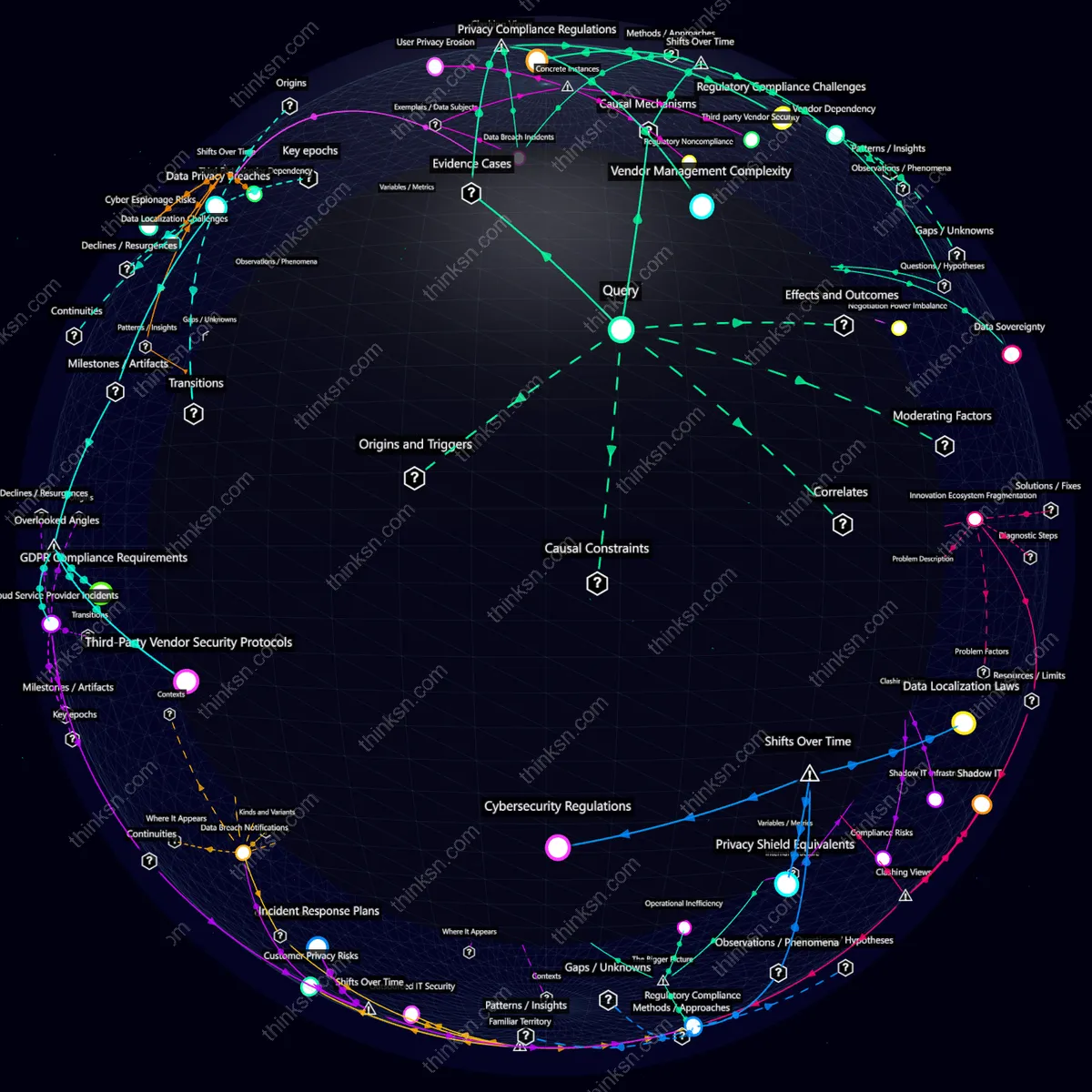
Data Breach Incidents
Outsourcing IT infrastructure increases the attack surface for cybercriminals, as data breaches at third-party providers can compromise multiple clients simultaneously. Companies must navigate a complex landscape of international regulations and contractual obligations to mitigate risks, often leading to fragmented security practices that may not align with internal standards.
Privacy Compliance Regulations
The evolution of privacy compliance across jurisdictions creates significant challenges for global companies outsourcing IT infrastructure. Stricter EU GDPR compared to more lenient U.S. laws means multinational corporations face a balancing act between legal requirements and operational efficiency, often leading to discrepancies in data protection standards that can expose users' information to greater risks.
Vendor Dependency
High reliance on third-party IT service providers introduces a new layer of vendor dependency. Companies may become overly reliant on vendors for critical infrastructure services, diminishing their autonomy and control over security measures. This interdependence can create fragile dependencies where the failure or compromise of one provider cascades across multiple enterprises, amplifying privacy risks.
Regulatory Compliance Challenges
Large companies face increased regulatory compliance challenges when outsourcing IT infrastructure across different jurisdictions with varying privacy laws, complicating adherence to strict data protection regulations like GDPR in Europe.
Vendor Management Complexity
Complex vendor management practices are required to mitigate risks associated with third-party IT services, leading to potential oversights or misalignment between the company's security policies and those of its service providers.
Deeper Analysis
What is the quantitative impact on data breach incidents when large companies outsource their IT infrastructure, and how do these breaches reveal systemic pressure points in terms of user data privacy risks?
Third-party Vendor Security
Large companies outsourcing IT infrastructure to third-party vendors often face heightened risks of data breaches due to the lower security standards and oversight in these vendors, as seen with Equifax's massive breach after a subcontractor failed to update software.
Regulatory Noncompliance
Data breaches can expose systemic gaps in regulatory compliance among outsourced IT services providers. For instance, the 2017 WannaCry ransomware attack revealed widespread non-compliance with basic cybersecurity protocols like patch management across multiple industries and countries.
User Privacy Erosion
Outsourcing IT infrastructure can lead to significant erosion of user privacy as personal data is transferred between companies, often without proper disclosure or consent. The Cambridge Analytica scandal exemplifies this risk, where Facebook's third-party data practices exposed millions of users' private information.
What are the emerging risks and hidden assumptions associated with vendor dependency in outsourcing IT infrastructure, and how do they affect user data privacy for large companies?
Data Sovereignty
Vendor dependency can lead to a loss of data sovereignty as companies increasingly rely on foreign vendors. This shifts control over user data from the company to another jurisdiction, potentially violating privacy laws and exposing sensitive information to different legal frameworks.
Supply Chain Security
Over-reliance on a single vendor for critical IT infrastructure can create significant supply chain security risks. If that vendor experiences a breach or outage, the impact cascades across all dependent companies, highlighting fragile dependencies and systemic vulnerabilities.
Vendor Lock-In
The use of proprietary technologies by vendors often results in vendor lock-in, where switching costs are prohibitively high. This reduces competitive pressure on vendors, allowing them to raise prices or diminish service quality without fear of loss of business, undermining the long-term interests of large companies.
Explore further:
- What are the emerging security risks in supply chain management when large companies outsource their IT infrastructure, and how might these affect user data privacy?
- What are the measurable risks and trade-offs associated with vendor lock-in when large companies outsource their IT infrastructure, particularly in terms of user data privacy?
What are the emerging security risks in supply chain management when large companies outsource their IT infrastructure, and how might these affect user data privacy?
Third-Party Vendor Dependency
As large companies increasingly outsource IT infrastructure to third-party vendors, the supply chain security landscape shifts dramatically. Vendors often operate across multiple industries and jurisdictions, introducing a complex web of dependencies that can expose user data privacy to significant risks. The more companies rely on these vendors for critical services, the more they inherit their security vulnerabilities, creating fragile ecosystems where a single breach can have cascading effects.
Data Localization Challenges
The rise of global IT outsourcing has led to data localization challenges and conflicting regulations across different countries. Companies must navigate stringent data privacy laws while maintaining operational efficiency, leading to potential security trade-offs. For instance, the requirement to store user data locally can conflict with cloud-based services' scalability benefits, forcing companies into costly and risky compliance strategies that may undermine supply chain security.
Cyber Espionage Risks
The global expansion of IT infrastructure outsourcing exposes large corporations to heightened cyber espionage risks. As data flows through international supply chains, adversaries can exploit the complexity and interdependencies within these systems. This creates a scenario where even minor breaches can have severe consequences, as sensitive information may be intercepted or manipulated during transit, leading to significant damage to both company reputations and user trust in data privacy.
What are the measurable risks and trade-offs associated with vendor lock-in when large companies outsource their IT infrastructure, particularly in terms of user data privacy?
Data Privacy Breaches
Vendor lock-in can lead to significant data privacy breaches as companies become overly reliant on a single vendor's security measures. When these vendors suffer major hacks, the outsourced IT infrastructure of dependent clients is often compromised simultaneously, amplifying risks and minimizing immediate exit options.
Negotiation Power Imbalance
The reliance on dominant IT vendors creates a negotiation power imbalance where smaller or less influential companies have limited leverage in contract negotiations. This can result in unfavorable terms that prioritize vendor profitability over user data privacy, undermining the security and compliance of outsourced systems.
Innovation Stagnation
Vendor lock-in often results in innovation stagnation as companies are reluctant to switch to more advanced or secure alternatives due to high switching costs. This dependency on outdated technology can expose businesses to increased cyber threats and regulatory penalties, trapping them in a cycle of risk.
How has the trend of outsourcing IT infrastructure by large companies evolved over time in relation to increasing data privacy breaches?
Third-Party Vendor Security Protocols
As companies outsource IT infrastructure to third-party vendors, the robustness of these vendors' security protocols becomes a critical determinant in preventing data breaches. However, relying heavily on external systems can expose organizations to vulnerabilities that they have limited control over.
GDPR Compliance Requirements
The introduction of GDPR has forced companies outsourcing IT infrastructure to reconsider their data privacy policies and practices abroad. While enhancing data protection standards, this shift also complicates international business operations by imposing stringent requirements on data handling and breach notification processes.
Cloud Service Provider Incidents
High-profile breaches of major cloud service providers have underscored the risks associated with centralizing corporate data in a few large-scale platforms. This has led companies to question the trade-offs between cost-efficiency and security, prompting a reevaluation of their reliance on these services.
In what ways might outsourcing IT infrastructure by large companies lead to innovation stagnation and affect user data privacy risks?
Dependency on External Providers
Large companies that outsource IT infrastructure risk becoming overly dependent on external providers for innovation. This dependency can stifle internal R&D efforts, leading to a lack of unique competitive advantages and an inability to quickly adapt to market changes or emerging threats.
Data Privacy Risks
Outsourcing IT infrastructure increases data privacy risks as companies cede control over user data to third-party providers. This shift can lead to a fragmented oversight of security measures, potentially exposing sensitive information to vulnerabilities and breaches that the company might not fully understand or mitigate.
Innovation Ecosystem Fragmentation
As large companies rely more on external IT services, an innovation ecosystem may emerge where small startups and tech providers compete for contracts. While this can drive some innovation in niche areas, it often results in a fragmented landscape that fails to support broad technological advancements crucial for industry-wide progress.
How have cloud service provider incidents evolved over time and what mechanisms contribute to their impact on user data privacy risks for large companies outsourcing IT infrastructure?
Data Breach Notifications
Increased frequency of data breach notifications by cloud service providers has heightened user anxiety about data privacy. This shift reflects the growing complexity and interconnectedness of digital infrastructures, where a single incident can have widespread ramifications.
Regulatory Compliance
Cloud service providers' compliance with stringent regulatory standards such as GDPR has intensified due to high-profile incidents. However, this focus on compliance may divert resources from proactive security measures, creating a fragile balance between legal obligations and operational efficiency.
Incident Response Plans
The evolution of incident response plans in cloud service providers reveals the industry's transition from reactive to proactive approaches. Yet, reliance on pre-established templates can undermine flexibility during unique or unprecedented incidents, highlighting a dependency on generic solutions.
How can innovation ecosystem fragmentation exacerbate user data privacy risks when large companies outsource their IT infrastructure?
Data Silos
As large companies outsource IT infrastructure to smaller, fragmented ecosystems, data silos emerge due to varying technical standards and lack of interoperability. This fragmentation exacerbates user data privacy risks as each fragment may inadequately secure or improperly handle sensitive information.
Shadow IT
Innovation ecosystem fragmentation can lead to an increase in shadow IT practices, where departments bypass official channels for quicker solutions using third-party tools. This undermines centralized security protocols and amplifies risks of unauthorized data access or breaches when large companies outsource infrastructure.
Regulatory Compliance
Fragile dependencies on diverse outsourced service providers complicate regulatory compliance efforts, particularly with varying legal requirements across jurisdictions. This can result in inadequate user privacy protections and increased liability for large companies should a data breach occur within the fragmented ecosystem.
What is the relationship between data breach notifications and the impact of outsourcing IT infrastructure on user data privacy risks for large companies?
Outsourced IT Security
Large companies increasingly rely on third-party providers for IT security, yet this outsourced model often introduces significant vulnerabilities. In the event of a data breach, delayed or ineffective communication can exacerbate damage and erode consumer trust.
Regulatory Compliance
With stricter regulations like GDPR, companies face stringent requirements for timely data breach notifications, which can create operational challenges for outsourced IT infrastructures. Non-compliance risks substantial fines and reputational harm, pushing organizations to balance innovation with legal constraints.
Customer Privacy Risks
Outsourcing IT infrastructure exposes user data privacy to new vulnerabilities. When a breach occurs, the need for swift notifications is critical but complex in multi-vendor ecosystems, often leading to fragmented responses and delayed protection measures.
What are the potential quantitative risks and trade-offs when large companies outsource IT infrastructure, particularly in relation to data silos and user data privacy?
Data Breaches
When large companies outsource IT infrastructure to third-party providers, data silos can exacerbate the risk of data breaches. The fragmented and isolated nature of data silos makes it harder for security teams to detect and respond to threats uniformly across different systems, leading to potential vulnerabilities that cyber attackers can exploit.
Regulatory Compliance
Outsourcing IT infrastructure complicates regulatory compliance due to data silo issues. As companies store user data in disparate systems without proper integration, they face challenges in ensuring consistent adherence to privacy laws like GDPR or CCPA across all datasets managed by different vendors, increasing the risk of non-compliance and hefty fines.
Operational Inefficiency
Data silos arising from outsourced IT infrastructure can lead to significant operational inefficiencies. Departments may duplicate efforts and resources due to lack of visibility into other teams' data, causing delays in decision-making processes and reducing overall productivity. This fragility in communication channels between internal units and external service providers hampers the agility needed for modern business operations.
Explore further:
- What is the relationship between outsourcing IT infrastructure and data breaches in large companies?
- What are the emerging regulatory compliance challenges that large companies face when outsourcing their IT infrastructure, and how might these affect user data privacy risks from various perspectives?
What is the relationship between outsourcing IT infrastructure and data breaches in large companies?
Vendor Lock-In
Large companies often find themselves trapped in contracts with IT outsourcing firms that lack robust security measures. This lock-in not only stifles innovation but also exposes the company to increased risk of data breaches due to a compromised third-party infrastructure.
Shadow IT Infrastructure
The reliance on outsourced IT can lead to employees bypassing official channels and setting up unauthorized cloud services or software, creating shadow IT that is difficult for central security teams to monitor. This decentralization of control significantly raises the risk of data breaches.
Compliance Risks
Outsourcing IT infrastructure to third-party providers complicates compliance with regulatory standards such as GDPR or HIPAA, especially when these providers operate across multiple jurisdictions. The failure to adequately manage and audit these complex relationships can result in severe data breaches and hefty fines.
What are the emerging regulatory compliance challenges that large companies face when outsourcing their IT infrastructure, and how might these affect user data privacy risks from various perspectives?
Data Localization Laws
As companies outsource IT infrastructure across borders, data localization laws impose strict requirements to store and process user data within specific geographic regions. This reframes corporate attention towards navigating complex legal landscapes, often leading to increased costs and operational challenges as firms must establish local data centers or partner with regional providers, potentially compromising data privacy due to fragmented compliance standards.
Privacy Shield Equivalents
The invalidation of the EU-US Privacy Shield has led companies to seek new frameworks for cross-border data transfers. Emerging equivalents face scrutiny and may not offer the same level of protection, creating a risk that user data privacy could be compromised through inadequate safeguards or enforcement mechanisms. This shift highlights the fragile dependency on international agreements and the need for continuous adaptation to evolving regulatory requirements.
Cybersecurity Regulations
Increasing cyber threats have prompted stricter cybersecurity regulations, forcing companies outsourcing IT infrastructure to implement robust security measures that can be costly and technically challenging. This systemic effect includes unintended consequences such as reduced agility in responding to new threats due to rigid compliance frameworks, potentially exposing user data privacy risks through a false sense of security provided by adherence to regulations.