Downsizing to Rent or Buy Small: Preserving Cash vs Equity Growth Post-Divorce?
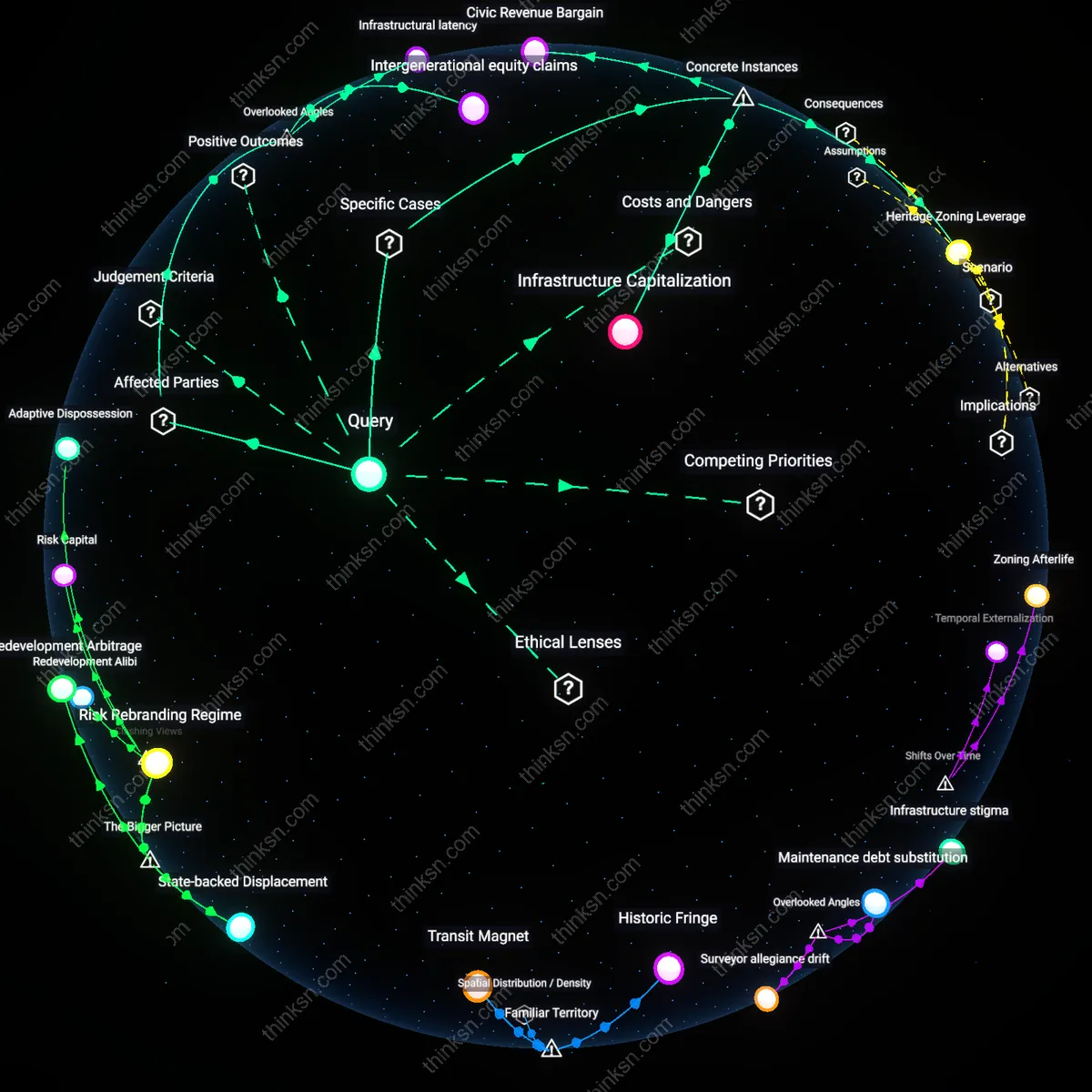
Analysis reveals 6 key thematic connections.
Key Findings
Municipal fiscal feedback
A recently divorced individual in a Sun Belt city should rent to preserve cash flow because the cyclical dependence of municipal capital budgets on property tax receipts creates an underappreciated feedback loop where rapid home ownership growth can trigger overspending on infrastructure, followed by sudden tax reassessments that burden new owners. In cities like Phoenix and Austin over the past two decades, surges in residential real estate transactions have temporarily inflated tax bases, inducing local governments to issue debt for public projects that later require tax rate hikes or maintenance levies when growth slows—risks concentrated on homeowners, not renters. This dynamic is rarely priced into personal affordability calculations, yet it systematically elevates ownership risk during demographic transition periods like divorce, where liquidity constraints reduce resilience to municipal-level fiscal volatility. The overlooked angle is that property ownership embeds individuals directly into municipal fiscal cycles as balance sheet counterparts, not just market participants.
Social repositioning latency
A recently divorced individual should rent because the latent instability in personal identity reconstruction after divorce disproportionately penalizes premature anchoring into owned space, a factor absent from standard housing models focused on interest rates or square footage. Historically, the post-divorce period resembles migration transitions seen in 19th-century urban resettlement programs, where individuals who acquired fixed dwellings too early experienced higher social fragmentation due to misaligned community assimilation trajectories. In contemporary Sun Belt metros, where neighborhood identities are rapidly reconfiguring through demographic churn, owning too soon risks spatial entrapment in a social geography that no longer reflects the individual’s evolving relational needs—delayed renter mobility functions as a strategic option on future belonging. The non-obvious mechanism is that housing form (rented vs. owned) regulates the tempo of social repositioning, not just economic status.
Climate adjustment arbitrage
A recently divorced individual should rent to preserve optionality in the face of accelerating climate-driven adjustments to urban habitability, a variable absent from traditional equity accumulation arguments. In Sun Belt cities such as Tampa or Las Vegas, long-term homeownership increasingly exposes occupants not just to real estate market cycles but to iterative municipal adaptation regimes—e.g., revised stormwater fees, cooling mandates, or insurance retrenchments—that systematically devalue thermal and hydrological efficiency of existing housing stock. Renters, who can rotate dwellings in response to these micro-regulatory shifts, gain unacknowledged arbitrage over owners locked into depreciating physical and regulatory envelopes. This residual risk—climate adjustment arbitrage—reframes home equity not as a steady-state asset but as a bet on administrative stability, a dimension ignored in personal finance orthodoxies centered on appreciation timelines.
Rental liquidity buffer
A recently divorced individual in a Sun Belt city should rent to preserve cash flow because the volatility of regional labor markets and the illiquidity of home equity during early post-divorce financial repositioning make immediate access to cash reserves a critical hedge against income disruption. This is driven by the interplay between high job churn in service-heavy Sun Belt economies—like those in Austin or Tampa—and the lag time required to extract home equity through sale or refinance, which can exceed six months. The non-obvious insight is that housing wealth is functionally inert during periods of personal transition, while rental flexibility enables rapid geographic or occupational pivoting in response to new economic pressures.
Equity anchor effect
A recently divorced individual should buy a smaller home to secure long-term equity growth because the persistent supply constraints in high-migration Sun Belt cities—such as Phoenix and Atlanta—create a structural upward pressure on housing values that outpaces inflation and rental yield differentials over time. This dynamic is reinforced by institutional investors leveraging economies of scale to acquire entry-level homes, reducing inventory available to individual buyers and accelerating price appreciation for owner-occupants who enter the market early. The underappreciated reality is that delayed entry risks permanent exclusion from neighborhood-level appreciation cycles due to threshold effects in down payment accumulation.
Emotional recalibration cost
A recently divorced individual should prioritize renting because the cognitive load of home ownership—maintenance decisions, neighborhood integration, and long-term commitments—interferes with the psychological recalibration required after marital dissolution, a process mediated by local social infrastructure that varies sharply across Sun Belt metros. In cities like Nashville or Raleigh, where community cohesion is transient and service density favors transient lifestyles, the burden of managing a property amplifies decision fatigue at a time when emotional flexibility is essential. The overlooked mechanism is that housing autonomy post-divorce is often experienced as isolation, not freedom, particularly when municipal design lacks walkable nodes that foster organic social re-engagement.