Is Expert Valuation Worth Litigation Risk for 60% Business Asset Split?)简化并纠正最后一个词的语法错误后应为: Is Expert Valuation Worth Litigation Risk for 60% Business Asset Split?
Analysis reveals 5 key thematic connections.
Key Findings
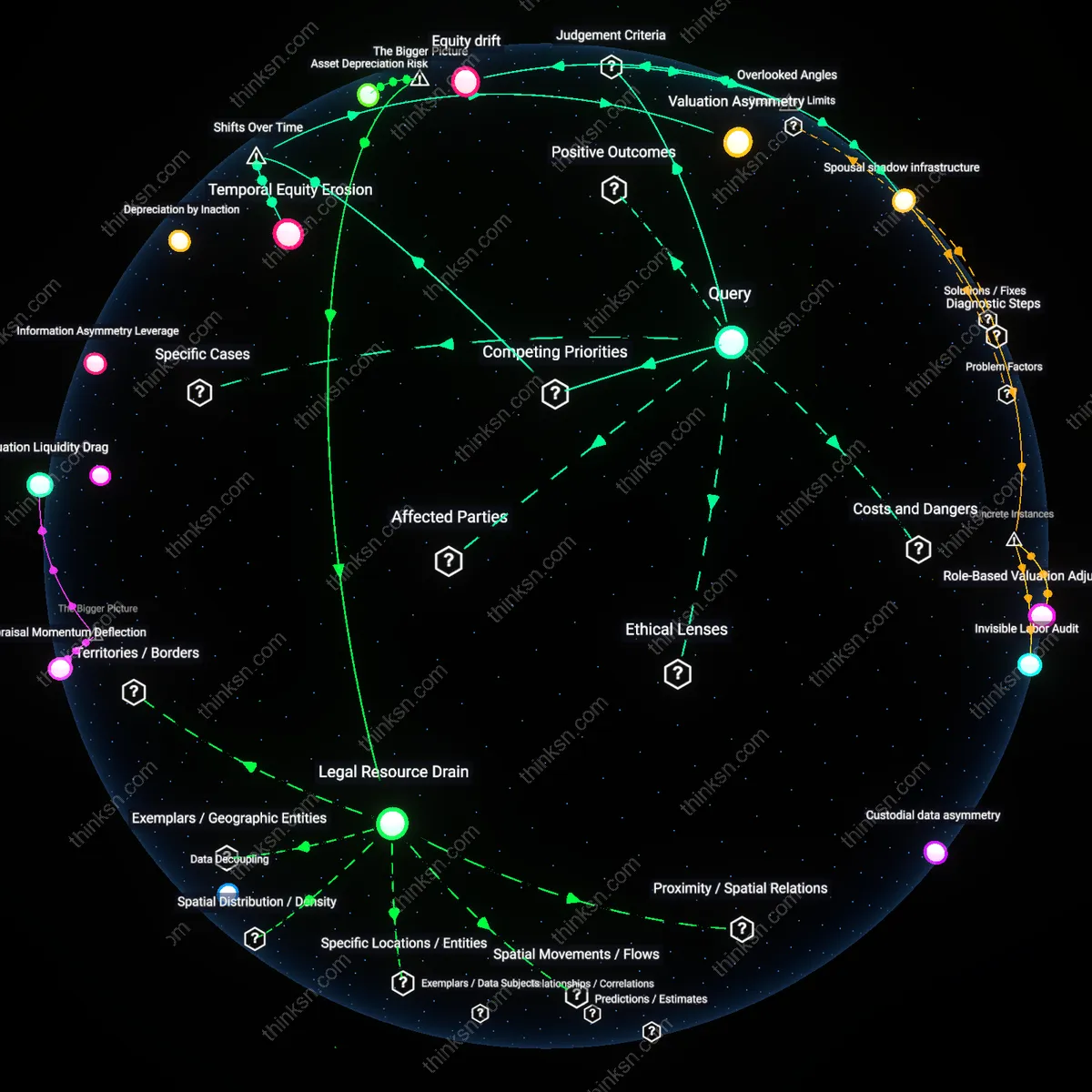
Equity drift
An expert valuation should be prioritized because delayed asset division disproportionately erodes the non-owner spouse’s compensatory equity through reinvestment and retained earnings within the business, a mechanism most visible in closely held tech startups in states like California where retained profits are not automatically deemed marital waste. This dynamic—where the business continues to grow using marital-period-generated capital while litigation stalls—shifts wealth without consent or accounting, violating the principle of just deserts; yet this 'equity drift' is rarely modeled in settlement calculations, which assume a static asset baseline. The overlooked reality is that time itself becomes a wealth transfer mechanism, not mere delay risk.
Spousal shadow infrastructure
An expert valuation should be subordinated to litigation resolution when the non-operating spouse has invisibly subsidized the business through off-balance-sheet domestic labor that enabled geographic mobility, client hospitality, or emotional scaffolding—such as a spouse who relocated repeatedly to support market expansion or hosted investor dinners from the marital home in Austin, Texas—because the economic weight of these contributions isn't separable from the business’s geographic or relational capital. Standard valuation methods cannot quantify these embedded relational assets, yet their absence inflates the owner-spouse’s perceived autonomy, violating the moral principle of full-spectrum contribution recognition. The overlooked truth is that some businesses are not just firms but spousal joint projects in organizational disguise.
Litigation Inertia
Prioritizing expert valuation mitigates prolonged litigation because the financial stakes in high-asset divorces have shifted dramatically since the 1980s, when privately held businesses became central assets rather than passive holdings, intensifying disputes over control and transparency; courts and accountants now function as de facto arbitrators of marital equity, yet the procedural complexity introduced by forensic valuations delays finality, revealing how the very mechanism designed to ensure fairness—precise asset pricing—has become a structural contributor to delay, undermining the speed and closure it promises. This non-obvious trade-off between accuracy and resolution time reflects the institutionalization of valuation as a stalling tactic within family law, where the verification of value is weaponized by liquidity-constrained spouses to extract concessions.
Valuation Asymmetry
The business-owning spouse increasingly controls the informational terrain of divorce proceedings, a shift crystallized in the post-2000 era when courts began deferring to specialized business valuators, inadvertently empowering the operating spouse to shape narratives around goodwill, future earnings, and debt load; this expertise gap entrenches an imbalance where the non-operating spouse must either accept opaque estimates or trigger litigation, making expert valuation not a neutral tool but a temporal lever—to commission it is to cede strategic time, yet to refuse it risks forfeiture of equity, exposing how the modern standard of 'informed consent' in asset division presupposes access to resources that emerge only through prolonged legal engagement.
Temporal Equity Erosion
Since the 1990s, the acceleration of market volatility and the rise of intangible business value—brand equity, customer relationships, digital infrastructure—have destabilized static valuation models, rendering even expert assessments rapidly outdated, which means that deferring distribution for a 'precise' valuation risks depleting the very asset being measured, particularly during drawn-out proceedings where operational neglect or market shifts degrade enterprise value; thus, prioritizing litigation conclusion over forensic perfection reflects an emerging norm where temporal decay outweighs measurement fidelity, a reversal from the 20th-century assumption that later, more accurate valuations yield fairer outcomes.