When Refusing Pronouns Violates a Child’s Dignity
Analysis reveals 9 key thematic connections.
Key Findings
Dignity Threshold
A family in British Columbia used the Fraser Scale for Person-Centered Planning during a mediation facilitated by the Provincial Family Support Institute to assess when a grandparent’s refusal to use a trans child’s pronouns crossed from disagreement into active harm, revealing that harm to dignity is not defined by intent but by measurable impact on the child’s emotional safety and social functioning within the kinship network; this case demonstrated that structured quality-of-life metrics can anchor ethical boundaries in emotionally charged intergenerational conflicts.
Relational Accountability
During a 2021 custody mediation in Cook County, Illinois, a court-appointed child advocate invoked the Native American Customary Adoption Framework—adapted from tribal kinship practices by the Two-Spirit relatives of the plaintiff—to establish that a grandparent’s consistent misgendering constituted cultural neglect, not free speech, because it disrupted the child’s belonging within an acknowledged lineage; this revealed that dignity is maintained not through tolerance but through demonstrated accountability within relational roles.
Boundary Integrity
In a 2019 family therapy case documented by the University of Michigan’s Gender and Family Program, clinicians applied the Bolman and Deal Organizational Frame to treat the family as a system with enforceable emotional boundaries, determining that a Michigan-based grandmother’s refusal to affirm pronouns after repeated warnings disabled the household’s capacity to protect the child’s identity, functioning like a breach in a secured perimeter; this illustrated that dignity violations are identified not by singular acts but by systemic failure to uphold declared thresholds.
Subsidy Triggers
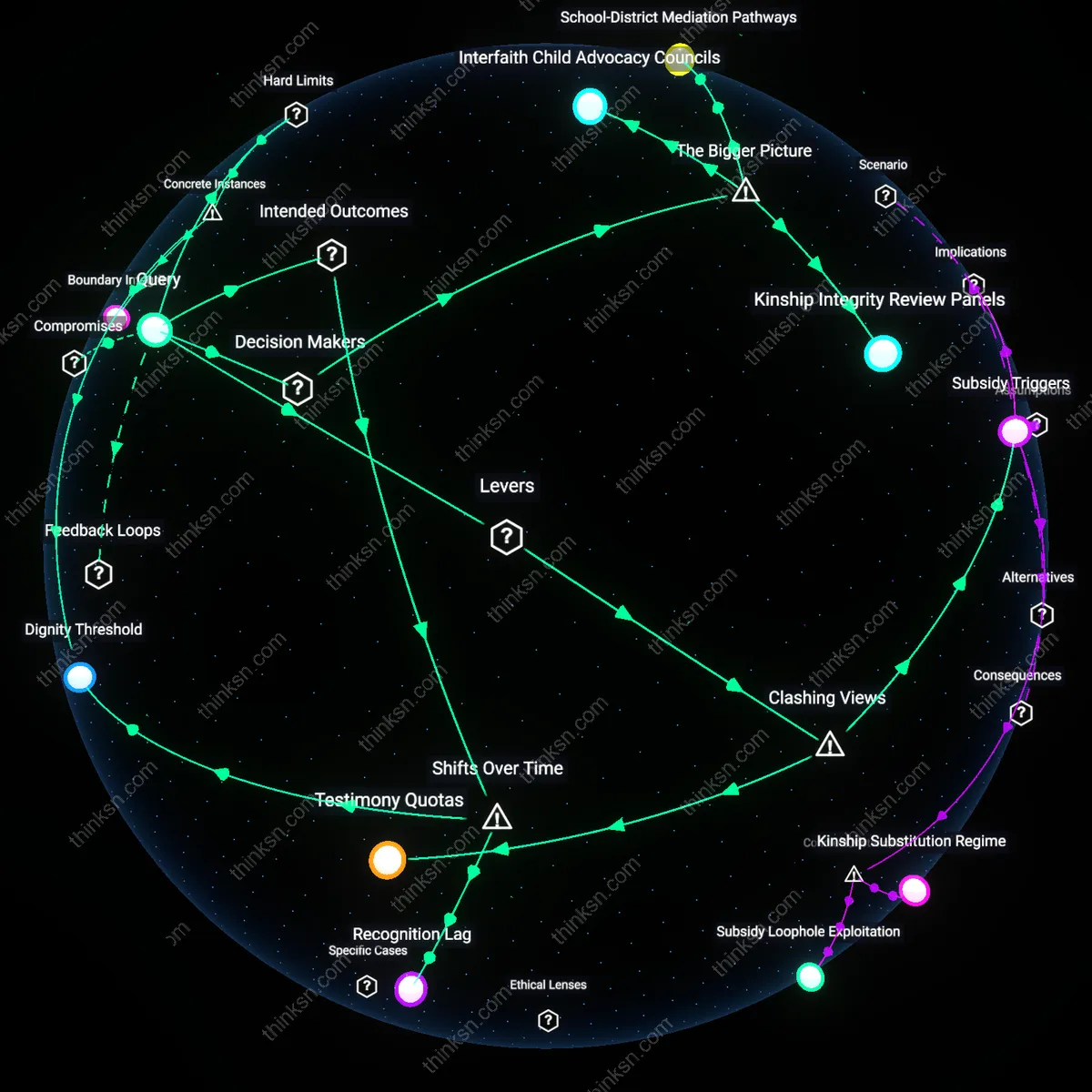
Withhold federal kinship caregiver subsidies from grandparents who fail mandatory LGBTQ+ competency training after a formal family dispute report involving pronoun denial. The mechanism—conditionality of financial support—operates through state-administered Title IV-E funding, leveraging economic dependence to enforce behavioral thresholds; significance lies in reframing dignity not as a moral appeal but as a contractual obligation tied to material support. This challenges the intuitive view that family dignity conflicts are private matters by treating them as policy-enforceable performance criteria, revealing that relational respect can be instrumentally calibrated through fiscal levers.
Testimony Quotas
Mandate that family courts admit at least three documented instances of pronoun misuse by a grandparent as presumptive evidence of emotional endangerment under state child protection codes, overriding claims of religious or generational difference. The mechanism—evidentiary rules in custody hearings—shifts the burden of proof from the child’s psychological report to patterned speech acts, operationalized through court-ordered guardians ad litem. This disrupts the dominant narrative that such refusals reflect harmless disagreement by codifying repetition as harm amplification, exposing how legal thresholds can transform speech frequency into structural abuse.
Interfaith Child Advocacy Councils
Religious denominational headquarters can establish mandatory inclusion guidelines that require affiliated local congregations to host facilitated family dialogues when pronoun disputes arise, because these central bodies control credentialing for clergy who perform family rites like baptisms and bar mitzvahs, and thus hold leverage over grandparent participation in sacramental milestones; this transforms individual identity conflicts into structured moral negotiations mediated by trusted spiritual authorities, revealing how doctrinal standardization enables consistency in otherwise fragmented kinship networks.
School-District Mediation Pathways
Public school student support teams—composed of counselors, social workers, and equity officers—are institutionally positioned to activate conflict resolution protocols that formally recognize a student’s affirmed identity as part of their educational record, thereby requiring family members accessing school-linked activities (e.g., grandparent volunteer programs or attendance at school events) to adhere to pronoun usage as a condition of participation, a mechanism that shifts familial norms through institutional gatekeeping rather than persuasion, exposing how civil bureaucracy can preemptively enforce dignity standards in private relational domains.
Kinship Integrity Review Panels
Hospital pediatric ethics committees can expand their jurisdiction beyond medical decisions to include family communication policies during adolescent treatment episodes, such that repeated refusal to use a youth’s pronouns by visiting relatives may be evaluated as psychosocial harm affecting recovery, triggering visitor restrictions under child welfare protocols; this reframes pronoun denial not as free speech but as clinical risk, demonstrating how medical authority legitimizes emotional dignity through diagnostic and custodial power.
Recognition Lag
A family can identify violation through the lag between a child’s public gender transition—a clearly demarcated event, often school-notified or legally documented—and a grandparent’s sustained non-compliance, where the duration of refusal beyond six months post-disclosure constitutes a dignitary injury. This benchmark emerged from legal and therapeutic consensus after 2020, when courts and child advocates began treating gender affirmation as time-sensitive developmental care, akin to medical adherence; the mechanism operates through school district policies and pediatric endocrinology timelines that define delays in social recognition as forms of psychological neglect. The non-obvious dimension is that dignity is not contingent on relationship quality or intent but on synchronization with clinically validated transition milestones—transforming the grandparent’s role from moral arbiter to time-bound participant in a child’s health trajectory.