At What Age Does Music Education Enrich or Strain Low-Income Kids?
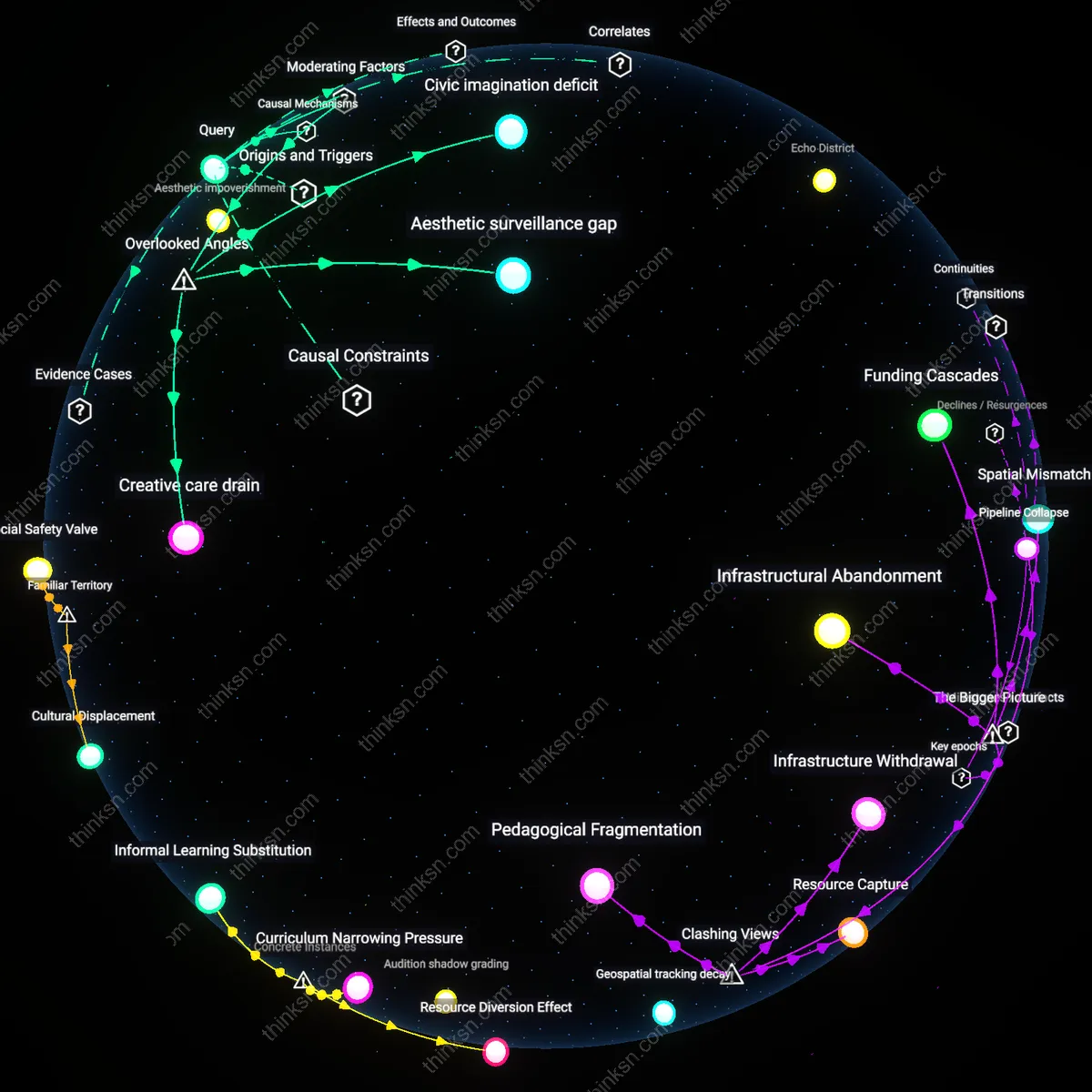
Analysis reveals 9 key thematic connections.
Key Findings
Instrumental Kinship Burden
Undue pressure arises when musical instruments become communal family assets inscribed with intergenerational obligation, particularly among diasporic communities such as Southeast Asian refugees or rural Appalachian families, where a single inherited violin or donated keyboard symbolizes collective sacrifice and upward mobility. When formal instruction frames individual performance as the sole success metric, it fractures communal ownership into private accountability, transforming children into reluctant custodians of cultural debt—pressured not by the music itself, but by the silent expectations of relatives who pooled resources to purchase equipment or pay fees. This dynamic is overlooked because standard discourse assumes access is the primary barrier, when in fact symbolic weight, not access, becomes the pressure point once instruction begins.
Acoustic Surveillance Disparity
Music instruction shifts into pressure when practice requirements assume private acoustic space, a condition routinely absent in high-density public housing such as Chicago’s Cabrini-Green or New York City Housing Authority complexes, where paper-thin walls make daily rehearsal a source of social friction and neighbor complaints. In these environments, the expectation to practice becomes a form of spatial punishment rather than development, forcing students to choose between musical progress and community belonging—especially among Black and Latinx youth for whom noise complaints are weaponized in tenant disputes. The overlooked factor is not funding or teacher quality, but the absence of acoustic privacy as a precondition for effective music learning, revealing a hidden infrastructure dependency that undermines equity even when instruments and lessons are 'free.'
Pedagogy as Triage
Formal music instruction shifts from enrichment to pressure when it becomes a tool for bureaucratic sorting rather than expressive development, as seen in U.S. public schools where low-income students are disproportionately tracked into performance-based assessments that privilege compliance over creativity. This mechanism ties musical achievement to disciplinary governance, transforming practice logs and audition outcomes into data points for non-music-related interventions like reduced academic tracking or exclusion from extracurriculars, which reframes music education as a surveillance conduit rather than an artistic pursuit. The non-obvious reality is that the burden often stems not from rigor but from being used as a soft metric for social control, subordinating aesthetic goals to institutional risk management.
Instrumentalization Debt
The shift occurs when music programs condition access to basic resources—such as school attendance credit or food stipends in after-school programs—on sustained participation, turning artistic engagement into an informal tuition payment in kind, as documented in charter networks in New Orleans where music enrollment is silently linked to behavioral contracts. This economic substitution exploits cultural capital as collateral, embedding opportunity costs so high that refusal equates to material loss, which fundamentally reorders autonomy. The dissonance lies in recognizing that coercion can be structured not through overt force but through the strategic withdrawal of necessities, rendering 'voluntary' enrichment a disguised obligation.
Temporal Dispossession
Music instruction becomes undue when its scheduling systematically overrides familial and domestic caretaking roles, particularly in single-parent, low-income households where after-school programs demand a fixed, inflexible time commitment that conflicts with siblings’ needs or household logistics, as observed in Chicago community centers requiring weekly solo rehearsals during peak family hours. The pressure emerges not from the skill demand but from the imposition of institutional time over domestic temporality, where the expectation of punctual, repeated attendance punishes those whose life rhythms are shaped by labor instability and care networks. This reveals that the conflict is less about musical intensity than about whose time is considered disposable.
Resource Drain Threshold
Formal music instruction shifts from beneficial enrichment to undue pressure when families in low-income households must divert funds from basic necessities to sustain program fees, instrument rentals, or transportation. This shift occurs not because music loses value, but because household financial systems operate near survival margins—adding culturally valued but non-essential costs forces trade-offs that generate stress rather than growth. The non-obvious insight is that the pressure point isn't the instruction itself, but the moment it becomes a budgetary anchor relative to other unstretchable needs, exposing how enrichment programs interface with economic precarity.
Time Burden Inflection
The shift occurs when music instruction demands after-school hours that conflict with children’s responsibilities to supervise siblings, assist caregivers, or contribute to household labor in low-income families. In these contexts, time is a constrained resource often more valuable than money, and scheduled programming competes directly with informal caregiving economies that sustain family functioning. The underappreciated reality is that structured enrichment assumes temporal flexibility—a luxury that disappears when children are embedded in interdependent domestic routines rather than individually optimized developmental tracks.
Status Penalty Exposure
Pressure overrides benefit when children from low-income households participate in music programs that are visibly stratified by skill or prestige—such as competitive ensembles or recitals—where they face implicit comparisons to peers with earlier access or private tutoring. In these settings, music instruction ceases to be neutral development and becomes a site of social exposure, where gaps in cultural capital are magnified rather than closed. The overlooked mechanism is that familiar enrichment spaces can function as rank-ordering institutions, turning artistic growth into a metric of deficit when social context is ignored.
Instrumentalization Threshold
In post-1990s Venezuela, El Sistema transitioned from a state-supported social uplift program to an internationally exported model that increasingly emphasized prodigy development and orchestral prestige, altering the experience of music instruction for low-income children who entered its advanced tiers after age ten. As the program gained global attention in the 2000s, admissions became more selective, rehearsals more intensive, and dropout rates more stigmatized—transforming early exposure into a high-stakes pathway where continued participation required subordination of personal well-being to collective excellence. This trajectory reveals that pressure does not arise abruptly but accrues as institutional success reshapes access, turning initial inclusion into implicit coercion for those who cross an unspoken threshold of commitment.