Do Quasi-Experiments Show Socioeconomic Status Drives Racial Sentencing Disparities?
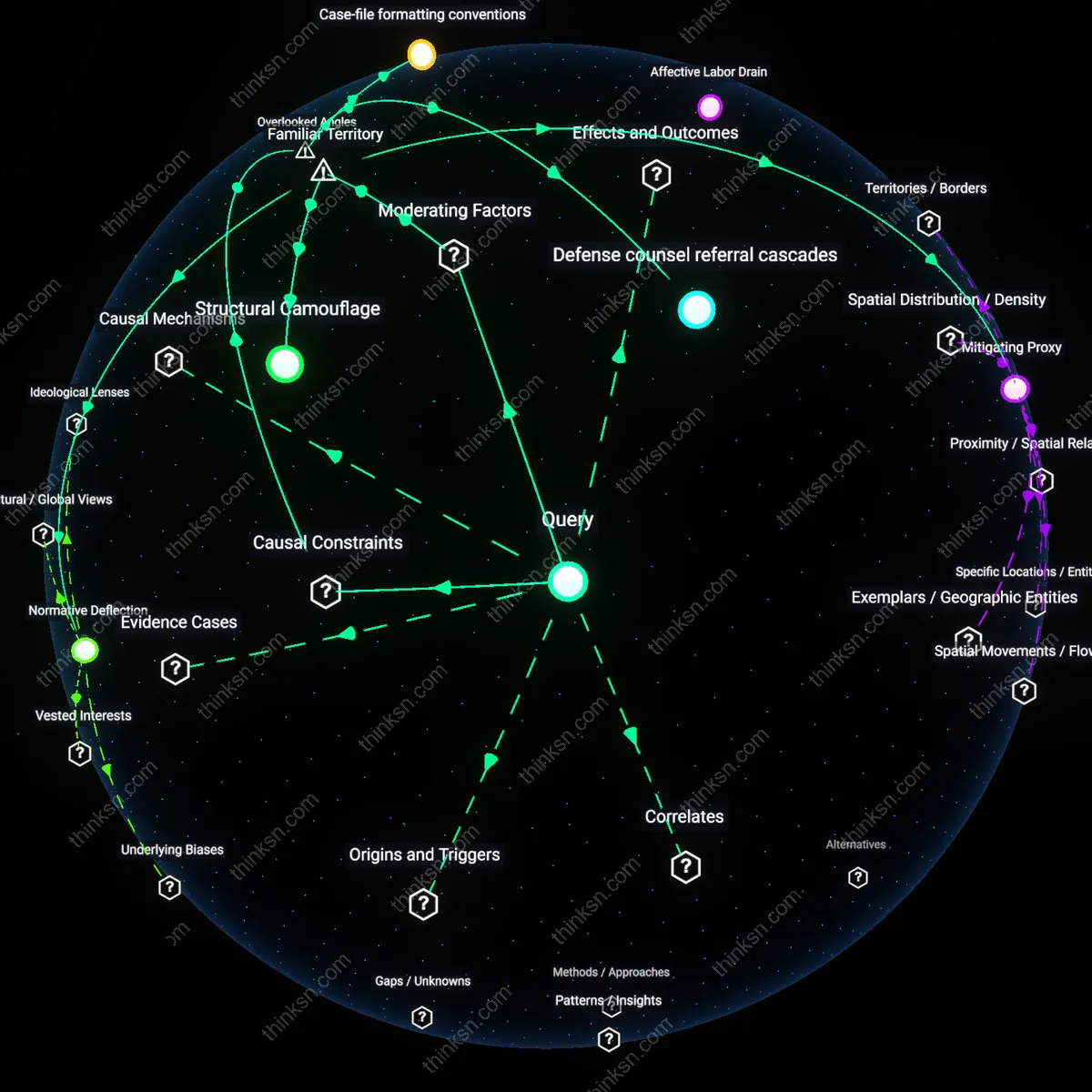
Analysis reveals 6 key thematic connections.
Key Findings
Mitigating Proxy
Socioeconomic controls in quasi-experimental studies often absorb the statistical signal of race, leading researchers to interpret reduced disparities as evidence that class, not race, drives sentencing differences. This occurs because income and education serve as measurable substitutes for deeper structural exclusions—such as neighborhood disinvestment or unequal schooling—which disproportionately affect racial minorities but are coded as economic rather than racial in data models. The mechanism operates through standard regression adjustments in criminology research, especially in federal sentencing datasets analyzed by institutions like the U.S. Sentencing Commission. What’s underappreciated is how this practice makes race appear redundant, obscuring how racism embeds itself precisely through the generation of uneven socioeconomic outcomes.
Normative Deflection
Public discourse frequently treats socioeconomic controls as a way to neutralize accusations of systemic racism, redirecting concern from institutional design to individual responsibility. This deflection works through media narratives and policy debates that frame racial disparities as a proxy for underlying differences in behavior or opportunity, reproduced in settings like congressional hearings or op-eds responding to Department of Justice reports. The analytic significance lies in how the methodological choice to 'control for' income and education becomes a rhetorical shield against structural critique. The non-obvious twist is that the very tools meant to isolate bias end up reinforcing the idea that racial inequity is natural or earned when its roots are in fact reproduced through policy.
Structural Camouflage
Racial sentencing disparities persist even after controlling for income and education because those variables cannot capture the full impact of racially segregated social institutions like policing, schooling, and housing—systems that generate unequal outcomes even at the same income level. This is visible in urban jurisdictions such as Chicago or Baltimore, where young Black men face higher charges and longer sentences than white counterparts with identical educational attainment and economic status, due to differential arrest patterns and prosecutorial discretion. The underappreciated reality is that income and education are downstream of racialized systems, not neutral filters, and treating them as adequate controls masks how racism operates through state institutions rather than outside them.
Case-file formatting conventions
Standard quasi-experimental models miss how prosecutorial case-file formatting conventions determine which defendants are statistically comparable, because only cases with specific narrative structures and charged offense combinations are included in matched analyses—this gatekeeping occurs before data is even structured for modeling, and it systematically excludes racialized defendants with complex charge bundles or sparse documentation, making socioeconomic controls irrelevant for entire swaths of cases. This bottleneck in data inclusion—governed by unstandardized, office-specific administrative practices in district attorney units in mid-sized counties like Fresno or Cuyahoga—functions as a prior causal filter that distorts the very population under study, rendering post-hoc controls for income and education moot for a significant subset of racial disparities. The non-obvious point is that methodological comparability is not neutral but institutionally scripted, and the formatting conventions themselves encode discretionary biases that precede and shape what later appears as race-neutral.
Defense counsel referral cascades
Racial sentencing disparities persist independently of socioeconomic status because public defense networks in urban counties like Cook or Harris rely on informal referral cascades, where overburdened attorneys route clients toward plea bargains based on implicit assessments of 'trial risk' that correlate with racialized demeanor coding—this mechanism operates outside income or education but affects outcomes by determining how aggressively a defendant is represented. These cascades are governed by unstated norms within defender offices about which clients are 'savable' or 'lost causes,' assessments influenced by clients’ speech patterns, affect, and cultural presentation, all of which intersect with race in ways not captured by socioeconomic variables. This dynamic reveals that legal advocacy intensity is rationed through social perception filters that mimic class logic but are racially structured, making SES controls unable to capture the actual pathway of disparity production.
Courtroom spatial segregation
Quasi-experimental models cannot eliminate racial sentencing disparity driven by courtroom spatial segregation, where defendants of different races are physically processed in different dockets, courtrooms, or shifts—each with distinct implicit norms, magistrate tendencies, and prosecutorial rotation schedules, creating non-random assignment to judicial environments that is unaccounted for in models assuming geographic or procedural uniformity. For example, in large urban courthouses like the Bronx County Courthouse, Black defendants are disproportionately funneled into morning arraignment tracks associated with higher bail settings and fast-tracked pleas, while white defendants appear more frequently in specialty courts or afternoon calendars with access to diversion programs—even when income and education are matched. This physical sorting constitutes a structural bottleneck that segregates legal experiences prior to sentencing decisions, rendering cross-sectional controls ineffective because they assume a single, cohesive judicial space that does not exist in practice.