Curriculum Bias: Why Indigenous Histories Remain Invisible?
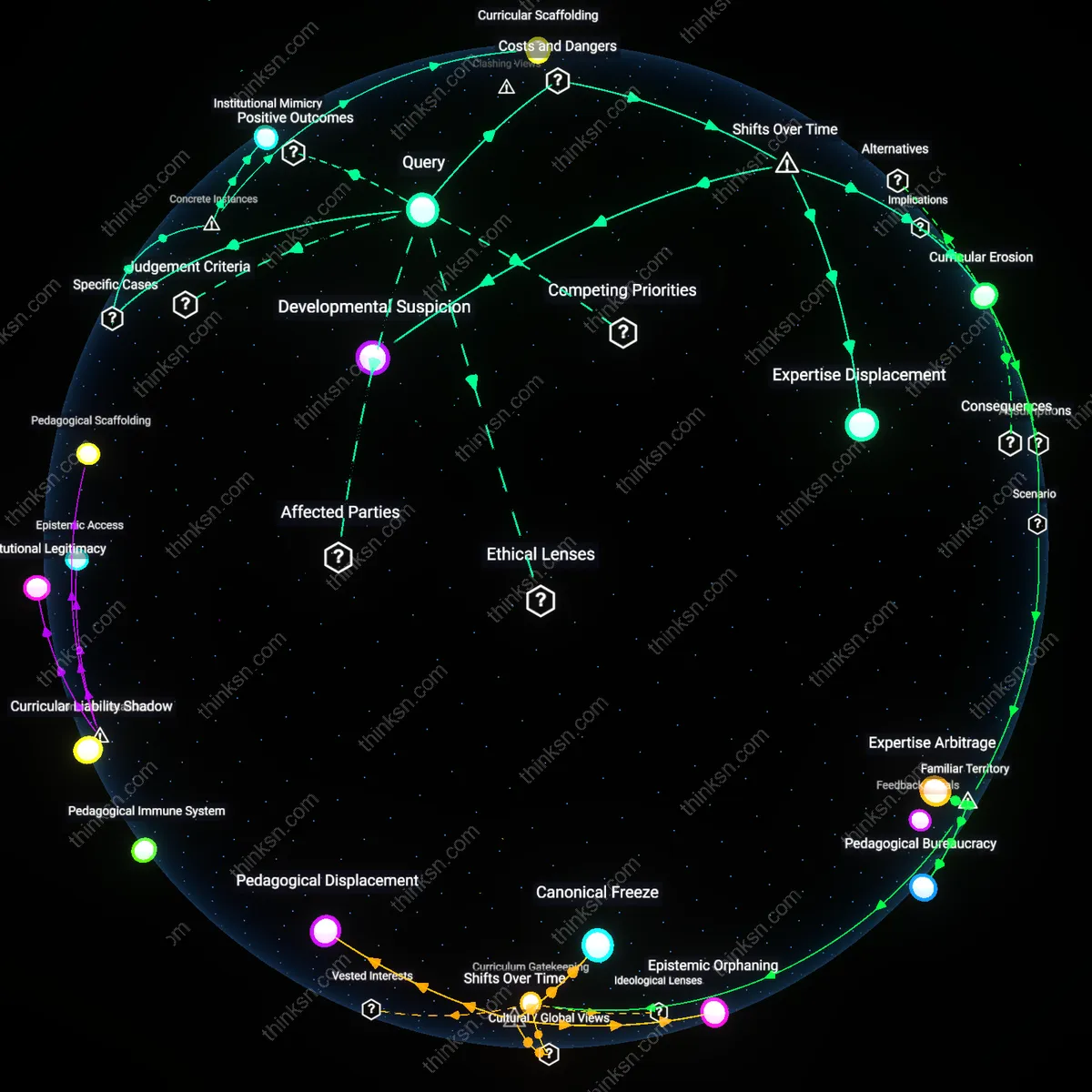
Analysis reveals 6 key thematic connections.
Key Findings
Epistemic sovereignty
The exclusion of Indigenous histories from curricula functions as a mechanism of ongoing epistemic sovereignty, where state educational systems assert control over what constitutes legitimate historical knowledge. This operates through standardized curriculum frameworks—such as those governed by national or provincial departments of education—that privilege settler-colonial narratives by framing them as neutral or foundational, while rendering Indigenous epistemologies peripheral or anecdotal. The non-obvious consequence is that curriculum design becomes a site of jurisdictional contestation not just over content, but over the authority to produce knowledge itself, implicating ministries of education, textbook publishers, and teacher training institutions in the reproduction of cognitive hierarchies.
Pedagogical containment
Reforming curricula to include Indigenous histories often fails to alter national identity construction because inclusion is structurally contained within preexisting pedagogical frameworks that assimilate difference into celebratory or historical modules—like 'Heritage Months' or standalone units on treaties—without disrupting the narrative dominance of the nation-state. This occurs through institutionalized pacing guides and assessment standards, such as those embedded in centralized examinations, which allow symbolic recognition while preserving the linear progression of national development as the core storyline. The underappreciated dynamic is that inclusion without structural reallocation of narrative authority reinforces national identity as an absorptive force, transforming resistance into curricular content.
Curricular invisibility regime
The absence of Indigenous histories from mainstream curricula reveals a curricular invisibility regime maintained by interlocking bureaucratic filters—including textbook adoption policies, teacher certification standards, and school accreditation requirements—that systematically devalue Indigenous knowledge forms even when no overt censorship exists. This regime persists because civil service norms and educational leadership training prioritize administrative consistency and political neutrality, which default to minimizing contested content rather than confronting historical erasure. The overlooked mechanism is that invisibility is not passive omission but an active equilibrium produced by risk-averse institutions that equate national cohesion with narrative uniformity.
Epistemic Vulnerability
The forced assimilation policies in Canada’s Indian Residential School system, which systematically erased Indigenous histories from education, reveal that national identity built on historical erasure creates epistemic vulnerability. This erasure severed intergenerational knowledge transmission, enabling state actors like the Department of Indian Affairs to redefine Indigenous identity through absence, distorting both public understanding and Indigenous self-perception. The mechanism—curricular exclusion sanctioned by federal education mandates—produced a national narrative that treated Indigenous peoples as peripheral, thereby weakening the nation’s capacity to respond to ongoing cultural and territorial claims. What is underappreciated is that this exclusion was not merely symbolic but functioned as an active cognitive infrastructure that disabled societal recognition of Indigenous sovereignty.
Pedagogical Containment
The exclusion of the Pueblo Revolt of 1680 from mainstream U.S. history textbooks reveals how national identity in New Mexico has been stabilized through pedagogical containment. State-mandated curricula in public schools minimized or omitted the successful uprising of Pueblo peoples against Spanish colonizers, reinforcing a narrative of passive Indigenous integration into American civic life. This mechanism operates through textbook adoption boards and standardized testing regimes that prioritize national continuity over contested histories. The non-obvious cost is that by suppressing narratives of Indigenous resistance and political agency, the curriculum structurally disarms future civic responses to Indigenous land and sovereignty claims, treating them as disruptions rather than continuities.
Narrative Monopoly
The prolonged absence of the Herero and Nama genocide from German history curricula exemplifies how national identity formation can depend on a narrative monopoly that excludes colonial atrocities. Despite the 1904–1908 extermination campaign in present-day Namibia being recognized by researchers consistently as the first genocide of the 20th century, its exclusion from formal education sustained a postwar identity centered on Holocaust remembrance while omitting colonial culpability. This selective memory is maintained through federal education standards and diplomatic silence, reinforcing a bounded moral identity that absolves the state of reparative responsibility. The underappreciated danger is that such omissions enable foreign policy and immigration frameworks that repeat colonial logics under the guise of neutrality.