How H-2A Visa Rules Empower Employers and Exploit Workers?
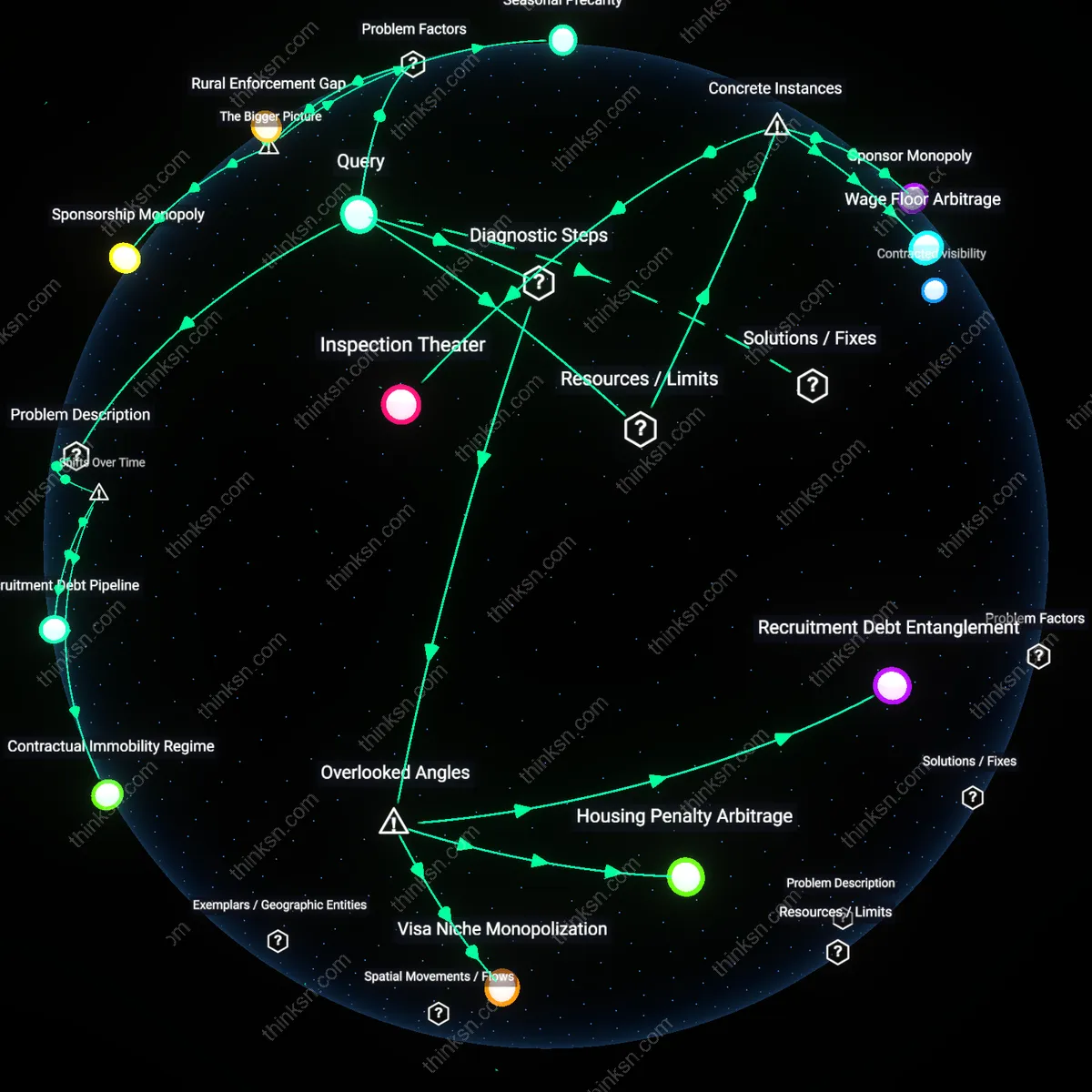
Analysis reveals 12 key thematic connections.
Key Findings
Contractual Immobility Regime
H-2A visa sponsorship binds workers to a single employer, and this tether—formalized in the 1986 Immigration Reform and Control Act—transformed temporary labor into a system of controlled dependency, where job mobility is legally prohibited and withdrawal of work authorization deters complaints. This mechanism emerged distinctly from earlier bracero programs, which, while exploitative, operated through informal coercion rather than codified employment lock; the shift to legal immobilization institutionalized leverage, allowing growers to extract surplus labor under threat of deportation, a systemic risk amplified by the lack of statutory whistleblower protections. The non-obvious outcome of this legal shift is not just vulnerability to abuse, but the normalization of labor control as a function of visa design itself.
Agricultural Exceptionalism Framework
The exclusion of farmworkers from core labor protections—such as collective bargaining under the 1935 National Labor Relations Act—created a regulatory void that H-2A sponsorship inherited and amplified when the program expanded post-1990 amid tightening border enforcement. As federal policy increasingly treated agriculture as a sector requiring flexible, racially segmented labor, the H-2A rules were shaped less by labor standards than by grower demands for predictability, embedding a permanent tier of disenfranchised workers whose rights are contractually diminished by design. This historical severance from labor law precedent, rather than being a residual oversight, functions as an enabler of exploitation, revealing how sector-specific legal carve-outs become mechanisms of systemic subordination.
Recruitment Debt Pipeline
Workers now routinely incur significant pre-departure debts to secure H-2A placement through private recruiters in countries like Mexico, Guatemala, or Jamaica—a practice that escalated after the 1990s as U.S. consulates restricted visa access and third-party labor brokers filled the gap, embedding financial dependency prior to arrival. This debt, often amounting to months of wages, is not addressed by current sponsorship rules, which formally prohibit charging fees but fail to regulate cross-border recruitment ecosystems, thus offshoring worker coercion beyond the reach of U.S. enforcement. The shift from state-mediated labor importation to privatized recruitment markets has effectively externalized exploitation, rendering debt a hidden but central organizing feature of the program’s labor control architecture.
Sponsorship Monopoly
H-2A visa holders cannot change employers without losing legal status, which binds workers to specific employers and enables coercive labor practices because growers control both job access and immigration standing, creating a structural dependency that undermines bargaining power and shields abuse from oversight, which is rarely acknowledged as a deliberate design feature of the program rather than an incidental flaw.
Rural Enforcement Gap
Labor violations in H-2A-dependent agricultural regions persist because federal enforcement agencies operate under limited jurisdiction and presence in isolated worksites, where local law enforcement often defers to employers and interpreters are scarce, enabling systemic underreporting and noncompliance—this deficit in on-the-ground accountability reveals how geographic marginalization functions as an enabling condition for exploitation, not merely a logistical hurdle.
Seasonal Precarity
The H-2A visa’s time-bound nature ties work authorization strictly to short-term production cycles, pressuring workers to prioritize job retention over rights reporting because any contract termination jeopardizes immediate deportation, which aligns employer profit cycles with migrant vulnerability—an underrecognized temporal mechanism that institutionalizes risk aversion and normalizes substandard conditions.
Recruitment Debt Entanglement
H-2A visa exploitation is primarily enabled by the enforceability of recruitment-related debts in home countries, which bind workers to employers before arrival. Third-party recruiters in countries like Guatemala or Mexico charge exorbitant fees that are neither regulated nor recognized as exploitative under U.S. labor law, creating binding financial obligations that persist even after workers enter the U.S. Because the U.S. system does not monitor or invalidate these pre-entry financial dependencies, workers flee deportation or contract non-renewal not to lose wages needed to repay debts, making them tolerate abuse. This mechanism is rarely factored into U.S.-based labor oversight, which focuses on post-arrival conditions, not transnational debt circuits that precede them.
Housing Penalty Arbitrage
Exploitation in H-2A programs intensifies through deliberate underfunding of employer-provided housing, where landlords—often the farmers themselves—treat substandard accommodations as a cost-shifting tool. While U.S. regulations require habitable housing, enforcement relies on infrequent inspections and self-reporting, allowing employers in states like Florida or North Carolina to congest workers into dilapidated trailers, deduct 'rent' from wages despite minimal investment, and pocket the difference between required upkeep and actual spending. This silent wage reduction, disguised as housing provision, evades scrutiny because labor audits treat housing as a non-wage benefit rather than a vehicle for indirect earnings extraction—making it a hidden form of wage theft invisible to wage and hour enforcement models.
Visa Niche Monopolization
Labor exploitation is structurally reinforced by the geographic concentration of H-2A certification capacity within state workforce agencies that lack independence from agribusiness lobbies, enabling local employer cartels to dominate visa allocations. In counties like those in eastern Washington or southern Idaho, a few large farms coordinate applications through shared labor contractors, effectively squeezing out smaller farms and consolidating control over the limited pool of certified H-2A workers, which artificially depresses competition for labor. This creates a 'certification bottleneck' no federal reform addresses, as most policy analysis assumes a competitive, open-access permit system rather than locally captured administrative gatekeeping that predetermines labor availability and weakens worker bargaining power before arrival.
Sponsor Monopoly
H-2A employers gain exclusive control over workers’ visa status, enabling coercion through job-lock; in Florida’s 2018 tomato harvest, growers tied housing and transportation to continued employment, making workers legally stranded if they protested unsafe conditions—this mechanism reveals how the exclusivity of the sponsoring employer becomes a structural weapon, not merely an administrative detail.
Wage Floor Arbitrage
The H-2A mandated wage rate, calculated through the elusive 'Adverse Effect Wage Rate' (AEWR), was exploited in 2021 by Georgia poultry farms that lobbied state agencies to undercount prevailing wages by classifying workers as 'farm laborers' instead of specifying skill subcategories, thereby legally depressing compensation; this shows how the complexity and opacity of wage determination create exploitable loopholes even within protective regulations.
Inspection Theater
In 2019, federal labor inspections of H-2A sites in Eastern North Carolina averaged under seven minutes per farm according to WHD records, with no unannounced visits or private worker interviews, allowing egregious violations—like wage theft and pesticide exposure at Pearson’s Blueberry Farm—to persist despite compliance paperwork; this reveals that enforcement resources are choreographed to simulate oversight while systematically excluding meaningful scrutiny.