Is Stepping Down Temporarily Worth Retiring Your Savings Goals?
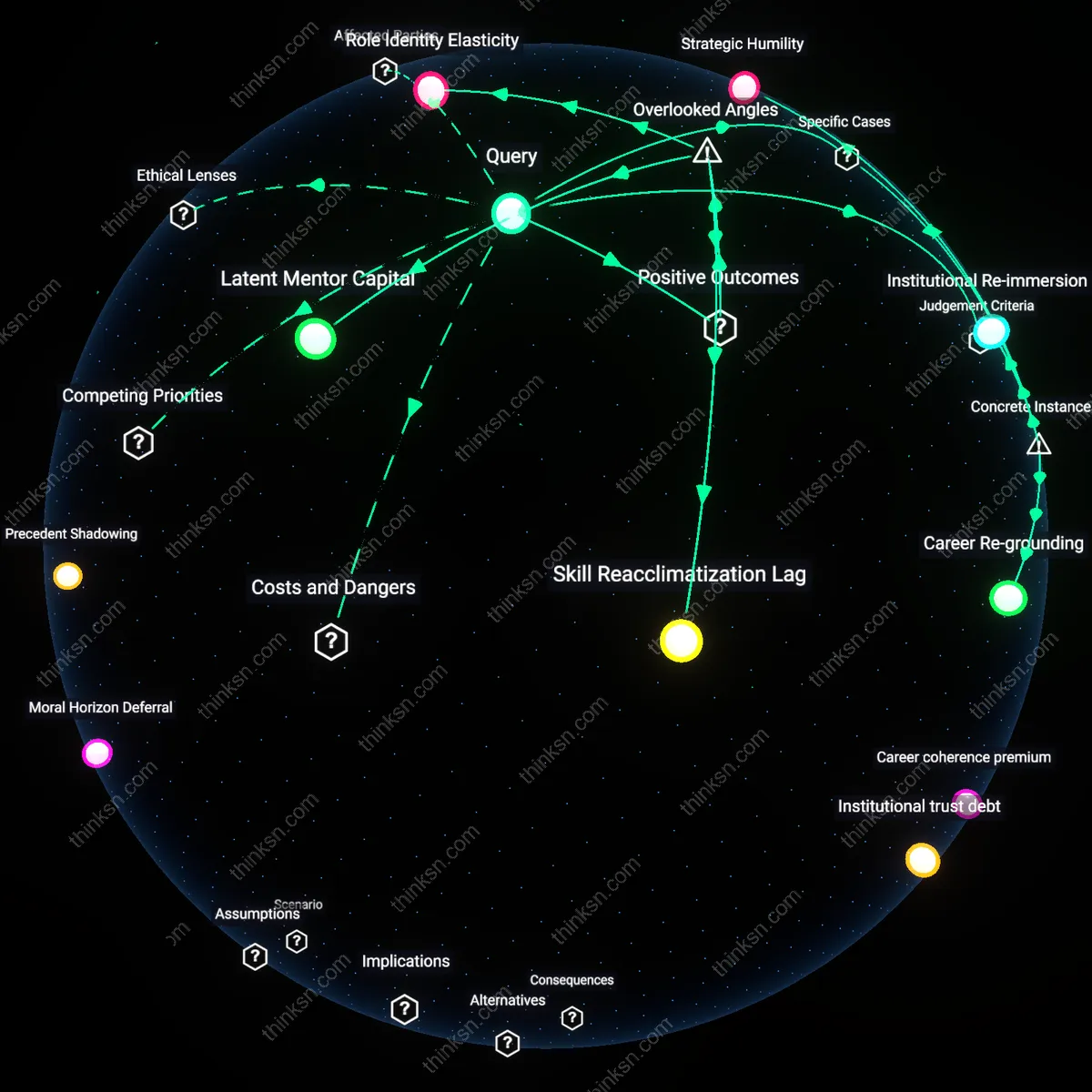
Analysis reveals 9 key thematic connections.
Key Findings
Career coherence premium
A temporary demotion can be justified if it realigns an individual’s role with their long-term professional identity, because sustained cognitive dissonance in misaligned roles erodes decision-making quality in knowledge-intensive sectors like tech or consulting; this loss is rarely priced into retirement calculations, yet it systematically degrades earning velocity over time, revealing that most financial planning models undervalue role coherence as a compounding asset.
Institutional trust debt
Accepting a temporary demotion to preserve relational capital within a stable organization can outweigh retirement account shortfalls, because in unionized or tenure-track environments like public education or defense contracting, long-term influence often flows through informal networks rather than formal rank; people overlook that demotions may reduce visible status while increasing access to backstage decision circuits that shape future opportunities.
Moral option value
A demotion is defensible when it prevents complicity in ethically hazardous outcomes, such as a senior engineer stepping back from overseeing unsafe AI deployment, because retaining personal integrity preserves the future ability to act decisively in high-stakes domains; this potential is invisible on balance sheets but becomes critical when societal trust collapses around entire industries, a risk standard compensation metrics fail to capture.
Skill Reacclimatization Lag
Accepting a temporary demotion accelerates skill reacclimatization to foundational operational rhythms, which most employees systematically underestimate during rapid upward mobility. In high-velocity career tracks—such as tech or finance—executives often lose touch with granular workflows, creating a hidden lag in adaptive responsiveness when down-market shifts occur; the demotion acts as a forced recalibration, re-immersing the individual in execution-level feedback loops that rebuild reflexive competence. This dimension is overlooked because career progression models assume skill accumulation is monotonic, yet the residual friction of relearning basics after prolonged abstraction creates latent vulnerability that a strategic demotion mitigates, enhancing long-term employability beyond retirement metrics.
Latent Mentor Capital
A temporary demotion generates latent mentor capital by repositioning the individual as an accessible peer-model within mid-tier teams, a role invisible to traditional advancement metrics but critical for organizational resilience. When high performers temporarily step down, they become conduits for informal knowledge transfer not captured in LMS platforms or structured training—especially in matrixed firms like multinational consultancies, where tacit coordination governs project success. This effect is typically ignored because HR analytics focus on upward mobility velocity, yet the residual influence of demoted experts quietly upgrading team capability density creates a stealth productivity dividend that outlasts their tenure.
Role Identity Elasticity
Voluntary temporary demotion strengthens role identity elasticity—the psychological capacity to navigate status fluctuations without performance degradation—particularly vital in industries undergoing digital disruption like publishing or energy. Employees who exercise this flexibility build reputational immunity to stigma, signaling adaptive loyalty rather than career distress, which alters peer and managerial perceptions in ways that open unconventional advancement paths later. This dynamic is routinely missed because compensation frameworks equate title with value, yet the unspoken organizational benefit lies in cultivating a cadre of leaders who can pivot across levels without morale collapse, effectively future-proofing human capital architecture.
Strategic Humility
A senior executive at General Electric voluntarily accepted a lateral-downward move to lead a struggling division during the early 2000s restructuring, sacrificing immediate pension accruals to rebuild credibility and operational literacy, thereby aligning with Jack Welch’s cultural mandate of accountability and hands-on leadership; this recalibration within GE’s performance-driven hierarchy enabled future C-suite positioning, revealing that temporary loss of status can function as a covert promotion pathway when tied to organizational ideology. The mechanism—cultural re-anchoring through visible self-correction—demonstrates how elite systems reward symbolic acts of humility when they reinforce systemic norms, even at actuarial cost.
Institutional Re-immersion
A tenured professor at the University of Chicago returned to a five-year associate-level position in a revamped interdisciplinary program in the late 2010s, accepting reduced retirement contributions to fully engage in curricular innovation and re-synchronize with emerging epistemic norms in data ethics; this demotion facilitated deep integration into a shifting scholarly ecosystem, allowing intellectual reinvention that later repositioned them as a field leader. The overlooked insight is that in knowledge-intensive institutions, proximity to emerging paradigms can outweigh seniority's financial protections when legitimacy depends on perceived relevance.
Career Re-grounding
In 2012, a partner at Goldman Sachs stepped into a junior risk oversight role during post-crisis regulatory reforms, accepting lower compensation and delayed retirement benefits to gain firsthand fluency in compliance architectures and restore internal trust after the Volcker Rule implementation; this move, while retrograde on paper, secured long-term influence by embedding the individual within a newly empowered governance apparatus. The counterintuitive logic here is that in post-scandal environments, downward mobility can serve as a stealth credentialing process, where re-earned legitimacy at a lower tier becomes a prerequisite for sustained authority.