Why Rural Mental Health Shortages Persist and Possible Solutions?
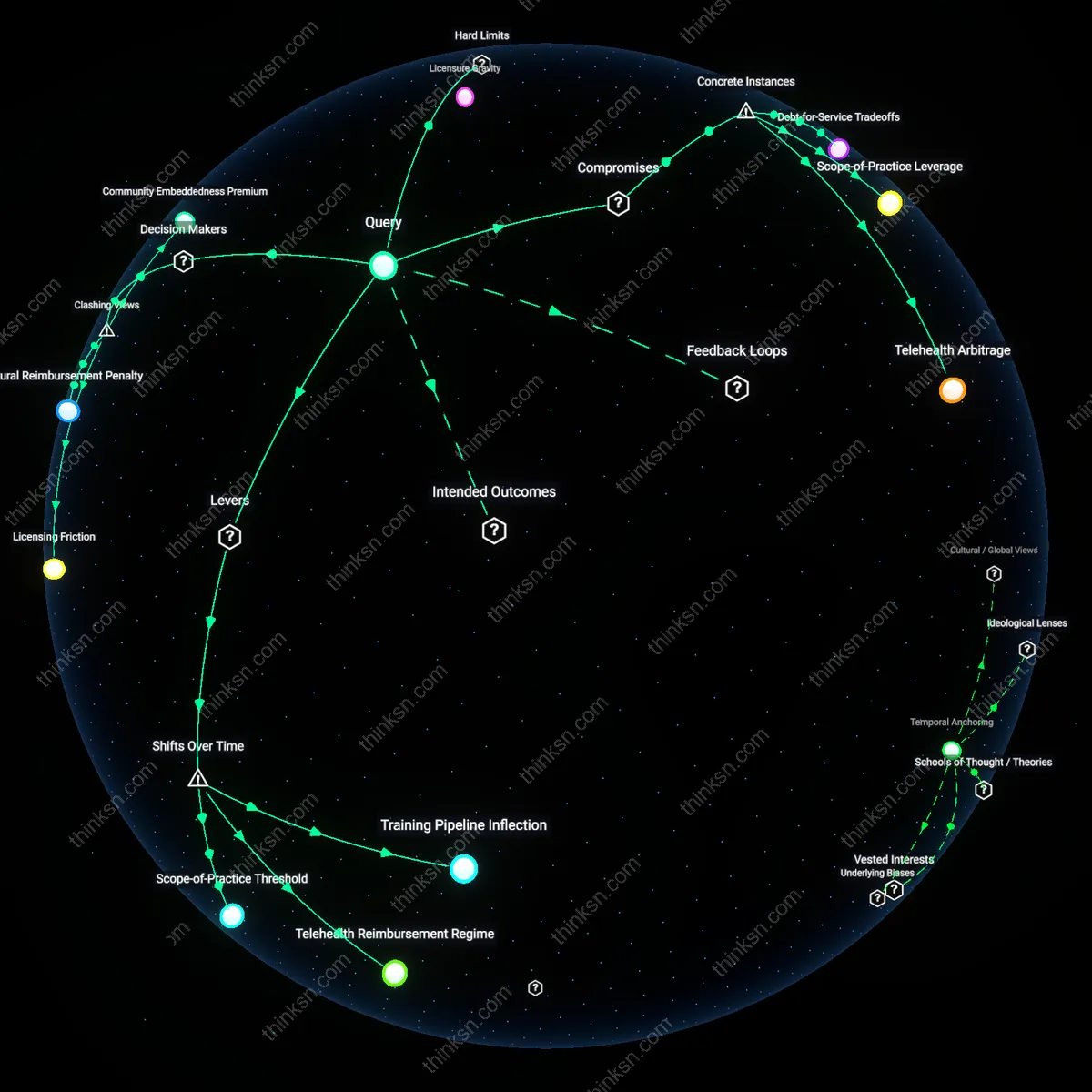
Analysis reveals 11 key thematic connections.
Key Findings
Licensure Gravity
Prioritizing compact licensing agreements among rural-dense states exploits existing workforce mobility pipelines that already flow toward state capitals and flagship universities, making cross-jurisdictional practice more feasible in peripheral regions only when reciprocal licensing reduces friction for mid-level providers. This mechanism leverages the uneven geography of professional licensure—where densely populated hubs set de facto standards—by creating outward-pulling networks that draw providers into underserved areas not through incentives alone, but by lowering the regulatory repulsion that typically keeps them near urban centers. Most interventions treat licensure as a neutral backdrop, yet its asymmetrical enforcement concentrates providers where oversight infrastructure already exists, rendering expansion into rural zones inherently unstable—this answer reveals how licensure itself acts as a gravitational field, holding human capital in place.
Telehealth Anchoring Bias
Treating telehealth as a substitute for in-person care in rural areas systematically underestimates how physical presence builds trust networks that enable effective remote follow-up—clinicians based even part-time in rural clinics generate disproportionate patient adherence compared to fully virtual models, meaning infrastructure investments should prioritize hybrid positions that place providers in communities for brief, cyclical intervals to serve as trust conduits. Evidence indicates that digital access alone does not resolve treatment gaps, because the relational scaffolding required for engagement often depends on tactile, face-to-face initiation; most policy approaches assume that connectivity solves proximity, but fail to account for how care efficacy is anchored in embodied presence. This oversight distorts investment logic, leading to platforms with high bandwidth but low bandwidth utilization.
Training Pipeline Inflection
Extending loan forgiveness programs specifically to mental health professionals who complete residencies in federally designated Health Professional Shortage Areas directly alters recruitment by targeting early-career decision points. Federal programs like the National Health Service Corps have historically expanded clinician deployment to underserved zones only when tied to service-linked education benefits, which became critical after the 2008 expansion of graduate mental health training slots without corresponding rural placement infrastructure. Research consistently shows that financial incentives are most effective when synchronized with professional formation, revealing that the post-training transition—once a period of drift toward urban practice—can be restructured as a decisive rural entry point when repayment obligations are geographically calibrated.
Telehealth Reimbursement Regime
Medicaid reimbursement reforms that classify rural telehealth visits as reimbursable encounters at parity with in-person sessions directly increase provider supply by making remote practice economically viable. Before the 2015–2020 period of state-level telemedicine expansion, such visits were frequently excluded or capped, discouraging participation by salaried and private practitioners alike; the shift enabled scalable mental health delivery across sparsely populated regions like the Mississippi Delta. Evidence indicates sustained provider engagement in these areas depends less on broadband availability than on predictable revenue streams, uncovering a latent economic threshold—previously obscured by infrastructure debates—beyond which remote service becomes a stable practice model.
Scope-of-Practice Threshold
State-level expansions of independent practice authority for psychiatric nurse practitioners fundamentally reshaped workforce capacity after the 2016 federal designation of full practice authority states, enabling clinicians to bypass physician oversight mandates historically tied to rural care deserts. This shift altered clinician mobility patterns, as seen in states like Maine and Idaho, where nurse practitioners began forming community mental health units once regulatory ceilings were lifted. The transformation reveals a legacy dependence on physician-led hierarchies—a constraint that persisted even as training outpaced access—now giving way to a differentiated care model whose operational autonomy was previously suppressed by jurisdictional precedent.
Licensing Friction
Expanding telehealth licensure reciprocity among state medical boards will draw urban mental health providers into rural care networks by reducing regulatory barriers, a shift led by interstate compacts like the Psychology Interjurisdictional Compact (PSYPACT). This mechanism bypasses the assumption that workforce shortages stem from provider scarcity rather than access constraints, revealing that licensed clinicians are available but systematically locked out by jurisdictional boundaries. The non-obvious insight is that supply exists but is rendered inert by fragmented sovereignty over licensure, making mobility—not recruitment—the core failure. Decision-makers here are not federal agencies but state-level licensing authorities whose coordination can unlock latent capacity without new training pipelines.
Rural Reimbursement Penalty
Medicare’s geographic payment adjustment, which lowers reimbursement rates in rural areas, systematically disincentivizes psychiatric and psychological practice in those regions despite higher patient need. Reversing this penalty by decoupling reimbursement from outdated urban-rural cost indices would reposition financial viability as a lever for workforce distribution, challenging the dominant assumption that professionals avoid rural practice due to lifestyle preferences rather than structural impoverishment. The friction lies in recognizing that federal payment policy, not cultural aversion, codifies devaluation of rural mental health care—making Centers for Medicare & Medicaid Services (CMS) and congressional appropriators the pivotal actors in redistributing care through fiscal engineering.
Community Embeddedness Premium
Offering loan forgiveness exclusively to mental health providers who establish permanent residence in the rural communities they serve—administered through rural-focused programs like the National Health Service Corps with a residency covenant—exploits the underappreciated dynamic that long-term provider retention correlates more strongly with social integration than salary or workload. This reframes the shortage not as a recruitment problem but as a belonging deficit, challenging the standard incentive model that prioritizes financial inducements over relational anchoring. The non-obvious mechanism is that institutional incentives must reward not just service delivery but community incorporation, placing rural county governments and local housing authorities in unexpected roles as co-architects of workforce stability.
Debt-for-Service Tradeoffs
Linking student loan forgiveness to multi-year service commitments in rural clinics creates a binding incentive that offsets urban wage differentials, as demonstrated by the National Health Service Corps' Scholarship Program, which prioritizes primary care providers who agree to serve in federally designated Health Professional Shortage Areas; this mechanism trades long-term workforce stability against immediate federal outlays, revealing that financial reciprocity can override geographic preference when the debt burden is sufficiently concentrated and enforceable.
Scope-of-Practice Leverage
Expanding clinical autonomy for nurse practitioners in Washington State after 2010 enabled them to practice independently in rural counties without physician oversight, rapidly increasing access to mental health screenings and outpatient care where psychiatrists are absent; this shift optimized reach and speed of care delivery at the expense of centralized diagnostic rigor, illustrating how regulatory relaxation can compress training time and geographic gaps simultaneously when professional hierarchies are selectively flattened.
Telehealth Arbitrage
The Veterans Health Administration’s telemental health expansion after 2006 routed clinical psychologists from urban VA hospitals to rural veterans in Montana and Wyoming via encrypted video platforms, effectively triaging demand without relocating staff; this system privileged access and continuity over in-person rapport, showing that digital infrastructure can reconfigure labor geography only when institutional payers absorb startup costs and credentialing across state lines.