Who Benefits from Life Insurance Jargon? Middle-Class Risks
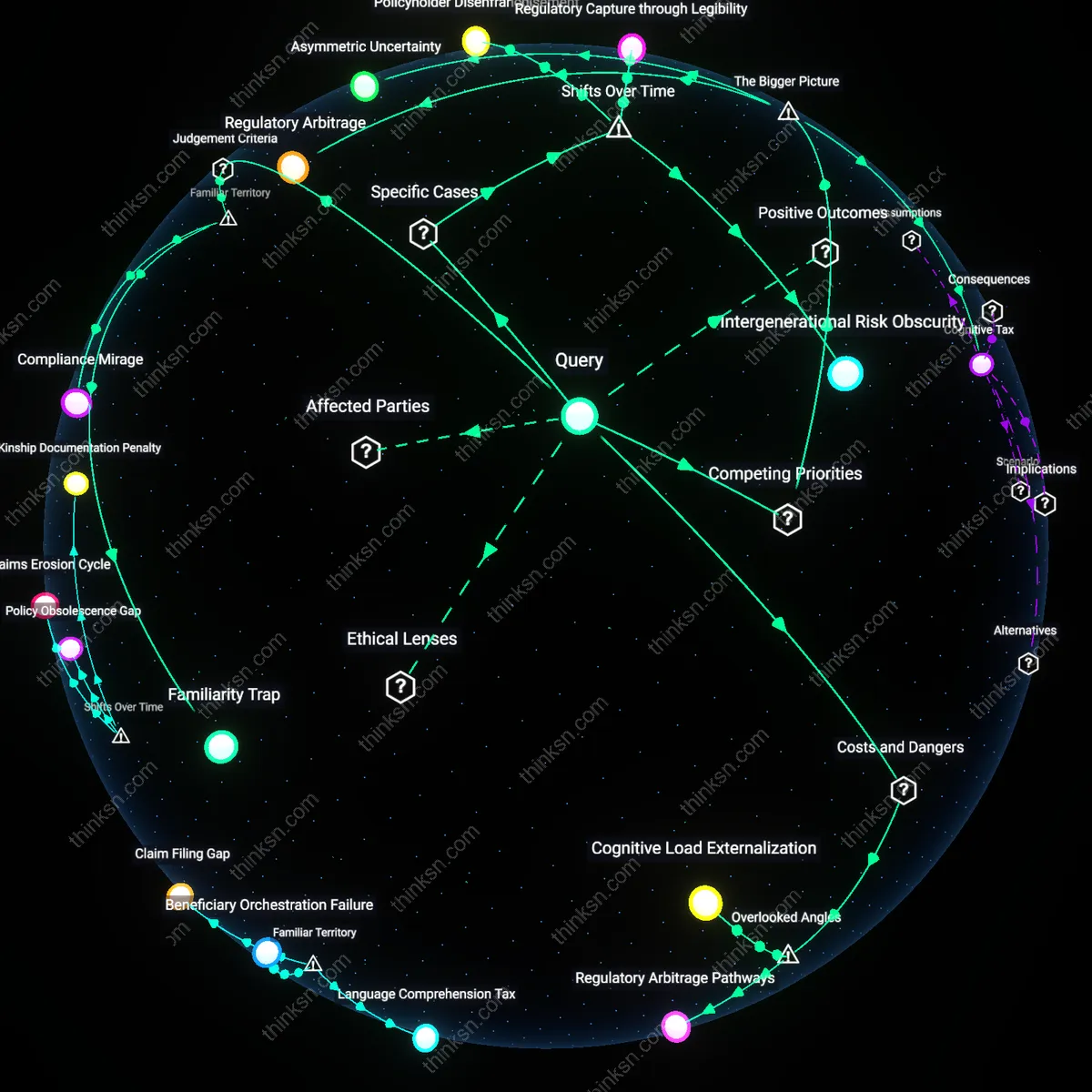
Analysis reveals 12 key thematic connections.
Key Findings
Insurer Advantage
Insurance companies benefit from complex language in life insurance policies because it reduces the likelihood of policyholders fully understanding exclusions, surrender charges, or claim limitations, allowing firms to minimize payouts while remaining compliant with disclosure requirements. This mechanism operates through contractual asymmetry—where legal precision favors the drafter—and is entrenched in state-level insurance regulation that permits broad interpretive discretion. The non-obvious element, despite public suspicion of 'fine print,' is that complexity is not a flaw but a functional feature of product design, engineered to preserve profit margins under the guise of regulatory adherence.
Familiarity Trap
Middle-class families mistakenly believe they understand their coverage because policy documents mimic the structure of familiar financial instruments like mortgages or auto insurance, creating a false sense of literacy. This illusion persists through the use of standardized forms and industry jargon that sound authoritative yet obscure key contingencies, such as beneficiary rules or mental health exclusions. The underappreciated reality is that the very resemblance to understood formats—like the 'benefits summary' or 'premium schedule'—acts as cognitive camouflage, making families less likely to seek independent advice or question inconsistencies.
Compliance Mirage
Regulatory agencies such as state insurance departments benefit politically by mandating disclosure without requiring comprehension, allowing them to claim oversight while tolerating opaque language that undermines informed consent. This dynamic satisfies the legal yardstick of procedural fairness—documents are 'available' and 'provided'—but fails the practical test of meaningful access, a gap that protects both insurers and regulators from liability. The overlooked insight is that compliance, in this context, becomes a ritual performance of transparency, where the act of disclosing complex terms substitutes for ensuring their understandability.
Regulatory Arbitrage Pathways
Insurance regulators benefit from the complexity of life insurance policies because it creates procedural opacity that shields them from political accountability when coverage failures occur. By allowing dense legal language to obscure enforceable obligations, agencies like state insurance departments can displace responsibility onto consumers or insurers during disputes, reducing their own institutional risk. This dynamic persists because regulatory metrics focus on solvency and fraud rather than clarity or comprehension, letting ambiguities accumulate without penalty. The overlooked reality is that complexity functions not just as a corporate shield but as a bureaucratic safety valve, preserving agency legitimacy at the cost of consumer certainty.
Cognitive Load Externalization
Actuarial consultants and product designers benefit from complex policy language by transferring the cognitive burden of interpretation onto middle-class families, who then absorb the mental labor of decoding coverage terms. This externalization allows firms to maintain high-margin products while shifting error costs—such as missed exclusions or misunderstood riders—onto households who lack legal or financial training. Most analyses frame complexity as intentional deception, but the deeper mechanism is a systemic offloading of decision fatigue onto the consumer level, where mistakes are privatized as personal failure rather than recognized as structural outcomes.
Intergenerational Risk Misalignment
Extended family members, particularly adult children managing aging parents’ policies, suffer hidden erosion of coverage certainty due to complex language that assumes a single, financially literate decision-maker. When original policyholders die or become incapacitated, heirs encounter unfamiliar terminology and conditional clauses that delay or deny intended benefits, fracturing wealth transfer plans. This disrupts middle-class estate continuity not through outright denial of claims but through procedural confusion during emotionally fragile transitions—revealing that policy complexity functions as a temporal trap, imposing its greatest costs not at purchase but at inheritance.
Regulatory Arbitrage
The complex language in life insurance policies primarily benefits insurance companies by enabling regulatory arbitrage, where ambiguous wording allows firms to comply with the letter of state insurance laws while subverting their intent. Insurers exploit inconsistencies across state-level regulatory frameworks—such as differing disclosure requirements in Texas versus New York—by drafting policies that appear compliant locally but systematically obscure payout conditions. This mechanism thrives on federalism’s fragmentation, where no national standard forces clarity, allowing industry actors to leverage legal complexity as a shield against accountability. The non-obvious impact is that regulatory decentralization, often praised for enabling policy experimentation, inadvertently authorizes obfuscation that erodes middle-class families’ certainty about when and how benefits are triggered.
Cognitive Tax
Middle-class families bear a disproportionate cognitive tax due to the complex language in life insurance policies, a burden that functions as a silent redistribution of decision-making power toward financial elites. Legalese and nested conditionals—such as exclusions buried in subsections referencing external riders—require legal or actuarial literacy to decode, capabilities that correlate strongly with income and education. This systemic exclusion operates through the normalization of inaccessible language in contracts, upheld by courts that enforce policy terms regardless of comprehension. The underappreciated consequence is that clarity is treated as a discretionary concession rather than a fiduciary obligation, making uncertainty a structurally enforced feature that insulates insurers from claims while placing middle-class policyholders in perpetual doubt about coverage validity.
Asymmetric Uncertainty
The ambiguity in life insurance policies institutionalizes asymmetric uncertainty, a condition that favors insurers by shifting risk evaluation onto policyholders while retaining unilateral interpretive authority. When events like suicide exclusions or pre-existing condition clauses are phrased conditionally—e.g., 'benefits void if death relates to a condition treated within five years prior'—insurers delay final interpretation until after a claim, long after the policy was purchased. This timing disparity is enabled by the claims adjudication process, in which insurance adjusters, not families or courts, initially determine coverage based on internal guidelines. The systemic dynamic lies in the lack of pre-claim legal recourse, which means middle-class families cannot test coverage certainty during the policy term, rendering their sense of security contingent on a future decision made by an adversarial party.
Policyholder Disenfranchisement
Insurers gained greater control over claims interpretation as standardized, densely worded life insurance contracts became dominant in the post-World War II expansion of suburban middle-class coverage, embedding ambiguity as a structural feature rather than a byproduct. This shift from personalized, agent-mediated policies in the early 20th century to uniform, legalistic documents after 1950 allowed carriers to exploit complex language during claim disputes, particularly around exclusions like suicide clauses or pre-existing conditions — mechanisms that are rarely challenged due to asymmetric legal resources. Evidence from state insurance department audits in New York and California reveals recurring enforcement actions against major carriers like MetLife and Prudential for downplaying material terms in policy language while promoting simplified summaries in sales materials, a practice that persists despite regulatory scrutiny. The non-obvious consequence is not merely confusion but a deliberate erosion of enforceability that benefits issuers at the moment of payout, precisely when middle-class families depend on certainty.
Regulatory Capture through Legibility
State insurance regulators increasingly deferred to actuarial rationale in the 1980s and 1990s, allowing the proliferation of complex riders and exclusions in policies as a condition of approving premium rates, thereby embedding convoluted language into the legitimacy of risk classification. As the National Association of Insurance Commissioners (NAIC) shifted from consumer protection toward actuarial harmonization during the financial deregulation wave, complex language became a proxy for technical necessity, shielding insurers from liability by framing obfuscation as professional rigor. Cases like the 1997 Texas Department of Insurance approval of tiered universal life products show how regulators accepted dense, conditional language as an inevitable part of underwriting sophistication, reducing their own oversight capacity. The shift from qualitative review to procedural compliance reveals how legibility to actuaries replaced clarity for policyholders as the standard, producing a regulatory environment where complexity is legitimized rather than curtailed.
Intergenerational Risk Obscurity
Middle-class families relying on life insurance as intergenerational wealth protection since the 1990s have encountered growing uncertainty as policies evolved to include investment components buried in complex terminology, transforming what appeared to be straightforward death benefits into volatile financial instruments. The rise of indexed and variable universal life policies sold through mass-market channels like MassMutual and State Farm tied cash value growth to opaque market indices and caps, terms rarely explained at point of sale but integral to long-term payout. Families in cities like Atlanta and Phoenix, where such products were heavily marketed in lieu of traditional whole life, discovered decades later that promised benefits were unattainable due to fee structures hidden in the language. The historical turn from static, guaranteed policies before 1980 to dynamic, condition-laden contracts reveals how linguistic complexity emerged not as an accident of legal drafting but as a mechanism to embed financial risk within domestic security — a shift that obscured permanence and predictability precisely when families expected continuity.