Should Mid-Career Pros Choose Partnership or Solo Success?
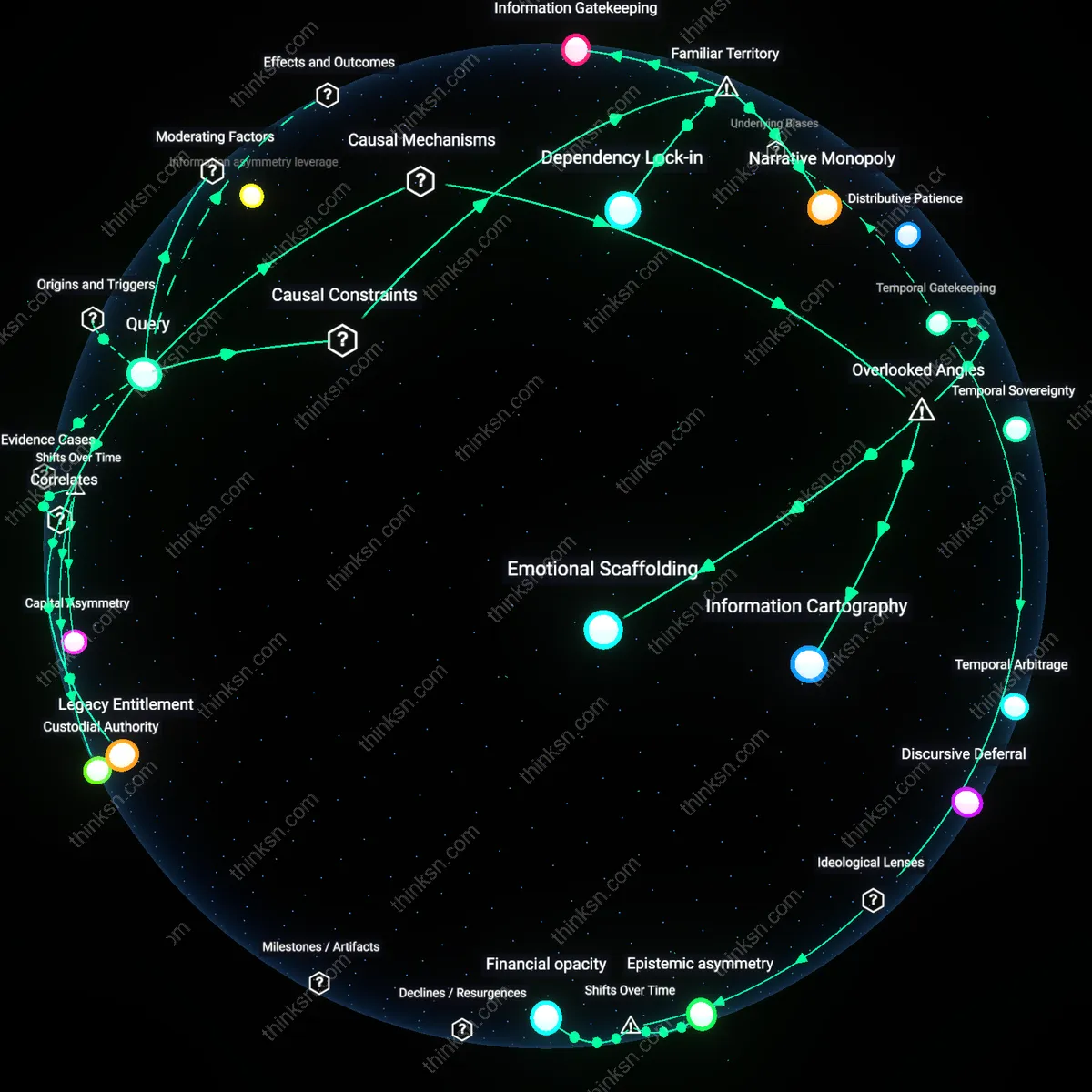
Analysis reveals 7 key thematic connections.
Key Findings
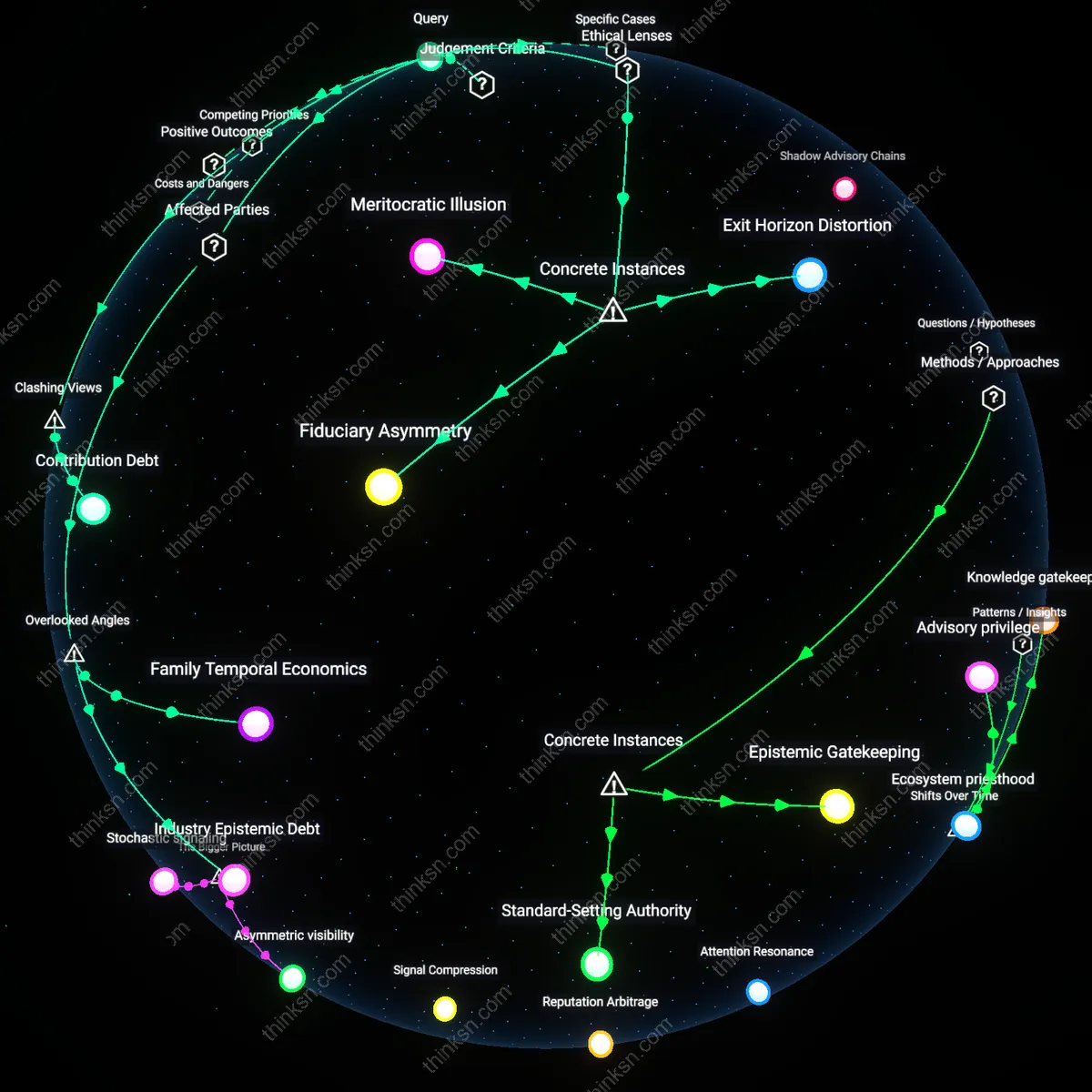
Family Temporal Economics
A mid-career professional should prioritize the asymmetry in household time allocation risks between co-founding and staying a senior IC, because the hidden burden of unstable income and erratic scheduling disproportionately affects partners and children in dual-income households with dependents. While standard analyses focus on personal risk tolerance, they overlook how the spillover of startup volatility reshapes domestic labor markets—specifically, who absorbs childcare disruptions or manages healthcare gaps during funding droughts. This dynamic transforms what appears to be an individual career choice into a family-wide temporal and economic renegotiation, where the co-founder’s time becomes socially illiquid while the senior IC retains predictable time sovereignty. The overlooked mechanism is that household resilience often depends not on total income but on the predictability of one partner’s temporal availability, which startups systematically erode.
Industry Epistemic Debt
Choosing between co-founding and deep technical specialization should account for the professional’s accumulated position within an industry’s knowledge commons, because transitioning to full-time entrepreneurship often severs access to the informal peer networks that generate cutting-edge domain insights. Senior ICs embedded in research labs or engineering teams benefit from continuous exposure to unsanitized problems and solution sketches that rarely appear in publications or conferences—what constitutes a form of unacknowledged epistemic infrastructure. The trade-off is not just title or equity, but gradual alienation from the cognitive currents that define technical leadership, which startups rarely replicate due to their inward-facing urgency. This dimension is overlooked because most framings assume knowledge flows equally in all high-level roles, when in practice, epistemic proximity decays rapidly outside sustained collaborative technical communities.
Investor Succession Pipeline
Mid-career professionals should evaluate how their visibility to angel and venture networks as a senior IC may offer a stealthier, lower-risk path to founding than immediate co-founding, because established individual contributors in high-leverage roles often become informal advisors to early-stage funds, thereby gaining backstage access to deal flow, mentorship, and investor trust without equity dilution or operational burnout. The unspoken advantage lies in being observed as a low-volatility, high-signal entity by capital allocators who later fund ventures—positioning the IC as a trusted founder when they eventually launch, rather than a speculative bet. This pathway is rarely discussed because it operates through social undercurrents of credibility transfer, not formal titles or equity stakes, making it invisible to conventional opportunity assessment frameworks.
Contribution Debt
Remaining a senior individual contributor in a high-leverage function like engineering or product design accumulates invisible organizational equity that founders rarely replicate, because their contributions are fungible across contexts while the IC’s value compounds through context-specific trust networks and system knowledge. Most market alternatives overlook this debt—a hidden accrual of credibility and operational access—because job evaluations focus on portable skills, not embeddedness, making external offers appear richer than they are. This reframes security not as a conservative choice but as the yield of irreplaceable situatedness, challenging the assumption that upward mobility requires structural risk. The counterintuitive insight is that staying increases optionality more reliably than leaving.
Fiduciary Asymmetry
A mid-career professional assessing the co-founder versus senior IC trade-off must recognize that fiduciary duties legally bind founders to prioritize enterprise survival over personal equity, as seen in the collapse of Theranos, where Elizabeth Holmes’ unchecked founder authority overrode ethical constraints and dissident expertise; this reveals that co-founder status concentrates decision rights in a way that structurally marginalizes individual contributors, even senior ones, because corporate law enables unilateral action under the business judgment rule—making the professional’s agency contingent on control, not competence, a dynamic rarely acknowledged when weighing prestige against influence.
Meritocratic Illusion
In the early scaling of GitHub, senior engineers like Max Howell retained deep technical influence without equity claims, illustrating that in high-trust, flat organizations, individual contributors can wield disproportionate shaping power over product and culture without assuming founder risk, a reality grounded in anarchist-inspired collaborative governance models that prioritize competence over ownership; this shows that remaining a senior IC may preserve ethical autonomy and reduce moral hazard, as the absence of equity pressure can insulate professionals from growth-at-all-costs mandates, a counterintuitive advantage rarely factored into career calculus dominated by capitalist accumulation logic.
Exit Horizon Distortion
When Whitney Wolfe Herd transitioned from VP at Tinder to founder of Bumble, she leveraged her domain-specific insight into workplace toxicity to build a company whose valuation hinged on ethical branding, demonstrating that co-founder roles enable alignment of personal ethics with institutional design in ways closed to even the most senior employees, as corporate personhood under U.S. commercial law grants founders unique capacity to embed social values into governance structures like Bumble’s women-first matching rule; this reveals that the founder path offers a temporally extended ethical agency—shaping norms over an exit horizon—that individual contribution, bounded by employer mandate, structurally cannot replicate.