Do Future Generations Consent to Our Infrastructure Choices?
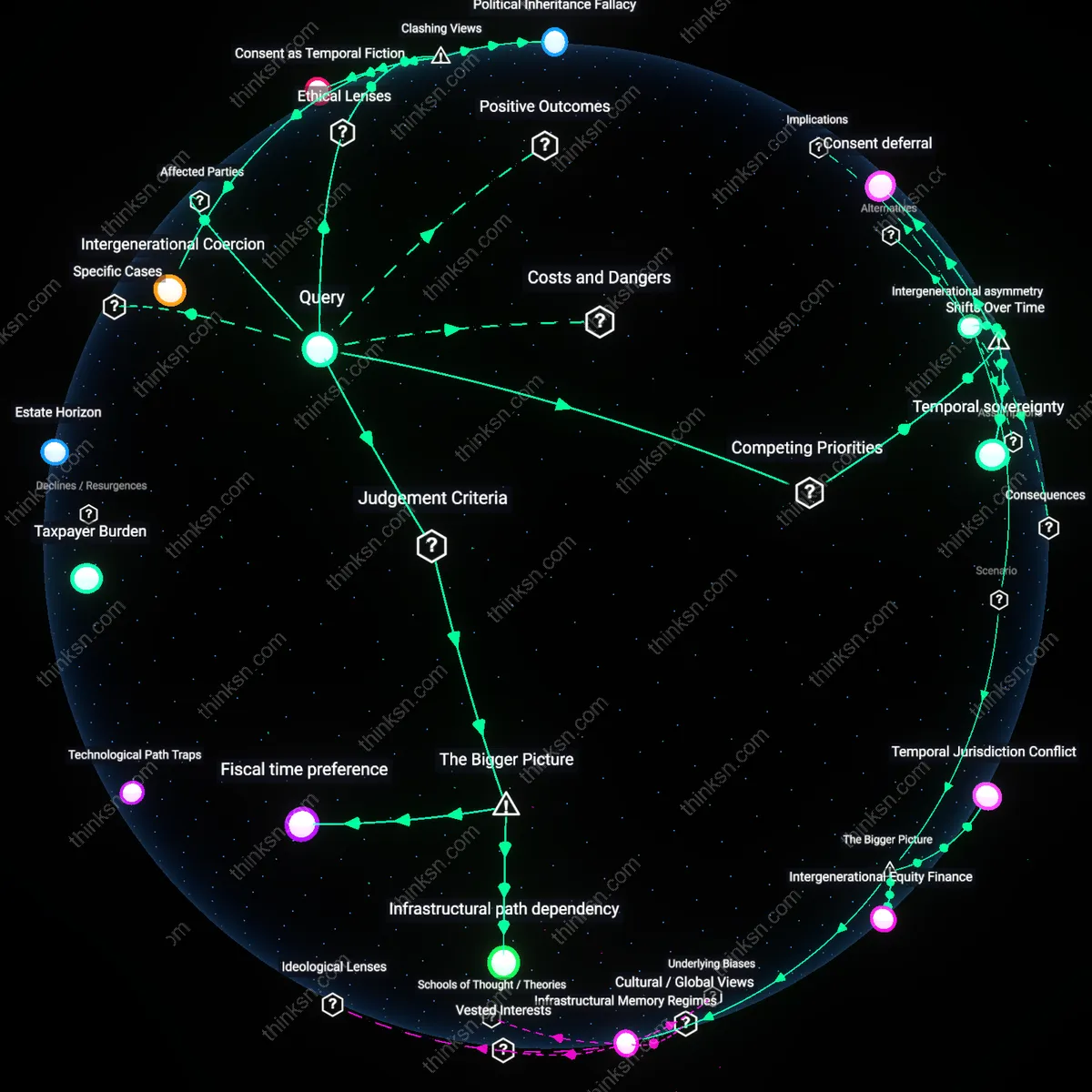
Analysis reveals 12 key thematic connections.
Key Findings
Taxpayer Burden
No, future generations do not meaningfully consent to current state infrastructure because they inherit financial obligations without choice. Citizens decades from now will pay for today’s high-speed rail or nuclear waste storage through taxes and reduced fiscal flexibility, enforced by the continuity of state debt mechanisms and intergenerational fiscal policy. The non-obvious reality beneath this familiar trade-off is that the state’s persistence functions not as consent but as compulsion—locking in economic liabilities that bind unrepresented populations. This reveals the taxpayer as a passive fiscal vessel, not a voluntary participant in political legacy projects.
Estate Horizon
Yes, the persistence of the state symbolically enrolls future citizens as heirs to collective infrastructure, much like inheriting property or national parks. Families raising children today anticipate their offspring will use bridges, schools, and broadband networks built now, and this shared expectation functions as passive civic enrollment through territorial belonging. The underappreciated dimension is that people intuitively accept intergenerational responsibility not via abstract consent, but through the lived continuity of place—where being 'from' a city or nation implies inheriting its built environment. This makes the idea of civic estate feel natural, even when it includes long-term debt or environmental cost.
Bureaucratic Inertia
No, because the justification confuses institutional survival with political legitimacy—agencies like the Army Corps of Engineers or state DOTs perpetuate projects across decades not due to future consent but because their operational logic rewards scale and permanence. These institutions secure funding, status, and mission continuity by initiating large, hard-to-reverse developments, and they use the rhetoric of intergenerational benefit to shield projects from scrutiny. What’s rarely acknowledged is that 'future generations' functions as a semantic placeholder that neutralizes dissent by appealing to an unseen, voiceless population, allowing entrenched planning cultures to operate without real-time accountability.
Intergenerational bargaining deficit
No, the claim is not convincing because it falsely presumes that future generations have a negotiable stake in present decisions, when in reality no enforceable bargaining mechanism exists between temporal cohorts; unlike contemporaneous stakeholders who can protest, litigate, or vote, future populations cannot signal preferences or impose accountability on current policymakers, rendering their 'consent' a rhetorical fiction rather than a political reality. This deficit is structurally embedded in democratic institutions that reward short-term electoral gains and discount long-term externalities, allowing present actors—elected officials, infrastructure lobbies, financial institutions—to externalize costs onto unborn populations without penalty. The non-obvious insight is that the persistence of the state does not constitute continuity of consent, but rather continuity of power asymmetry across time.
Infrastructural path dependency
No, the claim fails because large infrastructure projects lock societies into long-term technical and economic trajectories that constrain future autonomy, regardless of state continuity; once a high-speed rail corridor or nuclear waste repository is built, subsequent generations must maintain, adapt to, or dismantle it at great cost, effectively preempting their policy choices. This path dependency arises not from citizen agreement but from sunk-cost economics, institutional inertia, and vested interests like engineering consortia or energy utilities that benefit from maintaining the system. The underappreciated dynamic is that state persistence enables irreversible investments not because of intergenerational legitimacy, but because it grants incumbents the authority to reconfigure material landscapes in ways that later actors cannot easily reverse.
Fiscal time preference
No, because the justification confuses the state’s capacity to borrow against future revenues with a moral license to bind future will, when in fact the practice reflects a systemic economic bias toward present consumption financed by deferred liability; governments routinely fund infrastructure through long-term debt, effectively taxing future citizens who had no say in the spending decision, a transfer made possible by financial markets’ willingness to discount future income streams. This mechanism is driven by central banks, bond rating agencies, and fiscal rules that treat future economic growth as a monetizable asset, enabling current actors—treasury departments, contractors, legislators—to extract value from hypothetical future prosperity. The overlooked reality is that financializing future revenue creates a de facto transfer of political power from future communities to present creditors and decision-makers, masking exploitation as continuity.
Intergenerational asymmetry
No, the claim is not convincing because the state’s persistence creates a false equivalence between present political agency and future passive inheritance, where contemporary decision-makers impose irreversible ecological and financial burdens—such as nuclear waste storage or debt-financed transit systems—on populations who cannot resist or negotiate, a dynamic solidified since the postwar era of expansive welfare and infrastructure states, when planning horizons extended decades ahead without democratic extension to those affected. This shift from immediate communal reciprocity to long-term fiscal and environmental path dependency reveals how democratic legitimacy erodes across time, producing intergenerational asymmetry.
Consent deferral
No, the claim fails because large infrastructure projects lock in technical and bureaucratic infrastructures that later administrations must maintain, not because of imagined future consent but because abandonment would destabilize economic order, as seen after the neoliberal turn of the 1980s when privatization attempts faltered due to systemic reliance on existing energy and transport grids. The shift from discretionary public works to indispensable systems refracted the idea of consent into administrative inevitability, normalizing continuity not as choice but as survival, thus producing consent deferral.
Temporal sovereignty
Yes, the claim gains traction only in specific constitutional traditions, such as the German postwar model, where the concept of *Staatsverantwortung* (state responsibility) evolved to treat state continuity as a bearer of collective will, allowing long-term environmental and infrastructural decisions to be framed as binding across generations, particularly after the 1970s constitutionalization of future-oriented principles like intergenerational equity. This historical fusion of legal personhood with temporal endurance redefined sovereignty not as momentary popular expression but as a sustained juridical presence, establishing temporal sovereignty.
Intergenerational Coercion
No, the claim that future generations consent to current state actions via the state's persistence is not a convincing justification for large infrastructure projects because it conflates political continuity with moral authorization, treating the unrevoked existence of a legal order as implied assent. This justification relies on a Hobbesian conception of sovereignty in which the uninterrupted function of the state generates perpetual obligation, yet it erases the coercive temporality by which today’s policies bind unborn populations who cannot contest, amend, or opt out of decisions like long-term environmental degradation caused by megadams or nuclear waste storage. The non-obvious friction here is that legal endurance does not produce ethical legitimacy—instead, it masks a structural power asymmetry where future subjects are drafted into sacrifice zones through the bureaucratic inertia of present governance.
Consent as Temporal Fiction
No, because the idea that future generations consent through the persistence of the state is a performative illusion maintained by liberal legal formalism, which treats the state as a timeless juridical person despite radical shifts in population, values, and ecological conditions. This logic borrows from Locke’s theory of tacit consent but distorts it across generations, assuming that by inheriting a state structure, descendants passively approve of prior infrastructural impositions such as urban highways that displaced communities or fossil fuel dependencies locked in by energy grid expansions. The underappreciated reality is that consent becomes a retroactive narrative device—one that legal systems use to legitimize path dependency, not an actual mechanism of democratic will formation across time.
Political Inheritance Fallacy
No, because justifying today’s infrastructure by appealing to the state’s endurance mistakes institutional survival for normative continuity, a fallacy entrenched in conservative Hegelian views of the state as an ethical totality unfolding through history. This view assumes that because a nation persists, its successive populations inherit not just territory and laws but also an unbroken moral commitment to prior collective acts, such as colonial-era land seizures repurposed for modern high-speed rail. What remains hidden is that this rationale disables transformative justice—by framing current projects as fulfillment of an inherited mandate, it blocks repudiation of past harms and forecloses alternative futures that reject the very logic of extractive development embedded in earlier infrastructures.