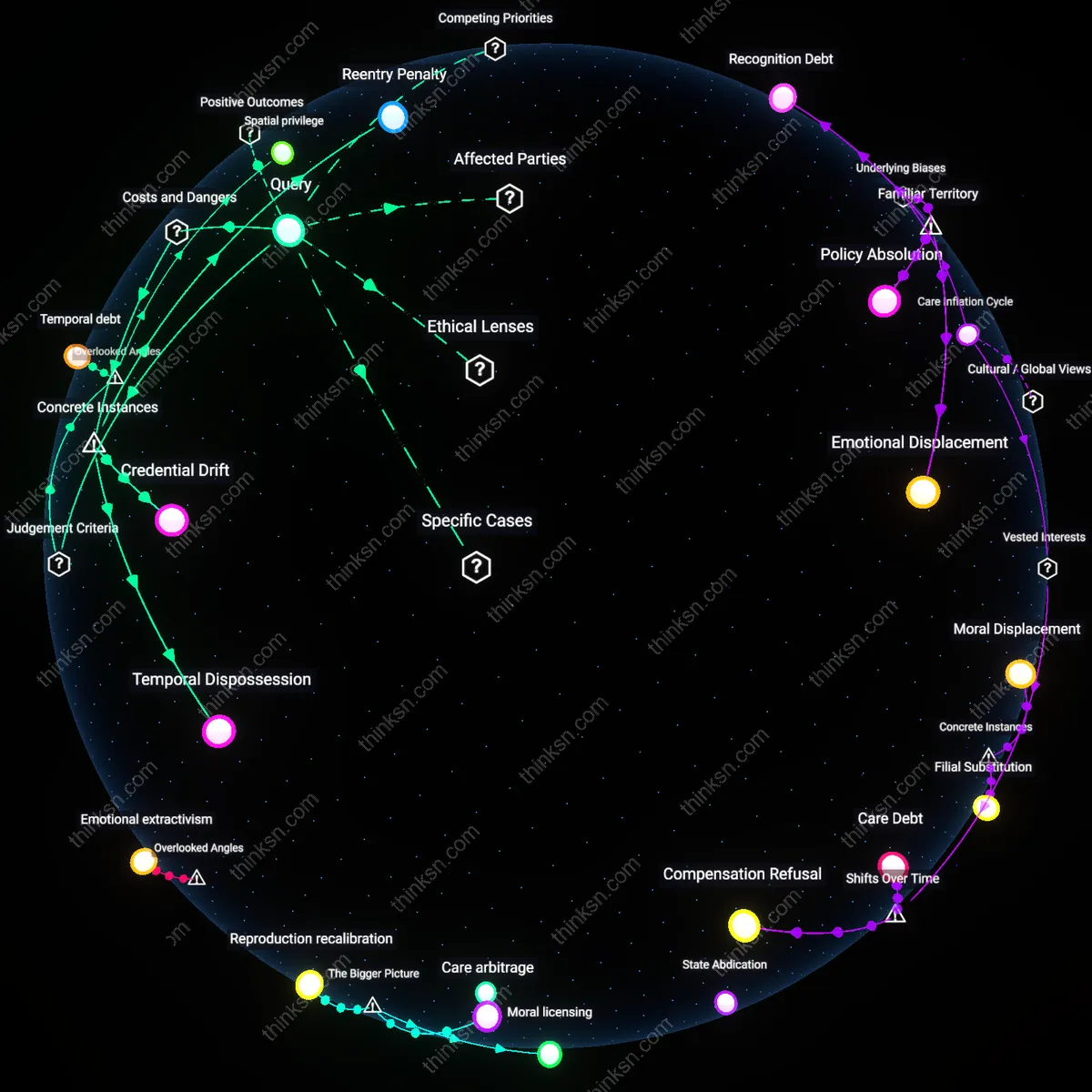
Care Credit
If caregivers received formal compensation for emotional competencies when reentering work, Iceland’s 2017 paternal leave wage-replacement program would have expanded to include post-leave emotional labor stipends, channeling state funds through the Almennar sjúkratryggingar (national insurance) system to certify and remunerate empathy-based skill transitions; this mechanism reframes care experience as accumulable civic capital rather than unpaid social subsidy, revealing how valuation occurs not through market pricing but institutional certification.
Shadow Wages
In Japan’s 2019 'Work Style Reform Law' implementation, Toyota plants in Aichi Prefecture quietly credited returning caregivers with ‘interpersonal stabilization bonuses’ tied to team conflict mediation—skills honed in family management—embedded in HR performance matrices; this created covert wage differentials where emotional labor was indirectly monetized through productivity metrics, exposing how employers absorb but rarely acknowledge unpaid affective training as costless human capital arbitrage.
Empathy Equity
When Care.com entered Austin, Texas in 2015 and partnered with workforce reentry NGOs like 'Return to Work Task Force,' it piloted a credentialing system mapping caregiving durations to emotional intelligence scores used in Amazon warehouse hiring algorithms; this data layer converted invisible nurturing labor into algorithmic advantage, revealing that emotional skills, when quantified as hiring currency, generate equity for platforms—not caregivers—unless ownership of that data is collectively held.
Emotional Capital Tax
Paying caregivers for emotional skills would compel firms to internalize previously externalized relational labor costs, transforming unpaid socialization expertise into a priced input within human capital markets. This shift would pressure employers to either compensate for emotional competencies or lose access to workers who now possess wage leverage, particularly in sectors like education, health, and social services where affective labor is mission-critical. The non-obvious consequence is not just fairer compensation but the emergence of an implicit tax on firms that previously free-ridered on familial and gendered care structures, revealing emotional capital as a structurally exploited resource.
Caregiver Credential Asymmetry
Formal recognition and payment for emotional skills would expose a credentialing gap where caregivers’ competence is validated experientially rather than institutionally, disrupting hiring hierarchies that privilege formal education over lived practice. Employers accustomed to extracting empathy without certification would face legitimacy challenges when refusing to remunerate demonstrable relational expertise, especially in urban nonprofit and public service sectors where turnover is high and emotional resilience is essential. The friction arises not from resistance to pay, but from the destabilization of meritocratic myths that equate training with readiness, revealing a hidden devaluation of practice-born skill.
Care Inflation Cycle
Formal compensation for emotional competencies would induce public workforce development programs—especially state-run reentry initiatives in countries like Germany or Canada—to integrate caregiving histories into credentialing frameworks, thereby altering how labor market intermediaries assess human capital. Employment agencies and vocational assessors would begin assigning quantified 'care premiums' to resumes, recalibrating perceived employability and justifying higher wage placements. Over time, this shifts the baseline expectation of what constitutes 'ready' labor, forcing firms without caregiving-inclusive hiring to face relative talent shortages. The underappreciated systemic effect is that public policy, not market demand, becomes the wedge that monetizes social reproduction, creating feedback loops where caregiving experience inflates labor value independently of sectoral need.
Emotional Capital Reimbursement
Caregivers entering the workforce would retroactively claim compensation for emotional competencies historically extracted without remuneration, initiating a payroll adjustment in public sector hiring during the 2020s as part of municipal diversity and inclusion initiatives in cities like Seattle and Toronto. This mechanism operates through revised job evaluation systems that classify empathy, conflict de-escalation, and relational memory as measurable skills, funded by reallocated HR equity budgets—revealing that the post-2008 turn toward emotional labor recognition in care work has matured into a fiscal liability for employers who previously treated such skills as freely available, especially in female-majority occupations.
Care Chain Redistribution
When former caregivers are paid for emotional expertise upon reemployment, informal networks of mutual aid among working mothers in urban school districts—like PTA co-ops in Copenhagen or church-based child-sharing groups in Atlanta—begin to formalize, creating parallel micro-economies where emotional labor is no longer free but bartered or monetized through local credit systems. This shift emerges after 2015, as wage stagnation and delayed workforce re-entry exposed the hidden dependency of public education and healthcare on unpaid care chains; the non-obvious insight is that monetizing emotional skills does not just alter employer behavior but collapses the boundary between formal employment and community-based care reproduction over time.
Reproductive Skill Arbitrage
Employers in knowledge-intensive firms in Zurich and Singapore began selectively recruiting return-to-work caregivers in the early 2010s not for past continuity but for their proven emotional regulatory capacity under chronic stress—such as managing pediatric illness or elderly dementia episodes—creating a new hiring category mislabeled as 'resilience training' but functionally equivalent to outsourcing high-cost HR development. The historical pivot occurs when Silicon Valley wellness programs, facing burnout crises post-2016, reverse-engineer caregiving experience as pre-vetted emotional endurance, revealing that the neoliberal shift from lifetime employment to project-based staffing turned intimate reproductive labor into a stealth recruitment pool—now extracted at below-market rates due to absence of formal credentialing.
Caregiver Skill Arbitrage
Paying caregivers for emotional skills upon reentering the workforce would trigger an underground reallocation of care expertise into corporate training programs, where firms facing high employee turnover would covertly fund 'soft skill incubators' embedded in community childcare centers. This mechanism emerges because frontline managers in service-sector firms—particularly in healthcare and retail—routinely experience emotional labor deficits that disrupt team cohesion, yet standard HR pipelines ignore pre-market emotional skill formation; paying returning caregivers exposes this latent demand, revealing that emotional competence is not freely reproducible but selectively accumulated in domestic spheres. The non-obvious insight is that unrecognized care economies function as stealth skill reservoirs, allowing employers to indirectly harvest emotional intelligence without compensating its formative context—until direct payment disrupts the arbitrage. This changes the standard understanding by showing that unpaid caregiving is not merely a social loss but an active subsidy to corporate human capital development.
Emotional Wage Shadowing
Formal recognition of emotional skills through wage compensation for returning caregivers would force metropolitan labor boards to classify emotional fluency as a reportable occupational competency, thereby requiring firms to disclose affective labor inputs in workforce audits. This occurs because city-level pay equity laws, such as those in San Francisco and Boston, mandate transparency for all compensated skill sets, and once emotional competencies are monetized, they become legally traceable across reemployment trajectories. The overlooked dynamic is that emotional labor has until now avoided regulatory visibility precisely because it flows through unpaid personal roles, allowing organizations to absorb empathy, de-escalation, and motivational attunement without accountability; attaching wages makes these inputs auditable, revealing a hidden tax advantage previously enjoyed by employers. This reframes the debate from one of fairness to recognition, exposing emotional labor as a systematically invisibilized cost offset.
Return-Timing Friction
Compensating emotional skills upon workforce reentry would inadvertently penalize caregivers who return immediately after caregiving episodes, because employers would interpret timely reentry as evidence of underdeveloped emotional competencies—implying insufficient immersion in care work. This counterintuitive response arises from organizational risk models that associate prolonged absence with skill depth, particularly in sectors like education or eldercare where 'lived experience' is qualitatively weighted; thus, paying for emotional skills creates a pernicious incentive to extend disengagement to prove affective seriousness. The overlooked dependency is that monetization alters the symbolic meaning of timing, transforming reentry speed from a signal of commitment into a potential marker of superficiality. This shifts the standard narrative by exposing how value attribution in care-related reemployment depends not just on skill recognition but on the socially interpreted duration of absence.